
We shall now examine the method of guidance that has especially been adopted in the literary work ‘Manache Shloka’, composed by Samartha Ramdas Swami. Through this Article, we shall study the distinctive features of these Shloka from the perspectives of Modern Neuroscience and Psychology.
In Part 1 of this Article, we read about the origin of Manache Shloka and the types of principles contained in them. Read Part 2 here.

A1. Melody reduces stress in the brain : The main principle is that recitation in the Bhujangaprayat Vrutta reduces stress in the brain because of its melody; this has become clear from the perspective of Neuroscience, which explains that the melody stimulates a specific part of the brain. The messages transmitted from the sensations thus generated to various parts of the brain undergo a qualitative change, resulting in a reduction of stress. In short, if reciting Manache Shloka makes one feel good, one reason is biological in nature. Where the cause-and-effect relationship is biological, its usefulness does not remain merely individual-specific. For example, a medicine that relieves stress does not distinguish whether the individual is male or female, fair or dark. Its effect on the brain remains broadly the same.

A2. Due to rhythm, the teaching gets ingrained easily in a verse form : Because of its melody, the likelihood of a statement being hummed repeatedly and memorised increases. All 205 verses in Manache Shloka are composed in this Vrutta. There is another benefit of melody. Generally, when we read or hear some lines in prose, the process in the brain proceeds gradually – understanding its meaning, grasping its import, and over time it becomes ingrained in the mind. However, when some lines are recited or heard in verse form with good rhythm, it begins to move directly towards getting ingrained, bypassing the intermediate stages. Its meaning then unfolds later according to each person’s understanding.
Thus, the process caused by melody is beneficial. What is good is first absorbed within. Many people may not know every word of a famous song; yet, its tune remains in their minds. The reason is that rhythm often has a greater effect than the literal meaning. Of course, it is better if the words and their exact meanings are also clearly known.
A3. In the Bhujangaprayat Vrutta, pauses occur at fixed intervals. This creates rhythm. Rhythmic recitation stimulates the vagus nerve, due to which the heart rate remains regulated and calmness is obtained. Because of rhythmic recitation, the breathing rate automatically becomes slow and rhythmic, which has a positive effect on the nervous system.
B. Addressing the mind is an important feature of Manache Shloka
One feature of Manache Shloka anyone will notice is that they are addressed to the mind, not to any individual. They say ‘Re mana’ (O’ mind), not ‘Janaho’ (O’ people). This distinction is intended here. When an individual recites them, he is addressing his own mind in a specific way. Bringing about change in the mind by clearly addressing it in a detached manner is itself a technique. This technique is studied in Modern Psychology. Let us now look at Manache Shloka from that perspective.

B1. The cognitive diffusion technique that creates distance between ‘I’ and ‘my mind’ : Modern Psychology says that by creating distance between ‘I’ and ‘my mind’, changes the way problems are experienced. A major reason for the increase in stress and anxiety today is that we completely identify ourselves with our thoughts. For example, while saying, ‘I am afraid’, we become one with fear. When the same thought is addressed to the mind, the environment (sensations) in the brain changes. In Psychology, this is called the Solomon paradox. We are often more skilled at advising others than at solving our own problems. When we say ‘Re mana’, we begin to regard ourselves as the other individual. As a result, our brain moves into an advisory role. When one says, ‘I am feeling afraid’, the brain’s fear or stress centre (the amygdala) becomes more active. However, when one addresses the mind as ‘Re mana’, it is as though one is speaking to someone else.
If stated in prose, it would be : ‘O’ mind ! Why are you afraid ?’ When this is done, the brain’s pre-frontal cortex (the reasoning part) becomes active. This part calms the brain’s fear centre. In one experiment, a researcher observed that the blood pressure and stress levels of people who spoke to themselves using their own name or ‘you’ were lower than those who kept saying ‘I’.
It is in this context that Manache Shloka stand apart from other familiar religious Texts. They treat the mind as ‘other’ and engage in dialogue with it. When we call out to the mind as ‘mana’, our brain becomes detached from those thoughts, and instead of becoming slaves to them, we become witnesses to them. We separate ourselves from fear. In Modern Psychology, this is called Cognitive diffusion.
On the other hand, in Vedanta it is philosophically stated as truth that the Manomaya kosha (the mind) is not the true ‘I’; this should also be noted. No matter by which Path a seeker performs sadhana, ultimately this is what he has to attain. Of course, this explanation is not intended to belittle other religious Texts, but only to point out the distinction. Each literary work has its own place from the perspective of sadhana, and all are important. Even taking the example of Samartha’s own writings, the importance of Dasbodh (philosophical treaties on Vedanta and spiritual practice) for a seeker is different, and that of Manache Shloka is different. For a seeker, Dasbodh is essential for better understanding Manache Shloka or some of its principle-oriented sections.
B2. Being able to observe thoughts without being carried away by them : Many times, distressing incidents from the past and the people connected with them leave a kind of sanskar (Impression) on the brain (mind). As a result, even a slight trigger related to them can give rise to reactive thoughts. Sometimes, even when seemingly nothing directly connected with that incident has happened, painful thoughts arise, the mental pain is reawakened, emotional waves surge through the body, and the mind gets carried away by those emotions and the subsequent thoughts arising from them.
To explain in simple language, being carried away by thoughts (fusion) means accepting all such thoughts as truth exactly as they appear. On the other hand, observing thoughts (diffusion) means regarding them merely as data in the brain.
Being carried away increases the momentum of emotions and often leads the individual to act incorrectly (for example, shouting in a fit of anger). When one observes thoughts, one only becomes aware of the anger; however, one is then able to decide what action should be taken. This makes it easier to cultivate the quality of discrimination. For example, when the thought arises, ‘Because that person deceived me, I am a failure,’ one generally gets carried away by that thought. However, Manache Shloka teach us, ‘This thought is not me; it is merely an image created by my mind’. Wherever Manache Shloka say ‘Nako re mana’ (O’ mind, do not …), the mind is cautioned at that very point against moving in an improper direction as soon as an inappropriate thought arises. The mind distances itself from improper emotions. Each Shloka, through the topic discussed, pauses the mind and makes it see what it should not desire. When thoughts are observed in a detached manner, their grip over oneself gradually loosens. One is then able to reflect upon what is right and wrong and act accordingly.
All these aspects can be better understood through the table given ahead.
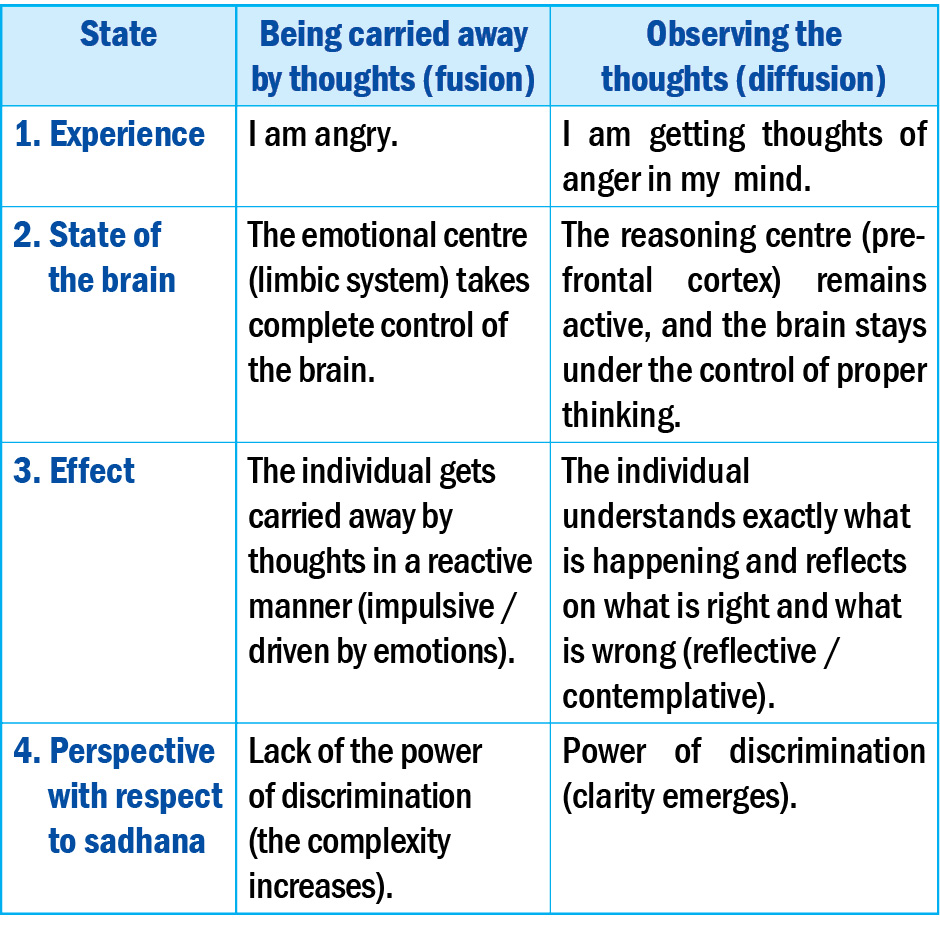
When an individual, through such a process, tells oneself what is right and what is wrong, Modern Psychology calls it ‘distanced self-talk’. Through expressions such as ‘re mana’ or ‘nako mana’, Manache Shloka achieves precisely this process.
C. Reining in the brain’s reward system that moves in the wrong direction
Many Texts instruct how an individual should behave properly. Such guidance is often philosophical in nature. However, the effect of such philosophical statements and the effect of presenting the same points through the method of Manache Shloka are different. For example, general philosophy says, ‘Greed for wealth is bad.’ Here, the intellect merely understands this as information. At most, it leads to reflection. Further thoughts may continue regarding what constitutes greed and non-greed; however, such an approach does not easily change behaviour or the old habitual movement of the mind. It remains, in a sense, passive. Why does this happen ? According to Modern Neuroscience, this is due to the functioning of the dopamine loop.
C1. What is the dopamine loop ? : According to neuroscience, greed arises because of the dopamine loop. Dopamine is a neurochemical produced in the brain. The greater the amount produced, the better one feels. Thus, on seeing an object, one feels pleasure. Because of prior experiences associated with that object, some dopamine has already been generated in the brain. Even merely thinking of that object again causes dopamine to be produced afresh. As a result, one begins to desire that object. If the object is not obtained, the expected rise in dopamine is obstructed, which increases discomfort. On the other hand, even the attempt to obtain it-or merely fantasising about it-can increase dopamine production. This becomes a kind of self-reinforcing cycle. This may be termed the brain’s reward system. If greed towards external objects is not restrained, it causes harm both in sadhana and in ordinary life. The beneficial effect produced by Manache Shloka in this regard (explain the harm caused) is far greater than what can be achieved merely by explaining the matter in plain prose.
For example, the moment a thought such as ‘greed for another person’s wealth’ arises, the brain’s activity begins moving in that direction. One may perhaps tell oneself in prose that taking another’s wealth is wrong for various reasons; however, this is not always easily accepted. One keeps finding loopholes.
This has been expressed in Manache Shloka as : ‘Nako re mana dravya te pudhilanche.’ (Manache Shloka 9)
Meaning : O’ mind, do not desire another person’s wealth.
Here, instead of merely reasoning with the intellect, an attempt is made to directly discipline the mind itself. This occurs comparatively more easily because, as explained earlier, a distance is created between the ‘I’ and the mind, enabling detached guidance. The mind then actively tries to remain aligned in the proper direction. Right at the very beginning, the Shloka instructs the mind : ‘It is wrong to desire another’s possessions’ This helps control the wrongly activated reward system in the brain.
D. Memorisation increases the brain’s plasticity (neuroplasticity)
One is advised to memorise Manache Shloka. By doing so, the mind gradually becomes increasingly aligned with the thoughts contained in them. This is because repeatedly reciting the Shloka produces a special effect on the brain. The neural connections through which brain cells exchange signals with one another begin to change, and through repeated memorisation they become stronger. This is termed neuroplasticity. As soon as the relevant thought or situation arises, the brain begins functioning automatically, without conscious effort, in a manner aligned with the thoughts given in the Shloka. The attempt to prevent the brain from moving towards incorrect actions then happens naturally and effortlessly. As a result, the tendency of the mind to become distracted from sadhana decreases.
E. Creating a safe space for fear instead of allowing the brain to be hijacked by it
When a situation generates fear, it generally affects the brain in such a way that all mental activity begins moving in that direction. This is called the brain being ‘hijacked’. If fear arises for some reason, the solution lies in creating a sense of safety within the mind. Usually, the mind is counselled externally through thoughts such as : ‘Why this fear is unfounded’ or ‘Even if it happens, this can be done.’ This means that an alternative thought is externally supplied. Even then, it remains a process in which the thought of fear and the accompanying emotion are countered through deliberate effort by a thought of safety. All this takes place at the level of intellect and logic. There is no immediate remedy at the very moment fear arises, nor is there an effective restraint upon the emotional energy that intensifies that fearful thought. Therefore, the fear still exerts some influence over the brain and produces harmful effects.
The technique of Manache Shloka handles this problem differently. At that very moment, the mind immediately receives the support of Raghav (Shriram). The mind experiences a sense of security, and the impact of fear diminishes. In psychology, this is known as attachment theory. When the mind is connected with a powerful and loving support (such as Shriram), the centres of fear in the brain become calm. The important message to note here is that it is not merely a matter of saying, give up fear. Rather, an alternative mental refuge is created for the brain to dispel fear.
Certain Shloka conclude with principles such as :
- ‘Nupekshi kada Ramdasabhimani (Shriram never ignores the devotee who is devoted to Him with humility and surrender.)’
- ‘Nupekshi kada Dev bhaktabhimani (God never neglects the devotee who is devoted to Him)’
- ‘Mana sajjana Raghavi vasti kije (‘O’ noble mind ! Let yourself dwell in Shriram.’)’
Please refer to those Shlokas.
– Dr Durgesh Samant (Age 65), M.D. (Medicine), Sanatan Ashram, Ramnathi, Goa. (24.3.2026)
 Nehruji’s Selection by Gandhiji for Congress Presidentship Again and Again
 Radiant Thoughts of Sachchidananda Parabrahman (Dr) Jayant Athavale
 We pay our obeisance a million times on the Birthday (as per Tithi) of
 Major win for Hindu unity : Maharashtra Government suspends the controversial ‘Devasthan Inam Abolition Draft Act’
 Amazon Insults Aryabhata : Hindu Janajagruti Samiti serves legal notice
 Murtis of Hindu Deities found in the basement of Jama Masjid in Bharuch (Gujarat)