
‘Manache Shloka’ that addresses directly to the mind
1. Origin of the Shlokas
One year, due to some reason, the provisions usually sent by Chhatrapati Shivaji Maharaj for the festival of Shriram Navami at Sajjangad fort (near Satara, India) could not arrive. Only 7 days were left for the festival. The people responsible for organising it on the fort became anxious. They informed Samartha Ramdas Swami (1608-1681) about the situation. He immediately penned 205 Shlokas (in Marathi) and said, ‘Go into society, stand in front of each house and recite these. Bring whatever alms you receive’.

Accordingly, everyone went in different directions. Within a short time, sufficient provisions were collected. The festival was conducted as usual. These Shlokas are called Manache Shloka (Dialogue with the mind)’ ! However, the main objective of this Article is not to narrate how did these Shlokas originated. We shall examine the method of imparting guidance adopted in this literary work.
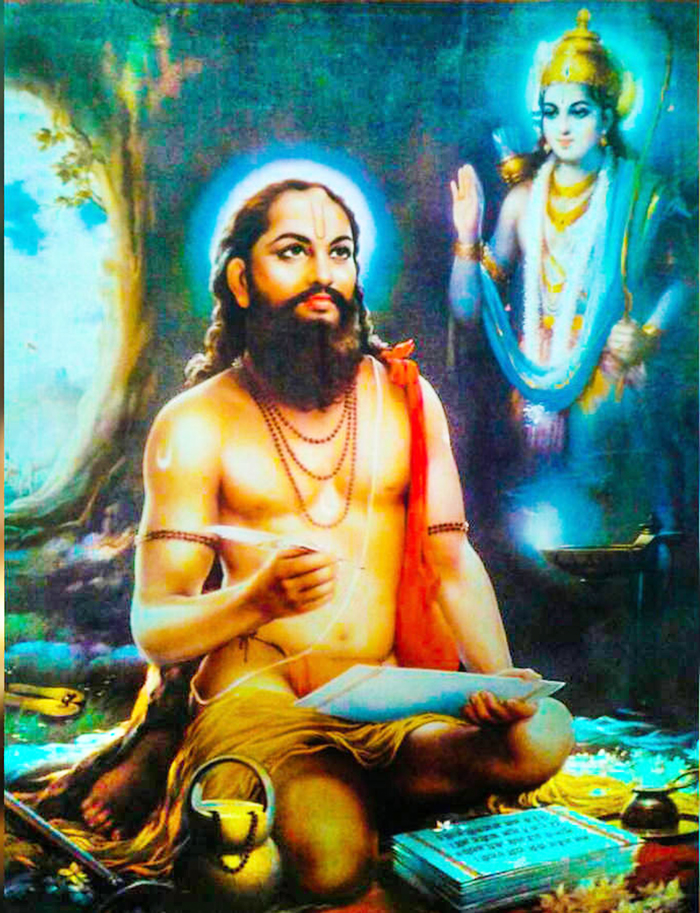
A. Two prominent characteristics of Manache Shloka : Even if someone has not recited all the Manache Shlokas, but has recited at least a few, two characteristics become evident. One is their lyrical nature, and the other is that they are addressed directly to the mind of the reciter as well as the listener. We shall study these characteristics from the perspective of neuroscience and psychology.
B. Reason for studying from the perspective of science : Some may feel that the purpose of this study is to prove that our ancient Scriptures and teachings stand the test of science, or to demonstrate how great Samartha Ramdas Swami was. This is not the author’s intention. For the author, the greatness of Manache Shloka, as well as the writings of Saints such as Sant Dnyaneshwar Maharaj, Sant Tukaram Maharaj, and literature such as the Shrimadbhagawadgeeta and the Upanishads, has already been established by time. They do not require validation from disciplines that have emerged in the past 100–200 years.
Even so, in today’s fast-paced world and changed circumstances, man needs the thoughts contained in works such as Manache Shloka. At present, modern science holds prominence, and people tend to view life from its perspective. If such individuals understand works such as Manache Shloka through the lens of modern science, they will certainly feel inclined to take support from them in guiding their lives in the right direction.

Another reason is that a notion has developed in the collective mind that literature such as Manache Shloka may have been useful in earlier times or even maybe 50 years ago; however, now in the 21st century the world and its problems have changed. What solutions can such ancient literature offer to modern problems ? For example, the stress in jobs and business has increased so much that such stress did not even exist when this literature was composed; so how can it be of help today ?
In reality, this is not the case. The functioning of the human brain has remained the same. The properties of its processes are unchanged. Neuroscience is now explaining these processes simply because appropriate tools for verification have become available. The origin and development of psychology as a science span only the last 1-2 centuries. However, the human mind has remained the same for centuries, meaning its processes remain unchanged. Modern psychology (that is, Western psychology) attempts to study the mind and its processes through scientific methods.
Another important reason is that topics validated by science have an impact that does not remain limited to a particular individual; this is generally accepted. Therefore, there is little room to assume that a work such as Manache Shloka, considered religious literature, will benefit only religious individuals or those belonging to a specific sect, and not others.
2. Various topics covered in Manache Shloka
Before proceeding to study Manache Shloka through modern scientific disciplines, let us attempt to classify the various topics conveyed to the mind within them.
A. Instructive
1. What should be done : ‘Mana sajjana bhaktipanthechi jave.’ (Manache Shloka 2 – O’ noble mind, one should follow the Path of devotion.) When this is recited, it becomes a general instruction.
2. What should not be done : ‘Mana papasankalpa sodoni dyava.’ (Manache Shloka 5 – O’ mind, give up all sinful intentions.) This tells the mind what it should avoid.
Based on these instructions, the mind receives a general outlook towards life. Otherwise, wrong thoughts and imaginations do arise in the mind. Often, the intellect can distinguish between right and wrong; however, by directly instructing the mind in advance, inappropriate thoughts pause before turning into action.
B. Presenting reality through questioning : ‘Jagi sarvasukhi asa kon ahe ? Vichare mana tu chi shodhuni pahe.’ (Manache Shloka 11 – Who in this world is completely happy ? O’ mind, think and search for yourself.) Here, a question is posed to the mind, and the mind itself provides the answer.
On closer observation, one realises that we are not speaking to ourselves, but to our mind. Thus, the mind becomes distinct from the ‘I’ reciting the Shloka, as if one is advising another individual.
C. Control over emotions : ‘Nako re mana krodha ha khedakari.’ (Manache Shloka 6 – O’ mind, do not harbour anger, for it only brings grief.)
Through such statements, the mind is clearly told to avoid anger. When anger arises, these Shlokas, having created impressions on the mind, help it pause; thus, restricting the expansion of that emotion.
D. Restraining the tendency for futile arguments : ‘Nako re mana vad ha khedakari.’ (Manache Shloka 160 – ‘O mind, do not engage in arguments, for they only bring grief.’) This makes the mind aware that if one is engaging in arguments, or someone is arguing with us, one should remain alert and not proceed in the wrong direction.
These are only a few examples. Through them, only a limited grouping of instructive topics has been presented. These examples are given to make the subsequent discussion easier to understand, and to provide direction on how one can use Manache Shloka in efforts towards self-transformation. In this way, one can classify the topics in Manache Shloka according to one’s own sadhana (Spiritual practice).
3. Reasons for the effectiveness of Manache Shloka from the perspective of branches of modern science
To understand this part, let us first understand a few basic principles.
In order to understand the effects of fear and stress on the body, brain, and mind, certain parts of the brain are mentioned ahead.
Generally, the sequence of transmission of impulses in the brain related to the creation of stress and relief from stress is as follows :
Stress generation : Amygdala (stimulated) > hypothalamus > pituitary gland > endocrine secretion
Stress relief pathway : Pre-frontal cortex > amygdala (becoming calm)
The hypothalamus, hippocampus, and amygdala together form the limbic system.
The transmission of stress-generating impulses is fundamentally faster than the transmission related to stress relief. Hence, even though one may know that becoming angry is incorrect, one often does not realise when anger arises. For the stress-generation process to become active, a stimulus from the sense organs or thoughts lasting merely one-twentieth of a second is sufficient. For the stress-relief pathway to become effective, the pre-frontal cortex must become stronger.
A. A melodic structure that removes stress : When Manache Shloka are recited aloud, their melody distinctly comes forth. The individual reciting them automatically begins to recite them effortlessly in a specific rhythm. Others too feel like listening to them, and the one reciting them also feels good.
Of course, if someone has not yet experienced this, one may try reciting or listening to the Shlokas a few times. This good feeling is due to their inherent melody. The structure of the Shlokas is responsible for this.
These Shlokas are composed in the Bhujangaprayat Vrutta (metre). Vrutta is a grammatical subject. Depending on which syllables in a poetic line are to be pronounced as short and which as long, each syllable is assigned a numerical value of 1 or 2. When the total number of syllabic units in one line reaches 12, it is termed as Bhujangaprayat Vrutta.
In our next Issue : Addressing the mind is an important feature of Manache Shloka.
(To be continued)
– Dr Durgesh Samant (Age 65),
M.D. (Medicine), Sanatan Ashram, Ramnathi, Goa. (24.3.2026)
 Nehruji’s Selection by Gandhiji for Congress Presidentship Again and Again
 Special court acquits MLA T. Raja Singh
 Radiant Thoughts of Sachchidananda Parabrahman (Dr) Jayant Athavale
 We pay our obeisance a million times on the Birthday (as per Tithi) of
 Major win for Hindu unity : Maharashtra Government suspends the controversial ‘Devasthan Inam Abolition Draft Act’
 Amazon Insults Aryabhata : Hindu Janajagruti Samiti serves legal notice