

We reproduce here excerpts from an article written by Shri. Sita Ram Goel ji, which throws light on the ‘Catholic Ashrams’ in India. For the complete article, please visit the website address given at the end.
It was early in 1987 that Hinduism Today sent to me reprints of four articles that had been published in its issue of November / December, 1986.
Based on extensive research, the articles told the story of some Catholic missionaries establishing ‘Ashrams’ in different parts of India and doing many other things in order to look like Hindu sannyasins. They also pointed out some glaring contradictions between Hindu spiritual perceptions on the one hand and the basic Christian beliefs on the other. One of the articles quoted from Vatican sources showed how Church proclamations disagreed with the professions of Christian ‘sannyasins’. Another asked the Christians as to how they would look at a Muslim missionary appearing in their midst in the dress of a Christian priest and adopting Christian rituals in a Church-like Mosque, but teaching the Quran instead of the Bible.
While these articles were getting printed, a friend in Madras informed me that a dialogue on the subject of Christian Ashrams had developed through correspondence between Swami Devananda Saraswati and Father Bede Griffiths. He sent to me an article and some letters to the editor which had appeared in the Indian Express of Madras in March and April 1987, and triggered the dialogue. The article, An Apostle of Peace, was the summary of a talk which Dr. Robert Wayne Teasdale, a Catholic theologian from Canada, had delivered in Madras on March 12, 1987. Fr. Bede Griffiths had been presented by him as ‘Britain’s appropriate gift to India’.
I wrote to Swami Devananda and obtained from him copies of the letters exchanged. He also supplied a letter from Dr. Teasdale that had appeared in the Indian Express of June 1, 1987 and was a defence of Teasdale’s earlier presentation. I found the material illuminating and immediately relevant to the subject I was planning to present for public discussion. Swami Devananda had no objection to Voice of India publishing the correspondence provided Fr. Bede Griffiths also gave his permission. He wrote to Fr. Bede who agreed readily and with grace. Swami Devananda then sent us copies of the last letters exchanged in October, 1987.
As I developed the Preface to the first edition and surveyed the mission strategies in the history of Christianity in this country, I realized that I was dealing with not only Catholic Ashrams but, in fact, with a whole movement known as the Christian Ashram Movement in the Christian Mission. Various Protestant missions were also practising the same fraud. But it was too late to change the title of the book because its main body had been already printed. I have retained the old title in this edition also because it has become well-known under this name not only in this country but also abroad, particularly in circles that control the Christian missions in this country. But I have made the subtitle more apt.
The first edition of Catholic Ashrams drew two sharp but opposite reactions from Hindu and Christian quarters.
Hindu readers by and large reacted favourably and welcomed the Hindu view of Christian missions. Some readers whom I had known for years and who had thought that Christian missions had undergone a change of character, were unpleasantly surprised. The only Hindu with whom I failed to carry weight was a noted Gandhian who refused to concede that there was anything wrong in what the Christian mission were doing. So unlike Mahatma Gandhi, I thought. I have found that for the Gandhians, by and large, Muslims and Christians are always in the right, and Hindus always in the wrong. I wonder if anyone of them has ever cared to read the Mahatma’s works, and know that, no matter what his strategy of serving Hinduism happened to be at any time, his commitment to Hinduism was uncompromising.
I end by mentioning a happy coincidence. When I sat down to write the Preface to the first edition of Catholic Ashrams, I ran into a lot of source material which enabled me eventually to write History of Hindu-Christian Encounters (1989), which, in turn, brought Koenraad Elst to me in December, 1989. This time, as I sat down to write the Preface to this edition, I ran into another lot of material which has enabled me to write Jesus Christ : An Artifice for Aggression.
– Sita Ram Goel, Vasantotsava,New Delhi, 27 March 1994
Hinduism Today writes :
Among those at the vanguard of Hindu renaissance there is suspicion, resistance and even outright hostility as shown by comments collected for Hinduism Today in India on the subject of Christian Ashrams. Here is a sampling : G.M. Jagtiani of Bombay wrote : “A mischievous attempt is being made by some Christian missionaries to wear the saffron robe, put tilak on their forehead, recite the Gita, and convert the Hindus to Christianity.” S. Shanmukham of the Hindu Munnani, Kanyakumari, states : “Once I met an orange-robed sannyasin. I took her to be a Hindu sannyasin. When asked, she said “I have put on this dress so that I can come in contact with Hindus very easily and tell them about Christianity”. R. Chidambasaksiamma, Kanyakumari, said, “It seems to be a sinister plan to make people accept Christ as God, the only God. They adopt all the philosophies and practices of Hindus but would accept only Jesus as God. It is only a development of their original plan of Indianisation of Christianity.”
At the root of these criticisms is a deep distrust of the Christians in India. Imposed by force from the outside, Christianity is still considered an unwelcome intrusion from the West. Even Mahatma Gandhi stated that from the time Christianity was established in Rome in the third century, “it became an imperialist faith as it remains to this day.” This unfortunate legacy has never been forgotten by the Hindus. Though the military backing is no longer present, enormous sums of money are sent into India for the use of the missionaries. A well-monied and successful missionary is regarded as a threat to the national stability.
Scathing account of the history of Christians in India
New Delhi’s Sita Ram Goel wrote a book on the Catholic threat in India full of intellectual fire. Papacy, Its Doctrine and History was published in response to the Pope’s 1986 visit to India. This small volume is a scathing account of the history of Christians in India. Some excerpts : ‘Hindus at large were showing great aversion to Christianity accompanied as it was by wanton violence, loud-mouthed outpourings of the friars against everything which the Hindus cherished, killing of Brahmins and cows wherever the newcomers had no fear of reprisals, the extremely unhygienic habits of the Portuguese including their ‘Holy men’, and the drunken revelries in which they all indulged very frequently. The only people who associated with the paranghis were prostitutes, pimps and similar characters living on the fringes of Hindu society,’ Goel explains the indifference which Hindus showed to the Christian missionaries : ‘To an average Hindu, Saintliness signified a calm self-possession and contemplative silence. The paroxysms of these strangers could only amuse him, whenever they did not leave him dead cold.’ Finally, Goel mentions the problem which continues to face the Christians : ‘Christianity had failed to register as a religion with the masses as well as the classes of Hindu society. They continued to look at this imported creed as an imposition with the help of British bayonets.’
It is against this background that any activities of the Christians are viewed. The early missionaries were not at all above acquiring converts by force, money or deception. And it’s reported that unscrupulous tactics still abound. The present Catholic Ashrams have inherited a history of intrigue and subterfuge. Here is a description from the Madhya Pradesh Report : ‘Robert De Nobili (A Catholic Jesuit priest) appeared in Madura in 1607 clad in the saffron robes of a Sadhu with sandal paste on his forehead and the sacred thread on his body. He gave out that he was a Brahmin from Rome. He showed documentary evidence to prove that he belonged to a clan that had migrated from ancient India. He declared that he was bringing a message which had been taught in India by Indian Ascetics of yore and that he was only restoring to Hindus one of their lost sacred books, namely the 5th Veda, called Yeshurveda (Jesus Veda). It passed for a genuine work until the Protestant Missionaries exposed the fraud about the year 1840.’
Critics also point to more recent examples of hidden motives in establishing Ashrams and adopting the appearance of sannyasins. Noted Indian writer Ram Swarup in his pamphlet ‘Liberal’ Christianity quoted the intentions of one of the founders of Shantivanam, Father J. Monchanin : ‘Fr. J. Monchanin himself defines his mission in these terms : ‘I have come to India for no other purpose than to awaken in a few souls the desire (the passion) to raise up a Christian India. It will take centuries, sacrificed lives and we shall perhaps die before seeing any realizations. A Christian India, completely Indian and completely Christian will be something so wonderful the sacrifice of our lives is not too much to ask.’
(Courtesy : Excerpts from a book ‘Catholic Ashrams Sannyasins or Swindlers’ written by Sita Ram Goel ji; published on voibooks.bitbucket.io)
| The official Government document, Madhya Pradesh Report on Christian Missionary Activities (1956) stated :
‘Evangelization in India appears to be a part of the uniform world policy to revive Christendom for re-establishing Western supremacy and is not prompted by spiritual motives. The objective is apparently to create Christian minority pockets with a view to disrupt the solidarity of the non-Christian societies. The ulterior motive is fraught with danger to the security of the State.’ Christians are only three per cent of India’s population, yet they control 25% of all schools and 40% of all social service organizations. Their Western affiliations give them political entree and cultural clout beyond their numbers. Christians are widely viewed as not necessarily strongly loyal to the Nation, the Catholics in particular being thought to be under the direct rule of the Vatican. The Madhya Pradesh report also says, ‘Because conversion muddles the convert’s sense of unity and solidarity with his society, there is a danger of his loyalty to his country and state being undermined.’ |
| Evangelization in India appears to be a part of the uniform policy to revive Christendom for re-establishing Western supremacy ! |
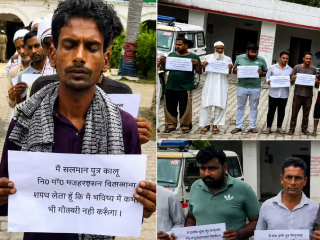 Forty-seven Muslim accused in cow slaughter cases voluntarily report to a police station in Saharanpur (Uttar Pradesh) !
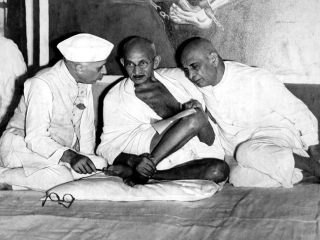 Nehruji’s Selection by Gandhiji for Congress Presidentship Again and Again
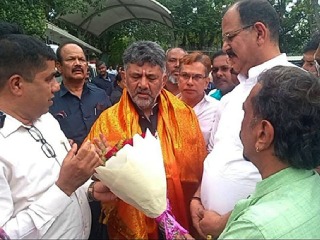 Appoint Ivan D’Souza as a Minister to represent the Christian community !
 Radiant Thoughts of Sachchidananda Parabrahman (Dr) Jayant Athavale
 We pay our obeisance a million times on the Birthday (as per Tithi) of
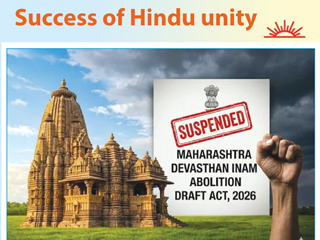 Major win for Hindu unity : Maharashtra Government suspends the controversial ‘Devasthan Inam Abolition Draft Act’