
1. The importance of purity in conduct during a Yajna
A few years ago, it was noticed that some of the Yajmans (Hosts) sitting for the Yajna were wearing artificial ornaments. Gurudev said, ‘If fake ornaments are worn during a sattvik act like a Yajna, how will sattvik vibrations be emitted by them ?’ Through this guidance, it became clear that during a Yajna, pure, natural and sattvik conduct must be followed. Thereafter, the scripturally appropriate practice of wearing only genuine ornaments while sitting for a Yajna was adopted.
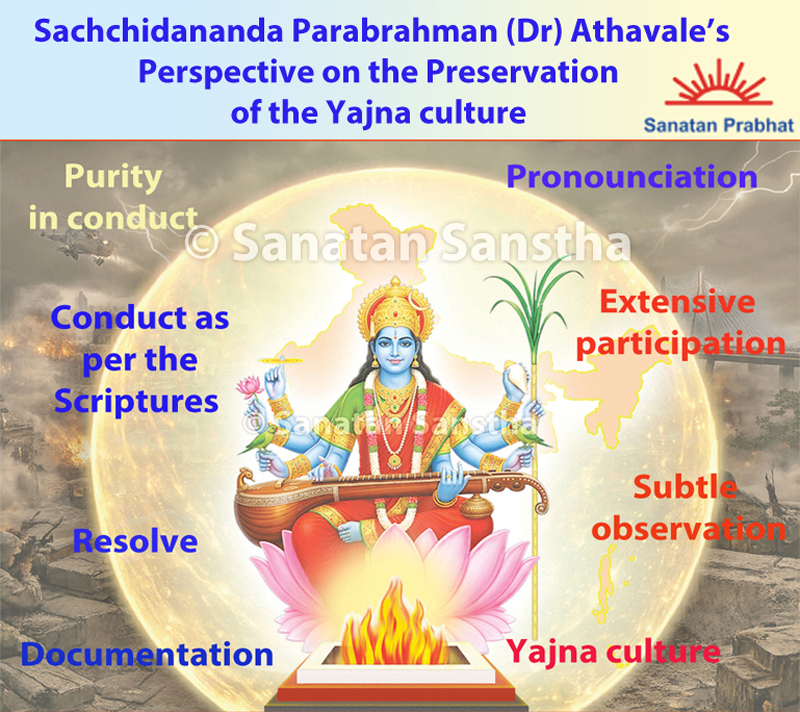
2. All-encompassing nature of the sankalpa (Resolve)
Initially, while making the sankalpa (Resolve) for a Yajna, it was limited only to Sanatan Sanstha and the seekers; however, Gurudev gave it a broader direction. He insisted upon samashti-oriented resolves such as – ‘May the ‘Hindu Rashtra’ (meaning, Ram Rajya) be established at the earliest, and may the entire human race be protected during the adverse times to come’. Through this, we realise intensely that Gurudev’s mission is for the welfare of the entire human race.
3. Purity of pronunciation in the sankalpa
At the commencement of the Yajna, Gurudev would be present for making the resolve. At that time, if any word was not heard properly or if the pronunciation was not accurate, He would ask for it to be repeated. For the resolve to be read and recited accurately, He instructed the Purohits (Priests) to provide the resolve in written form. Through this, it becomes clear that every word in the resolve, its pronunciation and its purity are extremely important.
4. Mission undertaken for preserving the Yajna culture
At a time when the importance of the Yajna culture is diminishing, Gurudev has undertaken great work for its preservation and propagation. So that the Scriptures on Dharma given by the Sages and the Yajna tradition within them may reach everyone, He established the Sanatan Purohit Pathashala (Priest school). Through this medium, Vedic study, Yajna rituals and Dharma education are being preserved.
5. Priority to conduct according to Scriptures on Dharma
While organising the Sanatan Rashtra Shankhnad Mahotsav in Goa on Gurudev’s 83rd Birth Anniversary in 2025, it was initially planned to build the Yajnakunda on an elevated platform so that those present could clearly see it; however, Gurudev clarified that the Yajnakunda must remain in contact with the ground, because only then will society obtain proper benefit from it. From this, it became clear that proper conduct according to Scriptures on Dharma is more important than visual attractiveness.
6. Perspective of inclusive participation
So that all seekers could obtain the benefit of the Yajnas conducted in the Ashram, Gurudev made special planning. For the Yajna to be viewed directly, it was projected on a large screen.
Similarly, so that seekers worldwide could also obtain the benefit of these Yajnas, He suggested arranging live telecast through a computerised system. Through this, His extensive and inclusive perspective becomes evident.
7. Gross and subtle observation
Even though it was physically difficult for Gurudev, He would be present at the Yajna venue for some time and observe. He would pay attention not only to external aspects, but also to the vibrations at the subtle level. Guiding so that the ahuti (Offerings) fall together, observing the vibrations of Shanti (Peace) and Anand (Bliss) generated by the seekers, are indicative of His subtle vision. He also points out even the smallest defects in abiding by Dharma.
8. Inspiration for documenting experiences
Gurudev would immediately write and publish points He noticed at the Yajna venue so that all seekers learn from them. He would tell the seekers participating in the Yajna to note the spiritual experiences and other aspects. From this, awareness among seekers increased and the importance of the Yajna became clearer.
9. Conclusion
Gurudev’s perspective on the Yajna culture is scripturally grounded, subtle, broad and beneficial for the samashti. Due to His guidance, the Yajna ceases to remain merely a traditional act and becomes an effective medium for spiritual upliftment and preservation of Dharma.
– Shri. Siddhesh Karandikar, Dhavali, Ponda, Goa.
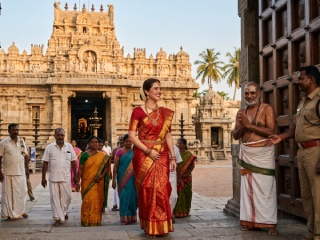 A person’s nationality or foreign name cannot determine their faith in Hindu Dharma !
 Radiant Thoughts of Sachchidananda Parabrahman (Dr) Jayant Athavale
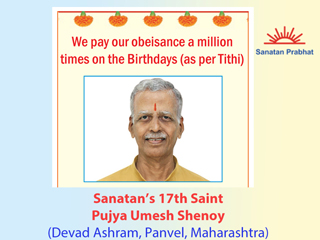 We pay our obeisance a million times on the Birthday (as per Tithi) of
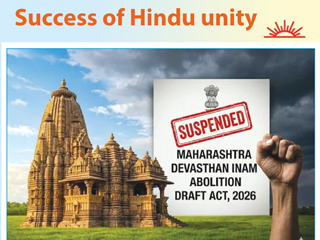 Major win for Hindu unity : Maharashtra Government suspends the controversial ‘Devasthan Inam Abolition Draft Act’
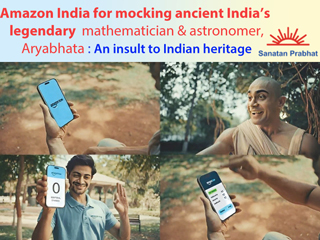 Amazon Insults Aryabhata : Hindu Janajagruti Samiti serves legal notice
 Murtis of Hindu Deities found in the basement of Jama Masjid in Bharuch (Gujarat)