
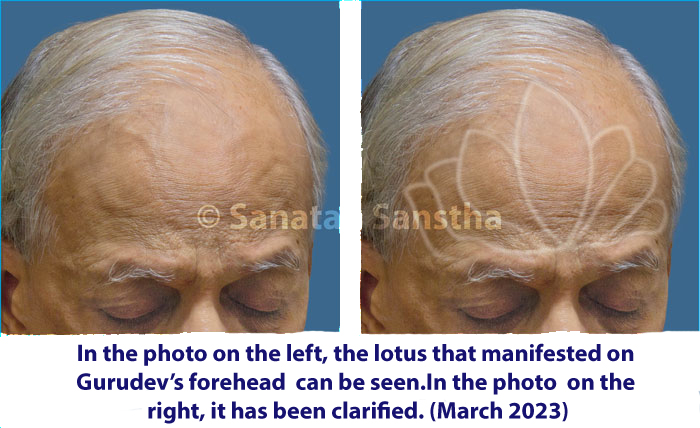
Compiler : What is the reason for the lotus that manifested on the forehead of Sachchidananda Parabrahman (Dr) Athavale becoming clearly visible ? From 2011 to 2012, 4 petals of that lotus appeared indistinct, whereas in 2013 they became clearly visible. What does the lotus becoming prominent indicate ?
Mr Ram Honap :
1. The reason why the lotus on the forehead of Saints becomes clearly visible
An individual’s spiritual practice begins from the Muladhar-chakra (The first centre in the spiritual energy flow system, located in the region between the anus and the base of the genitals in the subtle body). Due to the seeker’s spiritual practice and God’s grace, His Kundalini (Dormant spiritual energy in the subtle body) gradually moves upwards. An individual’s spiritual progress takes place through the Sushumna-nadi (The central channel of the spiritual energy flow system, which extends from the base of the spine to the top of the head).
At the final stage of a Saint’s spiritual progress, the Sushumna-nadi transforms into the Brahma-nadi. The Brahma-nadi unites with the Anand (Bliss) present at the location of the Sahasrar-chakra (Notional opening situated at the crown of the head, which leads to realisation of God). Once this process is complete, the manifestation of Anand (Bliss) in the Sahasrar-chakra appears in the form of a kamal (Lotus). This is called the Brahma-kamal.
Since the mission of Sachchidananda Parabrahman (Dr) Athavale is related to the samashti (Society), it has been compared to the Vishwa-kamal.
1A. Difference between the Sushumna-nadi and the Brahma-nadi
Some energy from the Sushumna-nadi is expended for the functioning of the Saint’s body, mind and intellect; however, the Brahma-nadi functions only to give Anand to the jiva (Embodied soul). The function of the Brahma-nadi is to bestow Brahmananda upon the jiva.
2. Characteristics of the 4 petals seen in the lotus on the forehead of Sachchidananda Parabrahman (Dr) Athavale
The names and functions of the 4 petals seen in the lotus on the forehead of Sachchidananda Parabrahman (Dr) Athavale are mentioned ahead.
2A. Sacheta : ‘Sa’ means ‘along with’ and ‘cheta’ means Chetana (The aspect of Divine consciousness that governs the functioning of the mind and body) or Chaitanya (Divine consciousness). One petal of the lotus functions along with Chaitanya. It is called ‘Sacheta’.
2B. Pracheta : ‘Pra’ means ‘awakened’. The lotus petal in which Chaitanya awakens according to the significance of times is called ‘Pracheta’.
2C. Nitya : ‘Nitya’ means ‘always’. One petal of the lotus is always active; that petal is called ‘Nitya’.
2D. Anitya : ‘Anitya’ means ‘sometimes’. One petal of the lotus awakens only for a specific task; it is called ‘Anitya’.
3. The reason why the lotus petals on the forehead of Sachchidananda Parabrahman (Dr) Athavale first appeared indistinct and later became clearly visible
From 2011 to 2012, the process of the union of Sachchidananda Parabrahman (Dr) Athavale with God through the Brahma-nadi was underway.
(In 2011, Sachchidananda Parabrahman [Dr] Athavale attained the spiritual level of 91% through spiritual practice, that is, He attained the state of a Paratpar Guru. Thereafter, in 2012, He attained the spiritual level of 92%. – Compiler)
Since this process was incomplete, 4 petals appeared indistinct on Sachchidananda Parabrahman (Dr) Athavale’s forehead. In 2013, this process was completed; hence, the lotus petals on His forehead began to appear clearly.
– Mr Ram Honap (Knowledge obtained through the subtle dimension), Sanatan Ashram, Ramnathi, Goa. (4.11.2025)
 Param Pujya (Dr) Athavale is an Incarnation ! : Jagadguru Shri Ramanandacharya Narendracharyaji
 Criminal case against 11 members of a Christian organisation who claimed that “Hindu is an abusive term, meaning thief, bandit and slave” will not be quashed !
 A person’s nationality or foreign name cannot determine their faith in Hindu Dharma !
 Radiant Thoughts of Sachchidananda Parabrahman (Dr) Jayant Athavale
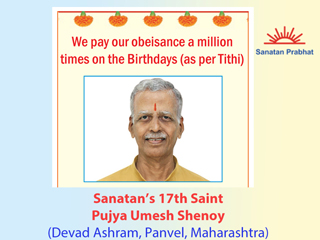 We pay our obeisance a million times on the Birthday (as per Tithi) of
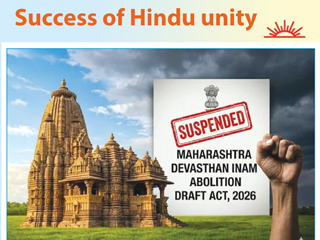 Major win for Hindu unity : Maharashtra Government suspends the controversial ‘Devasthan Inam Abolition Draft Act’