
One derivation of the word ‘Dussehra’ is dash-hara. ‘Dash’ means ten and ‘hara’ means defeated. Nine days before Dussehra, in the nine days of Navaratri, all the ten directions are gratified with the Devi’s Shakti (Female Deity’s Divine Energy). Shakti has control over Creation in all the ten directions, attendants, etc. This is why, this day is known as Dussehra, Vijayadashami, etc. This is one amongst the three and a half auspicious moments of the year. Let us read about the rituals to be performed.
1. Significance of Vijayadashami & Shri Durgadevi
A demon named Mahishasura, who defeated even the Deities, had to be destroyed by Shri Durgadevi. Since then, She came to be known as Mahishasurmardini, the annihilator of Mahishasur. The period of this Divine battle is commemorated as Navaratri, and the day of Her victory is celebrated as Dussehra or Vijayadashami. Hence, it holds unique spiritual significance. Shri Durgadevi is the supreme being in the tradition of Hindu Dharma.
Shri Durgadevi’s assurance & its importance : Whenever the tamasik (A Tama predominant person), demoniacal and cruel people become powerful and start troubling the sattvik, righteous humans, the Goddess will incarnate to reinstate Dharma (Righteousness). This is the vowed observance of Shri Durgadevi. (Markandeypurana, 91.51)
This reassurance makes the devotees of Shri Durgadevi feel protected and secure. If devotees adopt the scriptural information on Shri Durgadevi, they can develop and enhance their bhav (Spiritual emotion) unto Her, and benefit from Her Divine grace.
2. Steps invoved in celebration of Vijayadashami
Vijayadashami is celebrated in 5 steps – 1. Crossing the territory (known as ‘Simollanghan’), when the territory of a village is crossed in the North-East direction in the afternoon. One should stop at a Shami or Apta tree. 2. Worship of the Shami tree, 3. Worship of the Apta or Ashmantak tree, 4. Worship of Deity Aparajita, 5. Worship of instruments & weapons
3. Worship of the Apta or Ashmantak tree

The Apta is worshipped with the following mantra :
Ashmantak Mahavruksha Mahadoshnivaran l
Ishtanam darshanam dehi kuru shatruvinashanam ll
Meaning : O’ great Apta tree, you are the one who removes great sins. You show me my friends to unite and destroy my enemies.
Then rice, a betelnut and a gold coin (copper coin as a variant) are placed near the roots of the tree. After circumambulating the tree, some mud from its base and some of its leaves are brought home. Leaves of the Apta are offered as ‘gold’ to God and friends.
Conventionally, gold should be gifted by the young to the old. In Maharashtra, there is a custom of gifting gold to family members and friends on Dussehra. This has historical significance too. After a military expedition, the brave Marathas would bring home the plundered booty from the enemy’s territory. These victorious warriors were welcomed by their wives or sisters with Arati (A prayer sung with the waving of a lamp). In return, the warriors would give some gold ornaments from their plunder. The warriors then placed their loot before the Deities in the temple of the house, offered obeisance to them and elders seeking their blessings.
4 . Worship of instruments & weapons (Shastrapuja)
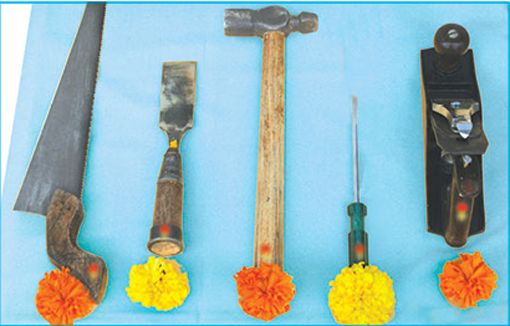
Kings, their soldiers and feudal lords clean their weapons, arrange them in rows and worship them. Farmers and artisans too worship their respective implements or instruments. Some also perform this ritual on the day of Navami during Navaratri. Pens and books are like weapons for students; hence, they worship them. The objective in this worship is to see the form of God in the respective things, to establish oneness with God.
5. Worship of Deity Aparajita (Aparajita Pujan)
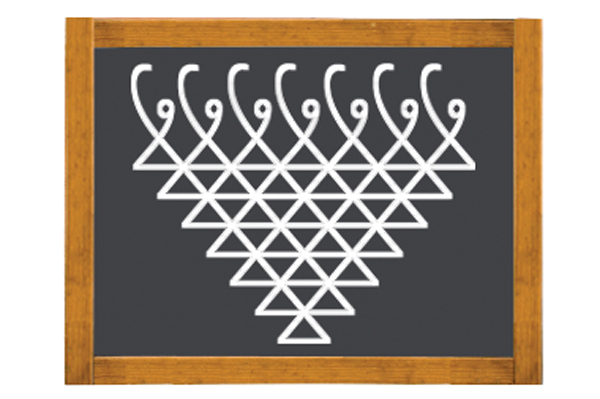
During the worship of the Shami tree, eight petals (Ashtadal) are drawn on the ground and an Idol of Deity Aparajita is placed on it and worshipped by chanting the following mantra :
Haren tu vichitren bhaswatkanakamekhala l
Aparajita bhadrarata karotu vijayam mam ll
Meaning : O’ Deity Aparajita, You who adorn a unique necklace, a glittering golden girdle and who blesses devotees earnestly, bestow victory upon me.
In some places, this worship is also performed before leaving for the ritual of crossing the territory. Placing an Idol of Deity Aparajita on a rangoli of an octapetalled figure signifies Her ability to control the 8 directions. Deity Aparajita is a destroyer form of Shri Durgadevi. Deity Aparajita manifests from the womb of the Earth with the help of the Prithvitattva (Absolute Earth Principle). This manifestation of Deity Aparajita is for the sake of souls on the Earth. This form of the Deity, which establishes itself on the throne of the eight petals, carries a trident, and with the help of Deity Shiva, seeks assistance from the Deities of directions and the Deities of the premises and destroys the demoniacal energies.
The tips of the eight petals represent these eight Deities. The destroyer waves generated from the creation of Deity Aparajita through the eight Deities get emitted as red light waves and destroys the accumulated Raja-Tama energy, thus purifying the atmosphere to help people on the Earth to lead an obstacle-free life.
Since the leaves of Shami tree are good conservers of energy, the worship of Deity Aparajita is conducted near a Shami tree. People benefit from this conserved energy of Deity Aparajita when they preserve these leaves in their homes.
(Read Sanatan’s Texts : ‘Appropriate method and science in celebrating Holy festivals’ and ‘Spiritual benefits of Religious festivals and Vowed observances’)
| The objective in the worship on Dussehra is to see the form of God in the respective things, to establish oneness with God ! |
 Nehruji’s Selection by Gandhiji for Congress Presidentship Again and Again
 Radiant Thoughts of Sachchidananda Parabrahman (Dr) Jayant Athavale
 We pay our obeisance a million times on the Birthday (as per Tithi) of
 Major win for Hindu unity : Maharashtra Government suspends the controversial ‘Devasthan Inam Abolition Draft Act’
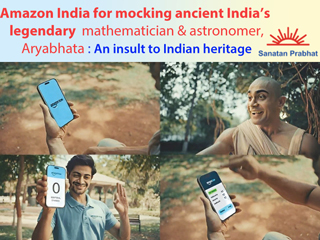 Amazon Insults Aryabhata : Hindu Janajagruti Samiti serves legal notice
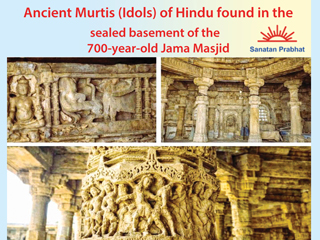 Murtis of Hindu Deities found in the basement of Jama Masjid in Bharuch (Gujarat)