

Difference between Holy festivals, Religious festivals and Vowed religious observances
This is not well-defined as some Holy festivals are also celebrated as Religious festivals and Vowed religious observances. For example Shriram Navami when celebrated individually is a Holy festival, when celebrated socially is a Religious festival and when celebrated individually with a specific sankalpa (Resolve), it becomes a vrat (Vowed religious observance).
Do not view Holy and other festivals as traditions, understand their underlying science and meaning
India has numerous festivals and traditions. However, most people view and celebrate them merely as age-old practices; they do not pay attention to the underlying science and their deeper meaning. On Gudhipadwa (Hindu New Year), Neem leaves are partaken as Prasad (Holy sacrament). Neem leaves have the ability to attract Prajapati waves, which are maximum on this day. This is the science underlying partaking of Neem leaves. If the underlying science of festivals is known, they can be celebrated with faith. Sometimes there is a difference in the ways of celebrating these festivals because of regional variations, social customs and ways of worship. The point to note is that when there is no scientific basis, celebrating festivals merely as an age-old tradition is incorrect. Such traditions should be discontinued and only those practices as advocated by our Scriptures should be continued. With respect to vrats – they have the sankalpa of an evolved person, which by itself is the underlying scientific reason.
Importance of festivals for God-realisation
A. Since festivals and vrats have a spiritual and scientific foundation, celebrating them leads to creation of Chaitanya (Divine consciousness), which helps even an ordinary man progress towards God.
B. From a seeker’s perspective, Karmakanda (Rites, rituals & observances) may be an inferior form of spiritual practice, yet it is important to gradually divert people who are not performing any spiritual practice, towards Spirituality. From the perspective of Karmakanda, these festivals and vrats are so important that at least one or the other happens to be on 75% of the tithis (Dates according to the Hindu Lunar Almanac) in a year.
C. We should always exercise restraint in our life; but in practice this is difficult. Hence, at least during festivals and vrats it should be exercised, so that gradually we become accustomed to a life of restraint.
Oppose practices harmful to Dharma and culture
Some practices have an important place in society; for example – firecrackers during festivals. Such practices have gained importance in today’s times. Banning such practices and opposing them amounts to practising Dharma. Expose the hollowness of such harmful practices by first learning and then spreading information lawfully.
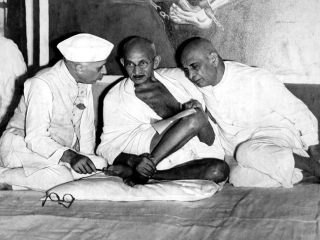 Nehruji’s Selection by Gandhiji for Congress Presidentship Again and Again
 Radiant Thoughts of Sachchidananda Parabrahman (Dr) Jayant Athavale
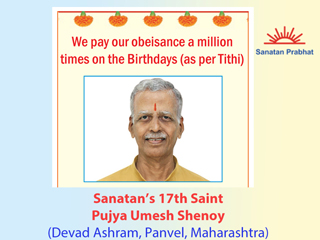 We pay our obeisance a million times on the Birthday (as per Tithi) of
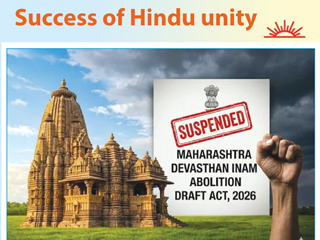 Major win for Hindu unity : Maharashtra Government suspends the controversial ‘Devasthan Inam Abolition Draft Act’
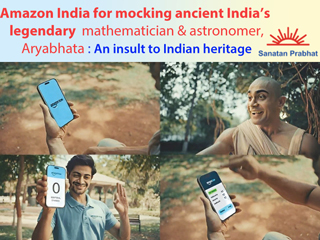 Amazon Insults Aryabhata : Hindu Janajagruti Samiti serves legal notice
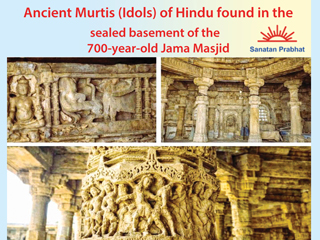 Murtis of Hindu Deities found in the basement of Jama Masjid in Bharuch (Gujarat)