
Considering the enormous expenditure incurred on the import of fuel, gold and other commodities, the impact on the economy due to foreign exchange flowing out of the country through such imports, and the prevailing situation of global war, Prime Minister Narendra Modi recently made certain appeals to the citizens of the country. These include avoiding unnecessary expenditure, political leaders reducing the number of vehicles in their convoys, using public transport, reducing the use of fuel, using video conferences for meetings, and working from home. Following this, mixed reactions emerged across the country. After the Prime Minister’s appeal, Maharashtra Chief Minister Devendra Fadnavis arrived at the Mantralaya on a Bullet motorcycle for a Cabinet meeting. Union Minister Nitin Gadkari travelled by bus to inspect a Palkhi route. Some leaders from the ruling and opposition Parties walked to their offices. Ministers in other States also reduced the number of vehicles in their convoys and travelled on two-wheelers, and the media gave wide publicity to all these acts, creating an aura around them.

While managing a family, we maintain financial balance considering children’s education, marriage and future difficulties. We practise frugality wherever necessary. A Nation too is like one family. Therefore, considering the present war-like situation, we should cultivate certain habits from now itself. There is a spirit of nationalism in this. It should not be turned into an event.
National interest through small actions
While travelling on roads or by train, we casually throw snack wrappers onto the road or along the railway tracks. It is due to the improper actions of millions of citizens in this manner that garbage accumulates in public places, and municipal councils, municipal corporations and railway administrations have to appoint sanitation workers by spending money to clean this garbage. Thus, through many improper actions, knowingly or unknowingly, we cause large-scale wastage of the Nation’s wealth.
If sacrifices are to be made for the Nation, doing so only during certain programmes is of no use; rather, it should become a deep-rooted sanskar (Subtle impression on the subconscious mind). After the Prime Minister’s appeal, many people mocked him on social media. However, keeping aside political opposition to the BJP Government, this issue should also be considered from the perspective of being one Nation; because if the thought, ‘Whether we are ruling, opposition, communist or right-wing, first and foremost we are Indians,’ is firmly rooted, there will be clarity on what should be politicised and what should be criticised. However, if national interest itself begins to be sacrificed for politics, then the people should reject such Parties as well.
The life of former Prime Minister of India Lal Bahadur Shastri is exemplary in politics. He did not misuse Government facilities for personal purposes. A reminder had once been sent to him from his son’s school regarding payment of educational fees. Even when Government officials told him that a concession in the fees could be granted as a special case since he was the Prime Minister’s son, he refused the concession.
During the food shortage in 1965, he appealed to citizens to observe a fast of one meal and strictly followed it himself. Only an individual who has a sense of responsibility towards the Nation can do this. Such action can arise only from the emotion that the ruler is the servant of the Nation, that is, of the people.
In ancient Indian tradition, there are many examples of kings who sacrificed everything for their subjects. In the present situation, however, selfishness has replaced sacrifice. Leaders who lack the capacity to sacrifice for the people get elected by distributing money during elections. Therefore, sacrifice for the Nation cannot remain limited only to adverse times. The spirit of sacrifice for the Nation should always remain awakened in rulers as well as citizens.
National interest lies in sacrifice
An ordinary citizen receives pension after working in a Government office for about 20 years. Municipal councillors, MLAs and MPs become entitled to lifelong pension after being elected even once. Some public representatives even draw pensions for all three positions – municipal councillor, MLA and MP. After becoming an MLA, the pension received as a municipal councillor is not stopped, and after becoming an MP, the MLA pension is not discontinued. Thus, one individual receiving two or three pensions is also a misuse of Government money.
Apart from this, while in office, they draw salaries up to Rs 2 lakh per month. Public representatives of the people whose assets increase four to five times or even more after being elected, despite having minimal assets before elections, are not worthy even of the toenail of Lal Bahadur Shastri, and they certainly have no eligibility to even utter the name of Chhatrapati Shivaji Maharaj. Such public representatives cannot even imagine making sacrifices for the Nation. Therefore, instead of keeping damaging criteria such as how much a candidate can spend on elections in order to get elected as a representative of the people, the foremost criterion should be sacrifice for the Nation. Only when all Parties adopt this criterion will elected representatives retain awareness of sacrifice. Those who get elected by distributing money and later fill their own coffers can never sacrifice for the Nation.

‘राष्ट्राय स्वाहा, राष्ट्राय इदं न मम् ’ (Rashtraya Swaha, Rashtraya Idam Na Mama)’ meaning, ‘Whatever exists belongs to the Nation, nothing belongs to me’ – this exalted sentiment in Indian culture itself is the strong foundation of national interest.
Keeping fans and lights switched on throughout the day in Government offices even when no one is present, making citizens make unnecessary visits to Government offices, and demanding money for work may appear normal; however, this is where wastage of the Nation’s wealth actually begins. It is said that while handling State affairs, Chanakya used a lamp fuelled by Government oil, but while doing personal work, he used a lamp fuelled by his own oil. This is an excellent example of how frugally the Nation’s wealth should be used. Therefore, the Prime Minister’s appeal for sacrifice should not remain merely for show, but should be followed in practice so that the path of national interest may be strengthened !
For Daily News : SanatanPrabhat.org/english/
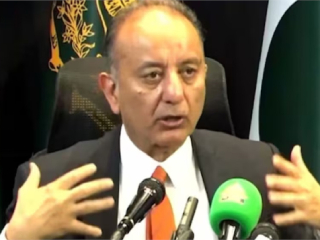 ‘We will cut off the hands of those who stop our water !’ : Pakistani Minister Musadik Malik
 Radiant Thoughts of Sachchidananda Parabrahman (Dr) Jayant Athavale
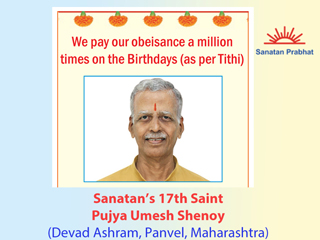 We pay our obeisance a million times on the Birthday (as per Tithi) of
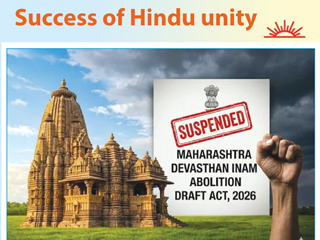 Major win for Hindu unity : Maharashtra Government suspends the controversial ‘Devasthan Inam Abolition Draft Act’
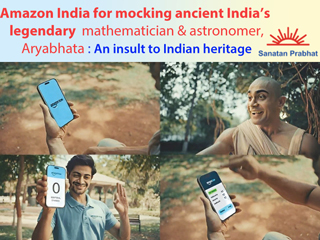 Amazon Insults Aryabhata : Hindu Janajagruti Samiti serves legal notice
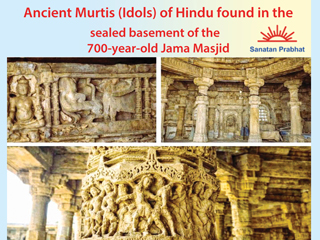 Murtis of Hindu Deities found in the basement of Jama Masjid in Bharuch (Gujarat)