
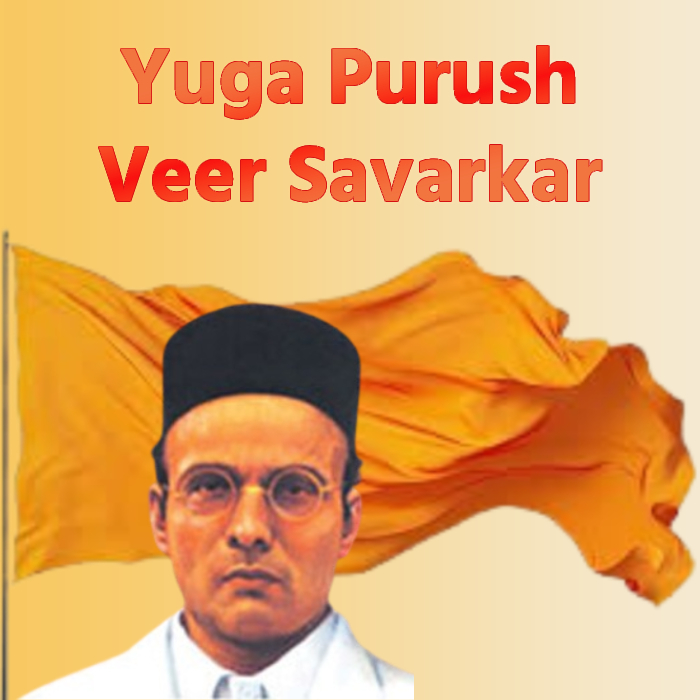
On Veer Savarkar’s Death Anniversary (23rd February by Tithi)
Raiding another’s kingdom, especially that of a likely enemy, is not injustice in political science. On the contrary, it is the king’s duty to strike and crush the barbaric enemy before he becomes capable of attacking us. In such statecraft, protecting our Aryavarta (The land of Aryas) is today the foremost duty of the ruler. Hindus should not ignore these invaluable thoughts of Medhatithi (Eminent Dharmashastra scholar and commentator on the Manusmruti).
– Mr Durgesh Jaywant Parulkar
Vinayak Damodar Savarkar, popularly known as Veer Savarkar was the unsung hero of the Indian freedom struggle against the British rule (1906-47). He made an outstanding contribution to this great cause. Leaders like Gandhi, Nehru and Bose adopted Savarkar’s main philosophies, but many years later.
At the time of Independence in 1947, many prominent leaders of the Congress Party, including its President, were members of Savarkar’s secret revolutionary society, called ‘The Abhinav Bharat’. He was the main source of their inspiration and, yet, was never given any credit for this.
Savarkar suffered terribly for 27 years at the hands of the English rulers. He spent 10½ years of hard labour in jail, in Andaman Islands, 1,000 miles off the east coast of India, followed by further 3 years in various jails in India and then 13½ years in internment there as well. Despite having suffered this appalling persecution by the British rulers, Savarkar had the greatness to proclaim, “I never hated the English just because they were English.” He sincerely believed in the universal brotherhood of man.
If the Nation had been blessed with a Prime Minister like Veer Savarkar – one who had a deep understanding of Bharat’s (India’s) ancient, glorious history, yet sought to take the Nation forward into the future with the aid of modern technology, there would have been an objective evaluation of history.
B. A foreign policy that safeguarded self-interests.C. Objective presentation of history and due respect for linguistic identity.
D. Supportive economic policies for self-reliance.– Editorial
1. Defence policy
A. Militarisation : A compulsory conscription or service policy, which included military service, would have been implemented. Veer Savarkar would have made it mandatory for young men and women in the age group of 18 to 25 to undergo military training for a few months and military service for a few years. If this initiative is viewed from a broader perspective, its usefulness becomes evident. Military training inculcates discipline and creates a mentally and physically robust younger generation. In times of crisis or war, they could be utilised as a reserve force.
Training initiatives for promising sportspersons under the guidance of the armed forces such as Mission Olympic Wing (Training military athletes for national and international competitions) would have been undertaken; thereby, giving more citizens the opportunity to represent the Nation.
B. Maritime-oriented mindset and defence preparedness : India’s borders are surrounded by the sea on three sides, and even today, 40% of the Nation’s trade takes place via sea routes. Considering this, the necessity of a maritime-oriented mindset for defence preparedness becomes evident.
It is often said that one should learn and adopt good things even from the enemy. The British used to say, “Britishers can never be slaves because British fleets rule the waves”. Following this line of thought, to prevent foreign invasions of India in the future, it would be essential for India to have control over islands in the eastern and western seas. Indian naval and air force bases should have been established there. These islands should have been usable as surveillance outposts and, during war, should have functioned as India’s sword arm.
Keeping this in mind, while negotiating with the British, as the first Prime Minister, Veer Savarkar would have made every possible effort to ensure that not only the Andaman & Nicobar and Lakshadweep islands, but also the Coco Islands (located north of the Andamans in the Bay of Bengal), remained under India’s control. History shows that these later went under Myanmar’s control and subsequently fell into China’s hands. Today, China uses the Coco Islands for surveillance over India’s eastern coastline. What applies to the eastern coast also applies to the western coastline. Gwadar Port, a deep-sea port on the Makran Coast, was offered for sale to India by the Sultan of Oman in the 1950s-60s. If Savarkar had been the Nation’s first Prime Minister, Gwadar Port would today have been under India’s control.
Now consider this – if the Andaman Islands northwest of the Malacca Strait and Gwadar Port at the mouth of the Strait of Hormuz had been under India’s control, in the great game of global powers, India’s strategic weight would have decisively tilted in India’s favour.
C. Defence preparedness : Along with this, a comprehensive security policy would have been formulated by considering self-reliance in defence preparedness – be it weapons, ammunition, fighter aircraft, the manufacturing processes and factories for their components, and the institutional framework required for research. This would have laid the foundation of a powerful Nation.
2. Foreign policy
Savarkar’s pragmatic foreign policy would have been one of multi-alignment rather than non-alignment. As per an adage – ‘There are no permanent friends or permanent enemies, only permanent interests’. Therefore, whatever was necessary to safeguard the supreme national interest would have been implemented by Savarkar through foreign policy.
A. During the Cold War era, both superpowers – Russia and the USA – had explored the possibility of granting India permanent membership of the United Nations Security Council. As the first Prime Minister, Veer Savarkar would have responded positively to this.
B. The Kashmir issue would have been resolved : After Partition, the Pakistani army, disguised as tribal raiders, had infiltrated Kashmir and unleashed violence. The Indian Army had driven them back. Savarkar would have entrusted the responsibility of resolving this issue to India’s brave soldiers and settled it on the battlefield. Present-day Pakistan-occupied Kashmir and Gilgit-Baltistan would have become an integral part of India, and the Kashmir issue would not have remained unresolved for decades.
C. New initiatives with Israel – rejuvenating force for India : India might have become the first country in the world to recognise the creation of Israel. Considering the position of the Jewish community in the economic and social life of the USA at that time, innovative initiatives in defence, technology, and agriculture would have been implemented with Israel’s assistance. This would have acted as a rejuvenating force for India, which was suffering from recurring droughts, erratic rainfall, food shortages, and the commercialisation of Indian agriculture by the British for their own benefit.
D. Reining in China : With his understanding of history, Savarkar would have adopted a cautious stance towards China and would not have allowed China’s move to swallow Tibet to succeed so easily. He knew that under the concept of an undivided China, once Tibet was considered the palm, China would not hesitate to claim the five fingers next – Ladakh, Nepal, Bhutan, Sikkim, and Arunachal Pradesh. By strengthening defence preparedness, Savarkar would have worked to rein in an aggressive China.
3. Objective presentation of history
If the Nation had been blessed with a Prime Minister like Savarkar, one who understood India’s ancient, glorious history yet aspired to propel the Nation into the future with modern technology, there would have been an objective evaluation of history. Along with acknowledging the contribution of non-violent mass movements in the freedom struggle, such as Satyagraha (non-violent civil resistance), Prabhat Pheris (Early-morning processions), and spinning yarn, the sacrifices of revolutionaries, right from the 1857 uprising to the Royal Indian Navy mutiny in Mumbai would have been prominently recorded. The sacrifices of pioneering revolutionaries such as Vasudev Balwant Phadke, the Chapekar brothers, Anant Kanhere, Madanlal Dhingra, Bhagat Singh, Udham Singh, Rajguru, Chandrashekhar Azad, and Sukhdev would also have been highlighted.
4. Economic policy for becoming self-reliant
Along with all this, to make India self-reliant, policies prioritising national interest while safeguarding the interests of the capitalists and workers would have been implemented. In this manner, as the first Prime Minister, Veer Savarkar would have built a powerful, self-reliant, defence-ready, and strong Nation.
– Mr Mandar Abhyankar
(Courtesy : Daily ‘Mumbai Tarun Bharat’; 27.5.2022)
| Whatever was necessary to safeguard the national interests would have been implemented by Savarkar through foreign policy ! |
 NCERT removes Hitler reference related to Subhas Chandra Bose from Class 8 textbook
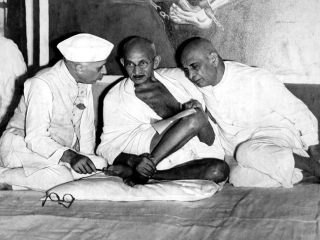 Nehruji’s Selection by Gandhiji for Congress Presidentship Again and Again
 Radiant Thoughts of Sachchidananda Parabrahman (Dr) Jayant Athavale
 We pay our obeisance a million times on the Birthday (as per Tithi) of
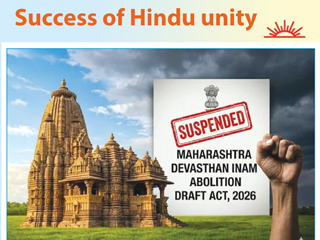 Major win for Hindu unity : Maharashtra Government suspends the controversial ‘Devasthan Inam Abolition Draft Act’
 Amazon Insults Aryabhata : Hindu Janajagruti Samiti serves legal notice