
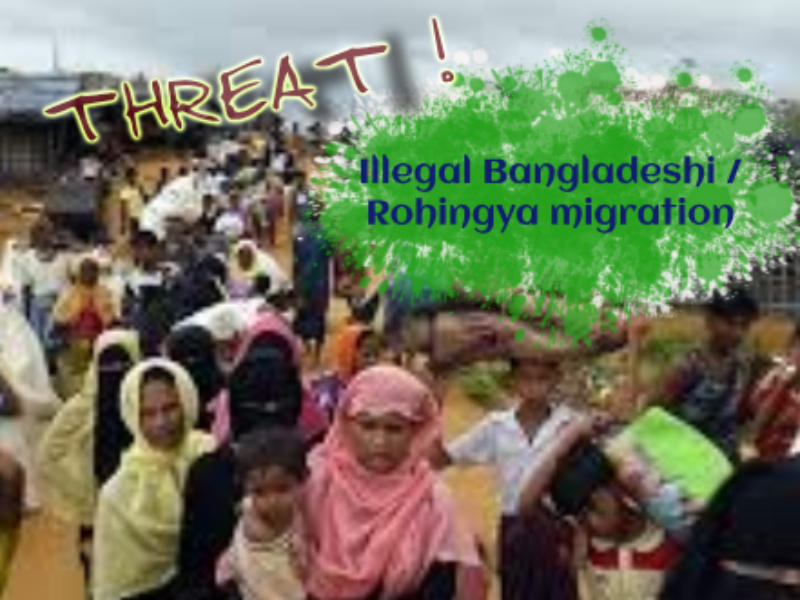
Porous India-Bangladesh Border and Fencing Efforts
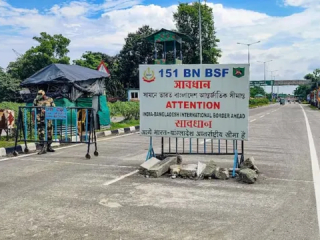
India shares a 4,096.7 km border with Bangladesh, distributed across several States:
Assam : 262 Km
Tripura : 856 Km
Mizoram : 318 Km
Meghalaya : 443 Km
West Bengal : 2,217 Km
Barbed wire fencing has been installed along 3,180.653 km of this border, with the remaining 916.7 km expected to be completed by 2025.
Border patrolling, especially in riverine areas, presents significant challenges. The previous scheme of floating border posts has proven ineffective. Despite stringent measures, illegal immigration from Bangladesh continues unabated.

Magnitude of the Problem
Millions of illegal Bangladeshi migrants have entered various Indian States by exploiting the porous Indo-Bangladesh border. Organized gangs of agents facilitate this migration. Initially concentrated in West Bengal, Assam, and the northeastern States, they have now spread to 8-9 other States, including Maharashtra.
In Maharashtra, their numbers are estimated to be in the hundreds of thousands, with significant concentrations in cities like Mumbai, Navi Mumbai, Pune, Aurangabad, Bhiwandi, Malegaon, and coastal areas. These migrants are often employed in labor-intensive sectors such as construction, roadwork, and metro projects.
Many Bangladeshi migrants are now resorting to sea routes. They are reaching new States such as Odisha via boats, leading to a surge in illegal settlements across several Districts, including Kendrapara, Nawarangpur, Malkangiri, Bhubaneswar, Puri, Chilika, Ganjam, Balasore, and Keonjhar.
Complicity of Local Administration
Instead of aiding the Border Security Force (BSF), local civil administrations are found supporting illegal migrants. In many cases, necessary documents are prepared even before migrants set foot on Indian soil. When the BSF manages to apprehend illegal entrants, legal obstacles and hostile local populations – many of whom are Bangladeshi settlers – hinder their efforts.
Role of Employers and Local Support
Some locals knowingly employ illegal migrants, driven by religious affiliations or vote-bank politics. This complicity enables migrants to integrate into local communities, making detection more challenging.
Continuing Infiltration Despite Security Measures
Despite the deployment of the Border Security Force illegal infiltration from Bangladesh into India continues unabated. Frequent complaints regarding illegal infiltration have been reported, yet no strong deterrent actions have been taken. Additionally, allegations of cattle smuggling from India to Bangladesh have continued for a long time.
A recent viral video has raised fresh concerns about the effectiveness of border surveillance. The video, captured in Assam’s Dhubri District, shows common people opening border gates in the absence of BSF personnel, allowing unrestricted movement between the two countries. The ease with which tractors entered Indian territory from Bangladesh suggests a serious security lapse.
Challenges in Border Management
This is not an isolated case; rather, it highlights a systemic issue in border management. While the Central Government has reiterated its commitment to strengthening border security, the video reveals a stark contrast to those claims. The apparent lack of enforcement and supervision raises questions about the effectiveness of existing security protocols.
The Need for Stronger Measures
The latest revelations underscore the urgent need for enhanced border security measures, increased deployment of personnel, and stricter enforcement of border management protocols. Authorities must ensure that such security breaches do not continue unchecked, as they pose a serious threat to national security and territorial integrity.
Bangladeshi Infiltration and Demographic Shift in Jharkhand’s Tribal Belt
The Santhal Pargana region, encompassing Pakur, Sahibganj, Godda, Jamtara, Dumka, and Deoghar, is experiencing a significant demographic transformation due to the continuous influx of illegal Bangladeshi immigrants. The Bharatiya Janata Party (BJP) has repeatedly raised concerns about this issue in the Jharkhand Legislative Assembly, demanding the implementation of the National Register of Citizens (NRC) to identify and deport illegal settlers.
Historically, the Santhal tribe settled in the Rajmahal Hills during the 18th century and played a pivotal role in resisting British rule, most notably in the 1855 Santhal Rebellion, which preceded the 1857 Revolt. The Santhals have long upheld the principle of not selling their land to non-tribals. However, the demographic influx now poses a severe threat to their cultural identity and traditional land ownership.
Special Branch Report Confirms Infiltration : A classified letter from the Special Branch of the Jharkhand Government, accessed by CNN-News18, has confirmed large-scale illegal entry of Bangladeshi nationals into Santhal Pargana and other parts of Jharkhand.
The report outlines a systematic process : Illegal immigrants are first sheltered in local madrasas, then registered as voters, and later integrated into society. A commonly observed strategy involves their marriage to tribal women, which provides them indirect ownership of tribal land through in-laws.
Ground Investigation – The Reality on the Ground : An on-ground investigation by CNN-News18 across the Santhal Pargana region uncovered unsettling realities. In Godda, groups of Bengali-speaking truck drivers were found gathering at roadside eateries late at night. The eatery’s owner confirmed that they were Bangladeshis residing in Pakur District and were regular customers, though he was unaware of how they had obtained driving licenses. When questioned about the Special Branch report, Pakur Superintendent of Police Hrudeep P. Janardhanan acknowledged the problem. He stated, “We received a letter regarding the influx of Bangladeshis. This issue has resurfaced repeatedly. While we face certain limitations, we are working with the Intelligence Bureau (IB) and the Foreigners Regional Registration Office (FRRO) to address it.”
Religious Institutions and Changing Demographics : Pakur, which shares a border with West Bengal’s Murshidabad District, has witnessed a rapid increase in the number of madarasas and mosques across both urban and rural areas. An RTI query revealed that Sahibganj alone has 43 State-funded madarasas.
Census data further highlights the shifting demographics : Between 2001 and 2011, Jharkhand’s overall Muslim population grew by 14%, nearly matching the 14.2% growth of the Santhal population. In Pakur, the Muslim population surged by 42%, while the Santhal population increased by only 19.51%. In Sahibganj, the Muslim population rose by 37%, whereas the Santhal population grew by just 10.8%.
Migration and Infiltration Routes : The porous land and riverine borders between India and Bangladesh facilitate illegal infiltration. Once inside India, infiltrators disperse across States using multiple routes :
Via Road : Many enter Jharkhand through Pakur by crossing from Murshidabad in West Bengal.
Via Rail : Upon reaching Pakur or Sahibganj, they board trains to different parts of Jharkhand.
Via River : Some infiltrators cross the Ganga from Sahibganj by boat to reach Katihar in Bihar.
Political Reactions and NRC Demands : The issue has triggered a major political debate. BJP leaders have accused the Jharkhand Mukti Morcha (JMM) and the Congress-led State Government of ignoring the problem.
BJP MP Nishikant Dubey alleged : “Bangladeshi infiltrators are grabbing land, marrying tribal women, and converting them. This has led to a decline in the tribal population and a rise in the Muslim population. Since the 1990s, a visible demographic shift has taken place. In Udhwa block alone, eight new Panchayats have been created, all with a Muslim majority.” He further demanded an NRC based on the 1951 Census and 1952 voter list to identify illegal immigrants.
On the other hand, JMM leaders have dismissed these claims, asserting that the BJP is using the issue for political mileage. However, BJP leaders argue that while border fencing is effective, river crossings remain a major challenge. They emphasize the need for penalizing locals who shelter illegal immigrants and reiterate their call for an NRC in the region.
Tribal Concerns Over Identity and Land Rights : Santhal activist Neeraj Hembrom expressed grave concerns over illegal land acquisition through fraudulent documentation. He pointed out, “Most illegal immigrants lack proof of residence dating back 30-40 years. Yet, they possess voter IDs and Aadhaar cards.”
Legal Action – PIL in Ranchi High Court : Activist Danyaal Danish has filed a Public Interest Litigation (PIL) in the Ranchi High Court, urging the State to take action against illegal infiltration and its impact on Jharkhand’s tribal demography. The petition also seeks an inquiry into the illegal construction of madarasas and other religious institutions. The court has admitted the PIL and directed the State Government to submit a report.
An Urgent Need for Action : The unchecked influx of Bangladeshi nationals into Jharkhand’s Santhal Pargana region is rapidly altering the demographic landscape, threatening the identity, culture, and land rights of indigenous tribal communities. While political parties continue their blame game, the core issues – illegal land encroachment, forced demographic change, and the proliferation of religious institutions – remain largely unaddressed.
With the Ranchi High Court’s intervention and increasing public outcry, the demand is for Stronger border security, Implementation of the NRC, and Stricter action against those facilitating illegal migration. The future of Jharkhand’s tribal communities hinges on decisive governance and proactive measures to prevent irreversible demographic transformation.
In the issue of illegal immigration from Bangladesh into India, the primary focus has historically been on the eastern border States, and now concerns have arisen regarding the spread of this issue to other regions of India.
(Courtesy : Excerpts from an Article by Brig. Hemant Mahajan posted on indusresearch.in; 7.4.2025)
| Millions of illegal Bangladeshi migrants have entered various Indian States by exploiting the porous Indo-Bangladesh border ! |
 Bangladesh refuses to accept 10 alleged infiltrators into its territory
 Nine Bangladeshi infiltrators arrested in Bengal !
 More than 13,000 illegal Bangladeshi infiltrators in Karnataka !
 Radiant Thoughts of Sachchidananda Parabrahman (Dr) Jayant Athavale
 We pay our obeisance a million times on the Birthday (as per Tithi) of
 Major win for Hindu unity : Maharashtra Government suspends the controversial ‘Devasthan Inam Abolition Draft Act’