

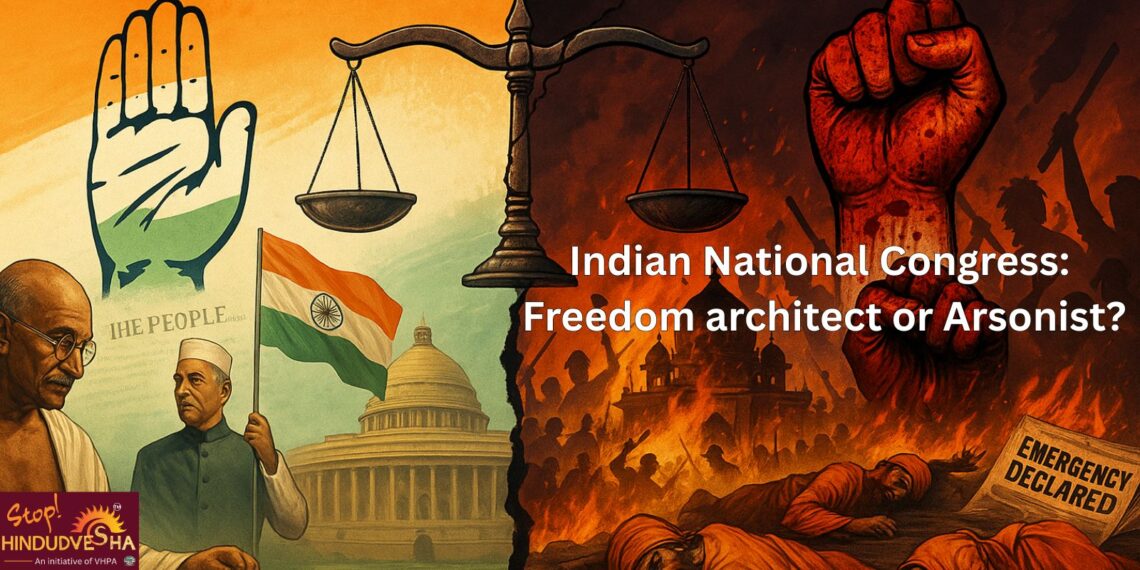
While celebrated as the architect of India’s Independence, the Indian National Congress repeatedly acted as an ‘arsonist,’ enabling or abetting mass violence and authoritarianism for political gain.
Pogrom Against Chitpavan Brahmins
In the immediate aftermath of Mahatma Gandhi’s assassination on 30 January 1948 by Nathuram Godse, a Chitpavan Brahmin from Pune, the entire Chitpavan community was subjected to collective punishment through widespread mob violence across Maharashtra. Contemporary accounts and oral histories attest that hundreds of Brahmins were killed, their homes and temples looted and destroyed, and families forced into mass displacement. While not officially acknowledged as state-sponsored, the role of local Congress workers in inciting mobs, coupled with the conspicuous inaction of the Police, points to a tacit complicity on the part of the ruling party.
The political dividends of this silence were considerable : The pogrom effectively dismantled the once-dominant socio-political position of Chitpavans, who had provided towering nationalist figures such as Bal Gangadhar Tilak and Gopal Krishna Gokhale, and ensured the rise of Maratha dominance in Maharashtra’s politics under the Congress umbrella. Unlike later instances of mass violence, such as the 1984 anti-Sikh pogrom, this episode received no official commission of inquiry, leaving it largely erased from mainstream historiography. Its neglect underscores both the selective memorialization of violence in postcolonial India and the Congress party’s recurring pattern of leveraging communal or caste-based hostilities to consolidate political power.
Saints in the Crosshairs : The 1966 Gopastami Massacre
On 7 November 1966, the streets of Delhi witnessed one of the most violent confrontations between the postcolonial Indian state and its religious citizens. Tens of thousands of Hindu devotees, led by Ascetics, converged on Parliament to demand what they saw as a non-negotiable civilizational imperative : A nationwide ban on cow slaughter. The Congress Government’s response was not dialogue but force. After hours of tense standoff and clashes, the Police opened fire on the demonstrators. The official tally admitted to at least seven deaths, yet eyewitnesses, journalists, and later independent observers suggested that the actual toll ran into the hundreds, a discrepancy that itself testifies to the opacity of state reporting in moments of crisis.
Parliamentary debates in the Rajya Sabha, less than two weeks later, resounded with outrage. Members across the spectrum characterized the episode as a massacre and demanded accountability from the Government. Their interventions reveal both the scale of the shock and the recognition that the state had violated not merely public order but the moral conscience of the majority. Yet despite parliamentary furor, no judicial commission was constituted, no minister resigned, and the matter was swiftly relegated to silence in official records.
The Gopastami bloodshed marked a turning point. It demonstrated that the Congress regime was willing to direct the violence of the state not against separatists or armed insurgents, but against unarmed Ascetics and lay devotees, voices rooted in India’s religious and cultural traditions. This inversion was politically revealing. The very Sadhus who had historically been seen as guardians of Dharmic values were reclassified as agitators, even threats, to the modernist vision of the Congress elite.
The Pogrom as Politics : The 1984 Anti-Sikh Atrocity
The assassination of Prime Minister Indira Gandhi on 31 October 1984 by her Sikh bodyguards precipitated what is now widely recognized as the darkest pogrom in independent India. For three consecutive days, Delhi and other urban centers descended into orchestrated carnage. Eyewitness testimonies, journalistic investigations, and the reports of human rights organizations consistently documented a chilling pattern : Mobs were not spontaneous aggregations of grief-stricken citizens but were armed, organized, and directed. Voter lists were used to identify Sikh households; kerosene and iron rods were distributed systematically; and survivors recalled assurances from local Congress leaders that those participating in the violence would enjoy protection from prosecution.
The Justice GT Nanavati Commission of Inquiry, established in 2000 and reporting in 2005, lent institutional authority to these accounts. It concluded unequivocally that local Congress functionaries ‘incited or helped the mobs’ and singled out leaders such as Sajjan Kumar for their role in enabling mass violence. Equally damning was its finding of deliberate Police inertia : Law enforcement personnel either failed to intervene or actively abetted the attackers. This abdication of the state’s most basic responsibility, protecting its citizens, revealed the pogrom as not merely a communal riot but as a state-enabled atrocity.
Rajiv Gandhi’s infamous remark, ‘when a big tree falls, the earth shakes’, delivered in the aftermath of the massacre, encapsulated the callousness of the regime. It simultaneously trivialized the suffering of the Sikh community and normalized the notion of retaliatory violence as the natural order of politics. For survivors, justice was postponed for decades, with prosecutions delayed, witnesses intimidated, and many accused leaders continuing in public life. For the Congress, however, the political calculus yielded immediate dividends : In the general elections of December 1984, it swept to power with an overwhelming parliamentary majority.
Silenced by Ideology : Anti-Brahmin Hostility in Tamil Nadu
Unlike the sudden eruption of mob violence in Delhi in 1984, Tamil Nadu did not witness a single cataclysmic massacre of Brahmins. Instead, what unfolded was a slower, insidious process of marginalization that worked through rhetoric, structures, and occasional physical intimidation. The rise of non-Brahmin movements in the early twentieth century, later crystallized into the Dravidian political project, generated a sustained discourse that positioned Brahmins as the monopolizers of education, bureaucracy, and cultural capital. This framing quickly seeped into popular consciousness, creating what scholars like MSS Pandian have described as an ‘anti-Brahmin common sense,’ in which derision of the Brahmin identity became normalized and politically virtuous.
Rhetorical violence was the most visible front of this process. Electoral campaigns often hinged on anti-Brahmin slogans, with the Brahmin imagined as the quintessential oppressor of the Tamil masses. Tamil cinema, too, reinforced these stereotypes, portraying Brahmins as pale-skinned, Sanskrit-chanting caricatures, at once effeminate, out of touch, and conniving. The repetition of these tropes shaped popular attitudes in subtle but powerful ways. Like propaganda elsewhere, such as the use of caricatures against Jews in Europe, the constant circulation of these images helped legitimate social suspicion and mockery as acceptable cultural expressions.
Structural violence compounded these rhetorical strategies. Educational and employment policies implemented under Dravidian regimes significantly reduced Brahmin representation in sectors where they had historically been dominant.
Reports from the 1950s and 1960s note instances where Brahmin households in smaller towns faced harassment during anti-Hindi or anti-Brahmin agitations. Symbolic acts of humiliation, such as the cutting of the sacred thread, signaled that Brahmin identity was no longer invulnerable in the public sphere. These were not widespread pogroms, but they reinforced the cumulative message of exclusion and insecurity.
The long-term consequence of this hostile environment was migration. Beginning in the mid-twentieth century and accelerating by the 1980s and 1990s, many Brahmin families left Tamil Nadu in search of professional and cultural space elsewhere. Some resettled in Bengaluru, Hyderabad, and Mumbai, while others pursued opportunities abroad, particularly in the United States. This exodus dramatically altered the community’s demographic presence in Tamil Nadu, while simultaneously fueling the growth of a Tamil Brahmin diaspora that is visible in global academia, technology, and medicine. In this sense, the story of Tamil Nadu’s Brahmins is not one of a sudden conflagration, but of a sustained attrition – a slow displacement that redefined community identity and reshaped the state’s social fabric.
Yet, what makes this saga even more striking is the studied silence of the Indian National Congress.
Though the party never held the reins of power in Tamil Nadu once the Dravidian tide took over, it sat by quietly, watching this slow attrition unfold. The Congress neither checked the deepening hostility toward Brahmins nor offered meaningful political or institutional resistance to the discriminatory currents sweeping the state.
By its indifference, it effectively legitimized the cultural and structural marginalization that stripped the Brahmins of their once-secure place in Tamil society, reducing them to a vulnerable minority forced to seek dignity and opportunity outside their homeland.
The Emergency State : Congress’s Machinery of Repression
If Tamil Nadu exemplified ideological complicity, the Emergency (1975-77) revealed the Congress party’s capacity for unmediated authoritarianism. On 25 June 1975, Prime Minister Indira Gandhi declared a state of Emergency, suspending civil liberties and reducing the world’s largest Democracy to rule by decree. The Shah Commission of Inquiry (1978) meticulously catalogued the abuses that followed : Tens of thousands detained without trial under preventive detention laws; censorship imposed on the press; custodial torture; and mass demolitions of urban settlements under the guise of ‘beautification.’
Perhaps the most notorious feature of this period was the coercive sterilization campaign, spearheaded by Sanjay Gandhi as part of a demographic ‘discipline.’ Official figures record over 10 million sterilizations during the Emergency years, many carried out under duress, with marginalized and impoverished communities disproportionately victimized. Testimonies collected by the Shah Commission detail instances of villagers being rounded up en masse, of livelihoods being threatened unless ‘voluntary’ consent was given, and of botched medical procedures leading to lifelong injury or death.
While the Emergency was not communal in character, its significance lies in demonstrating the Congress’s willingness to weaponize the state against its own citizens when power itself was imperiled. The suspension of habeas corpus, described by Justice HR Khanna in his famous dissent as the ‘slaughter of the Constitution,’ revealed the fragility of India’s Democratic order under Congress rule. Violence, whether physical, structural, or symbolic, was not an accidental byproduct but a deliberate instrument of governance.
The Emergency thus stands as a reminder that the Congress’s complicity in mass violence was not confined to communal settings. It extended to the very foundations of the Republic, exposing how easily democratic institutions could be bent, or broken, when survival of the party and its dynasty was at stake
The Architect and the Arsonist
The Indian National Congress occupies a paradoxical place in the historical imagination of modern India. Nationalist historiography, particularly in its mid-20th-century form, cast the party as the singular architect of freedom and the guardian of secular Democracy. School textbooks, political memoirs, and official commemorations reinforced this narrative of the Congress as the ‘father of the Republic.’ Yet revisionist scholarship and the testimony of survivors point toward a more troubling counter-memory : That the very party presided over some of the gravest betrayals of the Republic’s founding ideals.
From Ascetics felled by state bullets in Delhi in 1966 to Sikhs hunted down in the pogrom of 1984, from the hauntings of the Emergency era, the party’s willingness to suspend liberties, coerce populations, and bend constitutional norms revealed the precariousness of India’s Democracy under its stewardship.
The Congress may have worn the mantle of the architect of Independence and the builder of Democratic institutions, but history shows it was also the arsonist that repeatedly set fire to the fragile social fabric of the Republic. Far from being India’s friend, Congress again and again betrayed the very people it claimed to represent, whether by unleashing mobs, crushing dissent, or subverting the Constitution itself. Confronting this legacy is not about balancing two sides of a story, but about facing a hard truth : Congress was never the guardian of Indian Democracy, but its most persistent saboteur.
This Article is being re-published in Sanatan Prabhat with the explicit permission of the Editorial Team of StopHinduDvesha.org
(Courtesy : Excerpts from an Article by Aditi Joshi and posted on Stop Hindu Dvesha website )
Original Article on : https://stophindudvesha.org/when-the-state-turned-predator-indian-national-congress-and-the-politics-of-pogroms/
| Congress was willing to direct the violence of the state not against separatists, but against unarmed Ascetics & lay devotees !
Under Congress rule, violence, whether physical or symbolic, was not a byproduct but a deliberate instrument of governance ! |
 Criminal case against 11 members of a Christian organisation who claimed that “Hindu is an abusive term, meaning thief, bandit and slave” will not be quashed !
 Muslims cannot be granted reservation on the basis of religion ! : Nitesh Rane, Minister for Fisheries
 Karnataka Chief Minister D.K. Shivakumar orders installation of CCTV cameras in all temples across the State
 The Samajwadi Party and Cong. Govts committed the sin of having namaz offered on the steps of Hanumangarhi Temple ! : UP CM Yogi Adityanath
 Fanatical Muslims attack historic Shri Kalimata Temple in Bangladesh
 ‘If kumkum comes from Islamic countries, will Hindus stop applying tilak ?’ : Cong. HM Priyank Kharge