
Editorial

The Governor of Texas, Greg Abbott, announced on his X account that he would ban Sharia law in the State. His decision came in response to a widely circulated video of an Imam who is seen instructing shopkeepers via loudspeakers not to sell alcohol, pork, or lottery tickets, as these are considered haram (Forbidden) in Islam and one should not perform any act which Allah prohibits. In another video, the Imam further instructs a local shopkeeper to avoid haram practices.
In reaction to this, Abbott stated that no one should fear the foolish fatwas issued by such people. If anyone attempts to impose Sharia law, complaints should be filed with the local Law Enforcement Authority or the Texas Department of Public Safety.
While banning Sharia law, Abbott also outlined how citizens should oppose those who encourage it. Earlier, in May, Abbott had opposed a plan to build a separate Muslim colony in Dallas, Texas. This plan emerged after it was found that a large mosque was insufficient for over 10,000 Muslims in the area, and a 402-acre plot of land was proposed to create a separate Muslim colony. Many opposed the plan, and Abbott ordered an investigation into the matter. Overall, Abbott made it clear that he would not allow Sharia law to be implemented in Texas. In 2010, the USA decided to outlaw Sharia law in its States, with Texas becoming the 18th State to implement this decision.
Muslims and their separate Identity
Muslims often demand distinct provisions such as halal food, unique clothing such as the burqa, a separate language such as Urdu, a separate legal system such as Sharia, and their own educational institutions, such as madarasas, all of which are aligned with Islamic principles. In many non-Islamic countries, people have been allowed to live according to their faith due to the personal and religious freedom prevalent in those countries. However, there still remains a strong desire among radical Muslims to transform the entire world into Dar-al-Islam (the House of Islam), and this mindset has remained consistent since the advent of Islam.
To achieve this, Muslims often follow a particular method in non-Islamic countries. First, they build mosques, then establish colonies, increase their population in those areas, claim victimhood over trivial issues, oppose local administration and traditions, manipulate local laws, create Sharia institutions, demand their own independent land, and eventually seek control over the region. This strategy has already been followed in Afghanistan, Pakistan, and Lebanon, and this continues in countries such as France, Britain, and much of Europe, as well as in the USA.
Sharia Courts in India
In India, while the Supreme Court has not granted any legal recognition to Sharia courts, 74% of Muslims in India express a desire for the implementation of Sharia law. The Supreme Court has ruled that Sharia courts, Qazi courts, Darul Qaza, or Qadiyat hold no legal authority. However, by August 2022, approximately 70 Sharia Courts were still operational across the country. Most of these Courts are located in Uttar Pradesh and Maharashtra. It is said that these Courts provide simple and easy justice to the poor.
Imarat-e-Sharia (an organisation of Muslims) presently operates a network of 83 Sharia courts in the northern regions of India. In places where Sharia is implemented, such as Murshidabad in Uttar Pradesh and Malappuram in Kerala, entry-restricted zones have been created, though all this is done secretly.
While the Indian judicial system is not immediately threatened by these courts, poor Muslims often seek justice from them because they offer a quicker, more affordable alternative. In these courts, practices such as triple talaq and halala, which are deeply unjust to Muslim women, are endorsed.
Just a few days ago, in Afghanistan, due to the presence of Sharia law, women trapped under the rubble during an earthquake were left to die. Recently, during an Ambedkar Jayanti program, Hafizul Hasan Ansari, a Congress MLA and Minister in Jharkhand, stated, ‘First, we will adhere to Sharia, then to the Constitution ! Sharia is important in Islam’.
Sharia courts are often meant to be mere tools for solving problems; but in reality, they fuel extremist ideologies. The All India Muslim Personal Law Board (AIMPLB) supports these courts. AIMPLB members should themselves ensure the implementation of Sharia rules such as, ‘Cutting off the hands of thieves, stoning rapists to death in the streets, and not opening bank accounts or taking of loans by Muslims’.
Even though India has a Supreme Court, High Courts, and District Courts, the creation of a parallel judicial system to operate alongside is a violation of the Constitution. Sharia courts, which uphold practices that oppress women and divide our Nation, should be banned in India entirely. While the Government leaders in the USA openly oppose Sharia law, no Indian leader has yet called for an outright ban on Sharia laws. If Muslims wish to live according to the Sharia law, they must also abide by its stringent punishments.
The Government should firmly tell Muslims and their leaders in India not to selectively and conveniently implement Sharia law.
| Sharia courts, which uphold practices that oppress women and divide our Nation, should be banned in India entirely ! |
To get appropriate perspectives daily from News around the world, read : SanatanPrabhat.org/english/
 Villagers march to Kagal (Kolhapur district) Police Station in the ‘Love Jihad’ case and demand that the Hindu young woman be handed over to her parents !
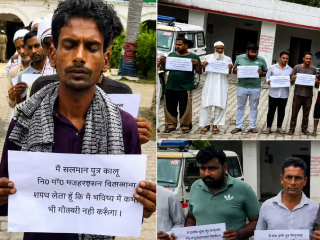 Forty-seven Muslim accused in cow slaughter cases voluntarily report to a police station in Saharanpur (Uttar Pradesh) !
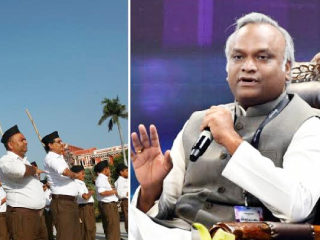 “As long as I remain a Minister, the RSS must obtain permission for its route marches”: K’taka HM Priyank Kharge
 Former IPS officer Rajesh Pandey’s book Antaheen claims terrorist Riyaz Bhatkal was killed in Pakistan by Hindu gangsters
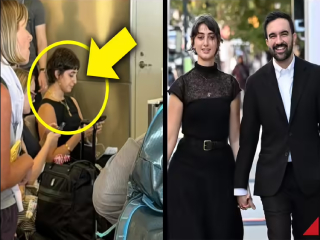 While the US celebrated its 250th anniversary, NYC Mayor Mamdani’s wife attended an Islamic programme in Spain
 Prime Minister Narendra Modi receives death threat ahead of his Australia tour