
The Article discusses the various adaptations and retellings of Valmiki’s Ramayana since its composition. Many poets have creatively adapted the epic across Greater India, adding value while preserving the original vision, though some adaptations lack aesthetic or philosophical appeal. Traditional Indian writers have always held Valmiki and the Ramayana in high esteem and never disrespected them.
A.K. Ramanujan’s misleading essay, 300 Ramayanas seeks to displace Valmiki as the original author, motivated by the Leftist narrative tools and tactics.
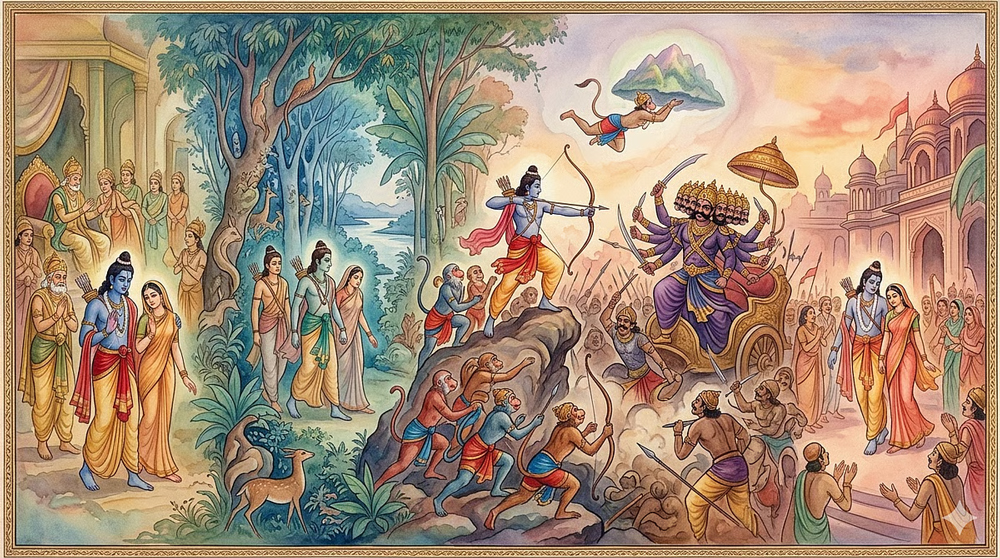
The ‘Other’ Ramayanas
Since the time of the composition of the Ramayana by Maharshi Valmiki, there have been many creative adaptations of the epic throughout Greater India. In many cases, poets have added value to the original story and have exercised creative liberty without compromising on the vision provided by the Sage. There are a few adaptations which are neither aesthetically nor philosophically appealing. Nevertheless, none of the traditional Indian writers on the Ramayana have disrespected the epic or its poet. They have held both in high esteem.
As if to answer why poets always use the story of Rama as the raw material for their literary works, Murari in his play Anargha-raghava says,
यदि क्षुण्णं पूर्वैरिति जहति रामस्य
चरितंगुणैरेतावद्भिर्जगति पुनरन्यो जयति कः।
स्वमात्मानं तत्तद्गुणगरिमगम्भीरमधुर-
स्फुरद्वाग्ब्रह्माणः कथमुपकरिष्यन्ति कवयः।। – 1.9
“If we abandon the story of Rama merely because it has been used by earlier poets, can we find another person who is endowed with these many positive qualities ? How else can we repay our debts to language, other than recounting the profound qualities of Rama ?”
Murari’s words also point to the fact that literature is not meant only for enjoyment but must also possess a moral view – it must help better our lives.
The different versions of the Ramayana may be broadly classified under four categories :
1. Sub-sects of the Sanatana-dharma using Ramayana for the propagation of their schools of thought : It is not surprising that a work which has enraptured the hearts of the masses for millennia will be used by the newer sects as vehicles for propagating their schools of thought. The Buddhists, Jains, Shaivas, Vaishnavas, and Shktas, among others, have created their versions of Ramayana.
While the sentiments of these ‘religious poets’ need to be respected, we must keep in mind that their works are mostly agenda-driven and may not be aesthetically appealing. The original Ramayana by Valmiki, however, is devoid of such ‘religious’ agendas and is composed purely for aesthetic delight and the realisation of universal human values. Nevertheless, we must note that the ‘religious poets’ have not marred the personality of Rama.
2. Ramayanas attributed to Valmiki; Folk traditions : The Adhyatma-ramayana, Ananda-ramayana, Adbhuta-ramayana, Yoga-vasishtha, and the like are attributed to Valmiki. They consist of episodes that are different from those found in the original Ramayana. They are also different from the original in their style, diction, content, and vision. Many a times, these Ramayanas attempt to justify the actions of the primary and secondary characters of the epic.
In some cases, they aim to preach philosophical concepts through didactical segments using the storyline as a pretext. While the original Ramayana has rasa as its focal point, the other Ramayanas were composed by poets driven by non-aesthetic purposes.
It also appears that the authors of these works have added fantastical elements for the entertainment of the masses. In many cases, the stories from these retellings have either inspired many folk traditions or have included within them stories popular in the folk traditions.
For instance, the Citra-pata-ramayana, portrays a kind of dispute between Sita and an imagined sister of Rama. The sister-in-law demands that Sita should draw a picture of the rakshasa who had abducted her. Sita draws only Ravana’s feet claiming that she never looked at his face. It is evident from such versions that everyday family feuds have been extrapolated into the retelling of the epic.
3. Classical works of literature based on the Ramayana : Poets writing in Sanskrit and regional languages have primarily relied upon Valmiki’s original; in some cases, they have drawn inspiration from various folklores as well.
Bhasa, Kalidasa, Bhavabhuti, Murari, Rajasheekhara, Kshemendra, Jayadeva, Kumaradasa, Abhinanda, Shaktibhadra, and others have composed plays and poems based on the Ramayana. In many cases, they have taken creative liberty as though to indicate their perspective on particular characters and episodes.
These literary works also reflect the tastes of the society of the particular period and place. Kalidasa in his Raghuvansha only makes a small deviation from the original, where he says that Ahalya turned into a stone due to Sage Gautama’s curse.
Bhasa deviates so greatly from the original story that it partially loses the grand vision provided in the original; he ends up portraying Kaikeyi as a positive character. Many a time, such literary works are appealing because of their poetic charm and not because of their plot or character development.
The plays and poems composed after the times of Bhasa and Kalidasa have, at certain instances, deviated so enormously from the original that towards the end of the classical era (around 9th Century CE), Ananda-vardhana cautions poets –
संति सिद्धरसप्रख्या ये च रामायणादयः ।
कथाश्रया न तैर्योज्या स्वेच्छा रसविरोधिनी ।।
(Udyota 3, segment after karika 14)
Ramayana and other epic poems are siddha-rasas, i.e., have attained perfection in rasa and poets should not meddle with it as per their whims and fancies.
Poets may take creative liberty in the secondary and tertiary aspects of the story, but they must examine precautions such that they do not disrupt the fundamental values the epic aims to communicate.
4. The leftist narratives : In recent decades, there has been a rampant tendency to look at the classics through the lens of ‘-isms’. The story of the Ramayana is either misinterpreted or manipulated to suit certain socio-political ideologies; in such narratives, the aesthetic and spiritual vision of the original is compromised and the ultimate purpose of rasananda is lost.
Readers must be careful before laying their hands on such works – in most cases, they contain Ramayana only in name and not in spirit.
As reiterated a couple of times in the preceding sections (of the website), no true Indian has ever been disrespectful to Valmiki, Rama, and the Ramayana.
The Influence of Ramayana
The Ramayana is truly the national epic of India. It has served as the raw material for all forms of classical and folk art including literature, music, dance, drama, puppetry, sculpture, painting, and cinema. The earliest literary work which creatively retells the story of the Ramayana is the Mahabharata.
Thereafter, we see its influence in the Buddhist and the Jaina works; the earliest dramas based on the Ramayana are those by Bhasa. Kalidasa was amongst the first poets to write an epic based on the Ramayana.
Poets writing in regional languages have contributed immensely to the Ramayana literature – the Kamba-ramayana in Tamil, Krittivasa-ramayana in Bengali and Tulasi-ramayana in Avadhi are good examples.
While it is difficult to tell the exact date of composition of the Ramayana, we can confidently say that it was composed after the Vedas were realised and before the Mahabharata was born; while the Mahabharata makes quite a few references to the Ramayana, the Ramayana does not mention anything connected with the Mahabharata. Ramayana was composed many centuries before the times of Buddha.
(Courtesy : Article by Mr Arjun Bharadwaj posted on dharmadispatch.in; 23.3.2026)
DVG’s Profound Commentary on the True Essence of Rama Rajya
|
 Criminal case against 11 members of a Christian organisation who claimed that “Hindu is an abusive term, meaning thief, bandit and slave” will not be quashed !
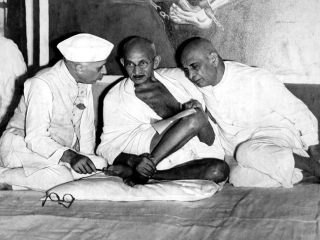 Nehruji’s Selection by Gandhiji for Congress Presidentship Again and Again
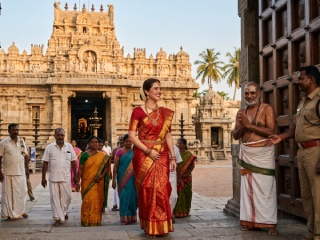 A person’s nationality or foreign name cannot determine their faith in Hindu Dharma !
 Radiant Thoughts of Sachchidananda Parabrahman (Dr) Jayant Athavale
 We pay our obeisance a million times on the Birthday (as per Tithi) of
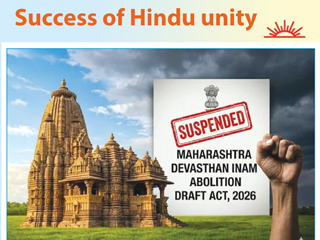 Major win for Hindu unity : Maharashtra Government suspends the controversial ‘Devasthan Inam Abolition Draft Act’