
19th April 2026
The ancient Sanskrut Holy text Madanratna says that Bhagawan Shrikrushna narrated the importance of this day – ‘O’ Yudhishthir, the offerings and the oblations in the sacrificial fire on this day never go in vain’. This is why, the Sages have given the name Akshayya Trutiya to this day. Everything done on this day for the Deities and ancestors is Akshayya (Imperishable).

1. A day that marks the end of Satyayug and the beginning of Tretayug
In every Yuga (Era), with the passage of time, sattvikata (Spiritual purity) keeps reducing, meaning, the effect of Raja-Tama components goes on increasing. The ability of humans to perform spiritual practice reduces and they do not abide by Dharma (Righteousness). Then, Dharma experiences lethargy. God incarnates to re-establish Dharma, and creates appropriate means of spiritual practice which can be followed by humans. This helps in increasing the sattvikata and beginning of Satyayug of the next Era.
This transition period is known as Shunyakal or Kalahakal. As per Hindu Scriptures, the day marking the end of one Era and beginning of another is considered to be very important. It marks the end of Kalahakal of one Era and commencement of the Satyayug of the next Era. This Muhurt (Auspicious time) lasts a few moments; but its effect lasts 24 hours. Therefore, the whole day of Akshayya Trutiya is considered to be auspicious.
2. Other significance of Akshayya Trutiya
Akshayya Trutiya is also considered to be one of the 3-1/2 auspicious Muhurts. To be precise, the auspicious Muhurts are – Chaitra Shukla Pratipada (Hindu New Year), Vijaya Dashami and Akshayya Trutiya. These are the 3 Muhurts, and Bali Pratipada is considered as half-a-Muhurt.
On this day, Incarnations of God such as Hayagreeva, Parashuram and Nara-narayana also manifested. On Akshayya Trutiya, the Principles of Brahma and Shri Vishnu jointly descend onto the Earth, which increases the sattvikata of the Earth by 10%.
On this very day, River Ganga and Goddess Annapurna descended on Earth. Sage Vedavyas commenced the composition of the Mahabharat, Deity Kubera became the Deity of Wealth and Yudhishthir got the Akshayyapatra (A Divine vessel given by the Sun, which offered a never-depleting supply of food to the Pandavs every day), and Adi Shankaracharya composed the Kanakadhara hymn on this day.
3. Method of celebrating the festival
The Scriptures prescribe rituals such as ritualistic bathing, donations, etc. on this day. Apindak shraddha (Rite for departed ancestors) is also recommended on this day, and if this is not feasible, then at least sesame seeds should be offered.
Offerings should be only to the deserving. Offering to Saints or spiritual organisations that spread Dharma in society is an offering to the deserving. By offering to the deserving, the act of donating becomes akarma-karma (An act, action which despite being a karma bestows the benefits of akarma [An act, action which does not give rise to destiny]). The account of merits-sins is not applicable to akarma-karma. Therefore, the donor is not entrapped in any attachment, and this helps in his spiritual progress.
4. Meaning and purpose of Til-tarpan
 Til-tarpan means offering sesame seeds and water to Deities and ancestors. Tarpan means offering water to Deities and ancestors to appease them. Water offered for ancestors is called Pitru-tarpan. Ancestors expect their descendants to offer Pinda and Brahman-bhojan (A meal to a Brahman) as well as water.
Through Tarpan, ancestors are satisfied. Sesame seeds symbolise sattvikata and water symbolises pure bhav (Spiritual emotion). Deities are offered white sesame seeds and ancestors are offered black sesame seeds. Black sesame seeds emit vibrations of Raja-Tama components, with the help of which unsatisfied souls of ancestors can easily come to the place on Earth where such a rite is being performed. They subtly partake the offering made in their name and get satisfaction.
(Note : White sesame seeds emit sattvikata, whereas black sesame seeds have added characteristics of emitting Raja-Tama vibrations, thus are specifically used in rites for ancestors. They attract the subtle bodies to the site of rites.)
5. Method of performing Til-tarpan to the Deities
A. First, hold a round, shelving metal plate of copper.
B. Remember Deity Brahma and Shri Vishnu and their Incarnate form Shri Dattatreya, and pray to them to descend onto the plate.
C. Have the bhav that Deities have descended onto the copper plate in their subtle form.
D. Take white sesame seeds and with the bhav of offering them to Deities, let the sesame seeds flow from the palm through the fingers into the copper plate by pouring water on the palm, so that the seeds fall in the plate.
E. Join your palms and pay obeisance to the Deities.
This is the method of Til-tarpan to the Deities. When sesame seeds and water are offered with bhav to Deities, the individual who is making this offering can imbibe sattvikata of the Deities to a larger extent.
6. Importance of performing Til-tarpan for departed ancestors on Akshayya Trutiya
On this day, sattvikata from higher regions reaches the Earth to a greater extent. Many souls from the Nether region come close to the Earth on this day to imbibe this sattvikata. This can cause distress to human beings. Distress due to unsatisfied ancestors’ souls is about 30-40% in today’s times. Since their souls come close to the Earth, they get energy through the Til-tarpan and attain momentum for their further journey.
7. How to perform Til-tarpan for the departed ancestors ?
A. Take a round, shelving metal plate of copper and pray to the departed ancestors to descend onto the plate.
B. Have the bhav that ancestors have descended in the subtle form onto the plate.
C. Take some black sesame seeds in your hand.
D. Pray to Shri Vishnu and Deity Brahma for the sesame seeds to get charged with their Principles.
E. Then, these sesame seeds charged with the Principles of Deities, should be offered in the copper plate while letting the water pass through the space between the thumb and the index finger. Have the bhav that you are offering sesame seeds and water to your ancestors.
F. Pray to Shri Dattatreya, Deity Brahma or Shri Vishnu for the smooth onward journey of the ancestors’ souls.
8. What is the effect of Til-tarpan ?
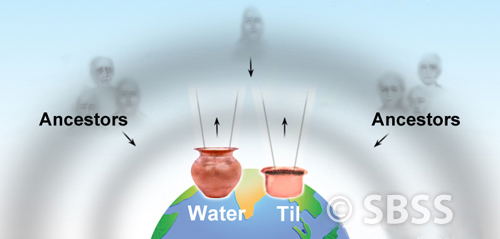 Ancestors love sesame seeds. When sesame seeds are used, negative energies do not create obstacles in the ritual being performed for the ancestors. Sesame seeds have greater ability to imbibe sattvikata and destroy the Raja-Tama components.
Upon invoking the subtle bodies of the ancestors during Til-tarpan, they descend onto the copper plate as per the bhav of the individual. These subtle bodies have a distressing covering around them. Upon performing Til-tarpan, they imbibe the sattvikata.
The subtle body that is satisfied with the ritual, starts shedding the distressing covering and a protective sheath of Chaitanya (Divine consciousness) begins to form around the subtle body, which obtains energy and vital energy necessary for its onward journey. As a result, the subtle body loses its grossness, becomes light in weight and obtains momentum.
Due to Til-tarpan, distress caused by ancestors’ problems reduces by about 5-10%. By performing Til-tarpan on the day of Akshayya Trutiya, the individual who is performing it is able to repay his debt unto the Deities and ancestors to some extent.
(Ref.: Sanatan’s Text – ‘Appropriate method and science in celebrating Holy festivals’)
1. Donation of Udak-kumbha : On this day, offer an Udak-kumbha (Water-filled pot) to a Brahman with the intent of offering it to Deities and ancestors. The Udak-kumbha is known as a ‘nirgun vessel at an all-inclusive level’.
2. Objective :
A. Donating the Udak-kumbha implies immersing all gross and subtle desire waves related to the body and actions into the sanctified water in the pot. In this way, purify the body through detachment-oriented actions, and then offer all desires at the feet of Deities and ancestors through the medium of a Brahman.
B. By donating the Udak-kumbha at the feet of ancestors, being connected to the human species, they help destroy our gross desires.
C. The grace of Deities destroys sins arising from subtle destiny-bound actions; hence, subtle action-related desires are offered at the feet of Deities through this donation.
3. Mantra to be recited while donating Udak-kumbha :While offering the Udak-kumbha to a Brahman, chant the following mantra :
एष धर्मघटो दत्तो ब्रह्मविष्णुशिवात्मकः ।
अस्य प्रदानात् तृप्यन्तु पितरोऽपि पितामहाः ।।
गन्धोदकतिलैर्मिश्रं सान्नं कुम्भं फलान्वितम् ।
पितृभ्यः सम्प्रदास्यामि अक्षय्यमुपतिष्ठतु ।।- Dharmasindhu
4. Science : On this day, Sattva-Raja predominant unbroken waves with uniform motion prevail in the Universe. Hence, donations made to a Brahman with the intent of Deities and ancestors become highly meritorious. As karma (Actions) performed by taking into account the give-and-take accounts of past births transforms it into akarma (Non-action), donations made through these imperishable waves gain special importance.– Astrologers Rahul Narayanrao Puranik and Akash Narayanrao Puranik, Jalna, Maharashtra
 Special court acquits MLA T. Raja Singh
 Radiant Thoughts of Sachchidananda Parabrahman (Dr) Jayant Athavale
 We pay our obeisance a million times on the Birthday (as per Tithi) of
 Major win for Hindu unity : Maharashtra Government suspends the controversial ‘Devasthan Inam Abolition Draft Act’
 Mumbai-based advocate Siddhavidya, who is trying to stop trafficking through surrogacy (artificial pregnancy) and animals, and animal killing
 Secularism and the ‘Hindu Rashtra’