
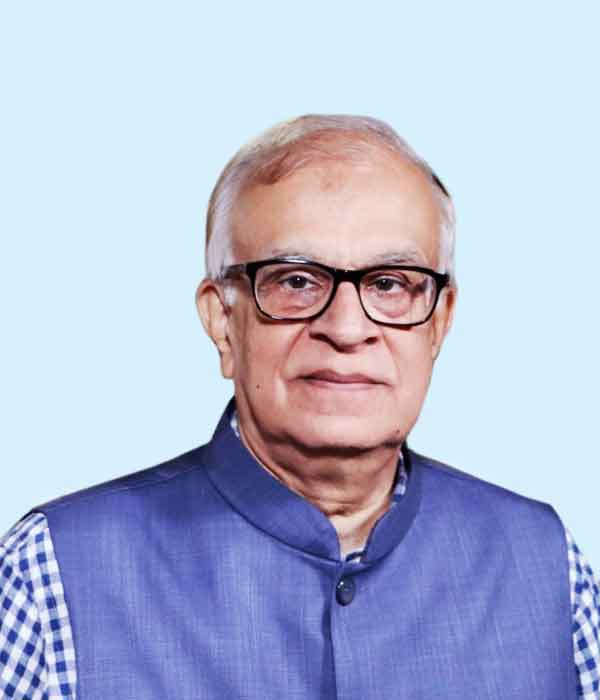
Speaking to Manish Pant, Rajiv Malhotra deals with a series of issues ranging from Buddhism and its impact on Hindus, the Indian way of thinking, teaching Arthashastra and Sanskrit to youngsters, evangelical myth-making and a possible Indian Renaissance. Here are excepts from the interview.
| It is the time of great challenge that is also the time for new hope and beginnings. Are we on the cusp of the New Indian Renaissance ?
The Indian Renaissance could happen. We would like it to happen. But it can happen when people who are the insiders with some authority are actually together and very clear. I am not sure whether we are there yet. We don’t want a Renaissance where we are sold out. That could also happen. We are having a Renaissance in yoga, but we have lost the whole system. Already people are saying the history of yoga is not from Hinduism but that the YMCA started yoga ! There are best-selling authors in the academic world who have written about the history of yoga that it was the YMCA who brought exercise to India because we were a weak people who needed to become strong. The Hindus decided to call it yoga. And our people accept these things. Same people are brought here to give lectures. The media in India thinks of them as experts. So our problem is not just with outsiders but also with a lot of our own insiders. |
Manish Pant (MP) : You talk about India being a different civilisation. What sets us apart ?
Rajiv Malhotra (RM) : Well, every civilisation is distinct. Arabs are a different civilisation. Chinese are a different civilisation. So it is not that only ours is different. Every civilisation has its own distinctiveness because it has its own geography, its own lifestyle, its own history and its own vichardhaara or way of thinking, which has evolved by itself. Our civilisation is different because in this great land for a long time we have had a continuous stream of thinkers and enlightened beings coming and new events happening. So the product of all that is our civilisation. And that’s why it is distinct. Now people may argue whether it is distinctly better or worse. That is a separate argument. But it is distinct. There is no doubt about it.
MP : What in your view are the main causal factors behind the decline of Hindu India ? Is the 1,300-year long process that began with the invasion of Sindh by Muhammed bin Qasim in 695AD responsible ?
RM : The sad thing is that when these invasions started there was no unified response. Somehow we lacked this sense that the Kshatriyas have to come together. That for some reason, we don’t know why, but it wasn’t there so much. I also feel that Buddhism had an impact in making Hindus docile. There is a theory that the expansion of Buddhism had the effect that there wasn’t the fiery fighting spirit like the one there used to be at one time. So maybe we became kind of willing to put up with all kind of invasions. My feeling is we somehow lost the Arthashastra training for some reason. We should find out why. And so the strategic thinking that the Arthashastra teaches wasn’t there in our young people. It could be a multitude of factors. My book The Battle for Sanskrit says we forgot the idea of doing purvapaksha on others. You become weak when you stop studying other people. When you are no longer keeping in touch with your competitors, on what are they up to, then you are gradually going to get weak. Somehow we stopped the purvapaksha tradition, which was very alive till the time of Adi Shankaracharya.
Now the strange thing is that from that time (seventh century) onwards, we have been busy debating with each other. Debating some Sankhya, Charvaka or Buddhist; one school of thought discussing with another school of thought. But why didn’t they study the Muslims as they were already there ? Christians had arrived on the Kerala coast long ago. But there was no purvapaksha, no analysis that this is our view of these people : Their church structure, their political thought, their economic thought, their metaphysics, their family life, all of that. We should have done an analysis. After all, we were highly educated people, we have a purvapaksha tradition, but it was not used in that way. So I think that the lack of purvapaksha of these foreign forces, was one of the many important factors in the decline of our culture.
MP : How relevant is the study of Sanskrit in contemporary India ? What is your take on the onslaught by a cabal of Western scholars to hijack it ?
RM : Sanskrit is many things as I have explained in The Battle for Sanskrit. At one level it is a language in which you can order a cup of chai or taxi. However, to me that’s not the most interesting thing. The language contains some non-translatable words. It contains words that you do not find in another language because our civilisation and our experiences are different. We have a word like yoga, which can’t be exercise, gymnastics or prayer. We have unique words in the Sanskrit language that ought to be preserved because they are very powerful and part of who we are. To me, that is one of the most important things.
Another important thing is the mantra. The idea of going into a higher state of consciousness through this whole mantra practice is I think a very important part of who we are. Sanskrit is also the keeper of the unity of our languages because it has influenced, if not all, most of them to varying degrees. Even Tamil, but maybe not as much as other languages. It has been the kind of an architecture of language and grammar. Words from many languages and ideas and so on, have gradually made their way into Sanskrit and become formalised. Once they are formalised they are transported to different parts of India and put back into local languages. So it’s like a language highway where language X and language Y communicate through Sanskrit. This is a very interesting process.
I think our Shastras are important in understanding as to who we are. And we should not translate them into English and do away with the Sanskrit originals. Or put them in a museum, which is what the Murty Classical Library wants to do. In a sense, kill Sanskrit and then say it was already dead. Writing a theory that Sanskrit died a 1,000 years ago, as if that would justify killing it now. And then you can say, “Oh, but it was already dead !”
This business that we will write 200-page short introductions in English and sell them for Rs 100 each, flood the market, put them through the Ministry of Human Resource Development in schools, media and everywhere, and then the Sanskrit originals don’t need to be read, that’s like saying let’s put the pundits out of business. Let’s put all these pathshalas (schools) out of business as we don’t need them. Then in all these Anglicised schools we will teach you what you need to know. And, of course, it will be interpreted through someone who is on their side. That’s very dangerous. So we need to reconnect all that. We need to take over this thing.
MP : But the same set of scholars who blame Sanskrit for being an oppressive idiom don’t have a problem with Persian, which was the court language during the Mughal period.
RM : Or Arabic… Or Chinese…
MP : Or English now.
RM : Or English. Or Latin. Or you look at Greek. Plato, Aristotle and Socrates. Plato talked about genocide. Socrates had slaves. But we don’t complain about their classics. You look at Latin. The whole history of the Church is about spreading and abusing and killing people. All those genocides, slavery and all that, there is a Latin discourse on that. But we don’t say that it is a dead language because all of these things happened.
And look at the oppression in the English language going on right now. If you wanted to go and blame all those guys you would be called intolerant, communal and so on. But the same standards don’t apply to them. This is our situation. But in China they will hit you back if you said your Mandarin led to all these bad things. If you go to some Arab country and start giving a lecture on the abusive discourse in Arabic at a university, they will kick you out. But in our country they welcome you. It’s our own inferiority complex.
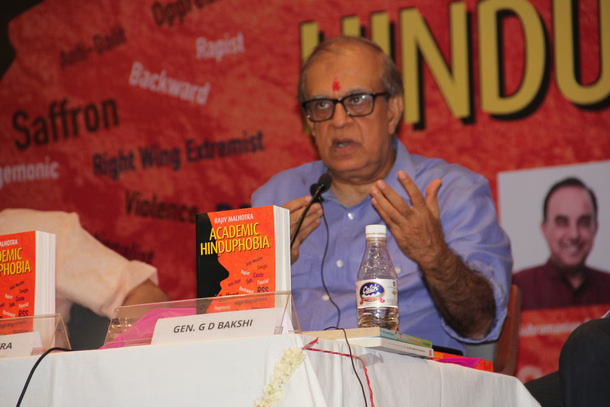
MP : While talking about one segment of insiders, in the epigraph to your latest work Academic Hinduphobia you write : “… the Indian Sepoy archetype, found in the Western academe and journalism, often does the dirty intellectual work. Their role on behalf of the dominant culture is to supply the myth of the “other” in a way that fits into the dominant culture grand narrative of itself.” How is this myth-making contrived ?
RM : Every civilisation builds myths about itself. Like a corporate entity it builds brands or propaganda. Civilisations too do it. That’s natural. Everything from their flag to their anthem has a lot of truth in it, lot of propaganda.
The interesting thing is that those who are colonisers have mastered the ability to take the colonised people and make them feel they are part of this myth only. That’s how these modern sepoys, the high flyers who go to these literary festivals and all that, they are now made to feel that they are part of this Western myth. Aapko bhi membership mil gayi hei (You too are a member now) !
Maybe it is at a junior level. Maybe it is temporary. Maybe it’s a few notches below the glass ceiling. But at least you have arrived. You are inside the door. This idea of making Indians feel part of the Western myth attracts a lot of our people into joining it. That’s what is going on. It’s a very sophisticated brainwashing mechanism. That is how the Western myth-making has expanded to include lots of Indians into it.
Similarly, the Islamic myth-making has expanded in this country and then through Sufism a lot of people think, “Wow ! I’ll also be a Sufi. What difference does it make ?” But these are competing myths. The friendly soft part of the myth, is a front to get you in. But once you are in, you go through more cleaning up to get upgraded to higher versions. From version 1.0 to version 2.0, to 3.0 to 4.0.
As you get more and more into that myth, you are asked to give up the earlier stuff that you knew about your own past. That is how it happens; there is a clash of myths.
MP : Therefore, you often warn against Hinduism getting enculturated or digested by the dominant Western culture or other narratives. But can that also work the other way around where Hinduism ends up accommodating or enculturating the dominant Abrahamic faiths into its humungous pantheon ?
RM : That too could be dangerous if you are not strong enough. Let’s say you look at two corporate mergers. When corporate X acquires corporate Y, you might say Y is winning, they can also have the upper hand. But somebody is controlling the merger. They will decide who stays, who is fired, whose factories will continue, what products will live. In a corporate merger there is a dominant side. It always generally happens. Similarly, when civilisations say we will assimilate them, they are assimilating us. The point is that at the end of the day we will end up like the pagans. Pagans and Christianity had a similar marriage. But it was not equal. Christianity borrowed many things from Paganism. Enculturated many things from Paganism. And Pagans were led to believe that Paganism is alive and well and Jesus was added to their pantheon. Even now when Christian missionaries visit the tribal areas of Latin American and Africa, they tell them you keep worshipping your natural Deities from your ancestors, but we will also put Jesus in a corner. But over the years that corner becomes bigger and bigger.
MP : Like what has happened in the North Eastern part of our country ?
RM : Exactly ! So you see, because they have a strategy, we don’t; they have teamwork, we don’t; they have organisational skills, we don’t; they have funding, we don’t. They know how to do this as they have been doing this for a long time. It’s like you are playing a game with somebody who has played it very well and you don’t know what you are doing. Even if one individual knows what he is doing, he can’t get all the other people to be on his side. If we were to play this game, we would first have to build a team. We would have to have a very consistent grand narrative of who we are. What we will compromise on and what we will never compromise on. How we are going to play the game. We will have to be very clear that the other guys, our opponents, are trying to defeat us and we have to defeat them. Imagine a cricket team where half the players imagine there is not even an opposing team and they keep playing. Or say in soccer they kick the ball around randomly. It will be confusing. You will never be able to win if most of your players don’t even understand that we got to beat them as they are trying to beat us, and here is how the game is played.
Our problem is that we don’t have our act together; we aren’t united. We don’t have leadership with enough clarity and enough strength to bring us together. That’s our problem. Until we can do that, we’d better not go around and say we can beat them. We have to first strengthen ourselves.
MP : How is Hinduphobia so successful in academia, media and popular culture ? What can be the best possible counter-strategy to it ?
RM : They have done lot of purvapaksha on us. We haven’t done that on them. They have studied the caste system. The Ford Foundation has invested in hundreds of NGOs on women’s issues, feminist issues and pollution issues. They are constantly studying what is weak and exploiting it. They have a very systematic long-term view of trying to do this to us. Therefore, they have come up with many Hinduphobic ideas about us. Our prestigious people still give them awards, thinking that I am some kind of a bad guy, who speaks nonsense. I would say a very large part of our problem is ignorance of our people and then being sold out because they have some business or political interests to be aligned with those guys. That is why the Hinduphobia has spread so much. And the resistance from our side is weak, with very few people doing that. They don’t have enough knowledge, passion and courage to resist. That’s our problem. So we have to reverse these things now. As a person, I am doing what I can by spreading awareness. As more people become aware, I want them to spread my books and videos to other people. It’s only going to go as a word-of-mouth game. But it is looking good as more people are looking interested than used to be the case earlier.
(Courtesy : Excerpts from an interview with Mr Rajiv Malhotra; posted on rajivmalhotra.com; 18.9.2025)
| Mr Rajiv Malhotra is a visionary who propelled Hindu Dharma from being dismissed as fringe to standing confidently on the global stage. A fierce intellectual, a tireless civilizational sentinel, and often the lone Hindu voice in the West, his contributions are legendary. Mr Manish Pant is an independent media and communication consultant specialising in content, and is based in New Delhi. |
| The Indian Renaissance could happen when people who are insiders with some authority are actually together and very clear ! |
 Case registered against husband and wife for propagating Christianity at Sassoon General Hospital, Pune
 Criminal case against 11 members of a Christian organisation who claimed that “Hindu is an abusive term, meaning thief, bandit and slave” will not be quashed !
 The Samajwadi Party and Cong. Govts committed the sin of having namaz offered on the steps of Hanumangarhi Temple ! : UP CM Yogi Adityanath
 ‘If kumkum comes from Islamic countries, will Hindus stop applying tilak ?’ : Cong. HM Priyank Kharge
 Andhra Pradesh: Miscreant lights cigarette from the sacred lamp placed before the Shivalinga !
 Nehruji’s Selection by Gandhiji for Congress Presidentship Again and Again