
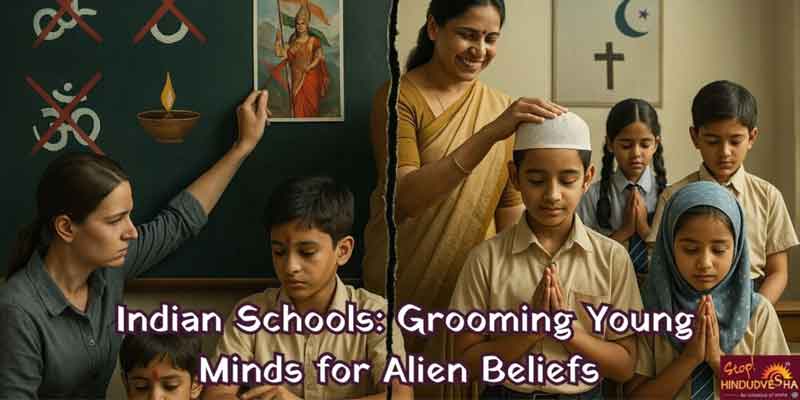
Behind the façade of “secular” education, a systematic campaign is unfolding to replace Hindu cultural pride with Abrahamic indoctrination, ensuring that the next generation grows up disconnected from, and even hostile to, their civilizational roots.
Ms Rati Agnihotri is an independent journalist and writer currently based in Dehradun (Uttarakhand). She has extensive experience in broadcast journalism. She has worked across radio and digital media. She is regularly contributing news analysis videos to a nationalist news portal with a considerable YouTube presence.
For centuries, India’s education system has been shaped to distort history and weaken Hindu civilizational identity. From colonial policies to post-Independence curricula, the contributions of Hindu rulers and thinkers have been downplayed or erased, foreign invaders glorified, and Bharat’s ancient history reframed through a Western lens. Indian knowledge systems were ignored while Western achievements were celebrated. This bias persisted for decades, with NCERT textbooks praising Mughal emperors and reducing Hindu heritage to the margins. The New Education Policy 2020 has begun reversing some of these distortions – rightly calling Aurangzeb a ‘temple destroyer,’ Babur a ‘brutal invader,’ and portraying Akbar as ‘a blend of brutality and tolerance.’
Yet the deeper problem lies not just in what is printed, but in the culture of schools themselves. For many Hindu children, the bias is lived reality : The sting of being mocked for a bindi, the embarrassment of hearing a sacred thread called ‘backward,’ the hurt of having their festivals dismissed as superstition. It surfaces when they are discouraged from speaking their mother tongue, or when Diwali passes unnoticed while other festivals are celebrated with fanfare. Some endure open bullying or even physical intimidation – sometimes from peers, at times from teachers.
Day after day, these experiences erode pride and belonging, turning schools – meant to nurture and uplift – into quiet battlegrounds where Hindu Dharma, culture, and civilization are steadily undermined. This ongoing weaponization of schooling is one of the least acknowl-edged but most urgent challenges facing India’s future.
From Kalawa to Tilak : Symbols Under Siege
There is an alarming number of incidents involving the bullying, harassment, and intimidation of Hindu students for displaying their cultural and religious identity and symbols, if media reports are anything to go by. Although this phenomenon has not received the media attention it deserves in terms of an overall analysis of the rising trend of hate crimes against Hindu students in schools, many standalone stories report specific instances of such bullying and harassment.
The mainstream media generally avoids reporting these stories unless the incident becomes so significant that it makes national headlines. However, niche nationalist media publications report many such cases involving the targeting and abuse of Hindu students for their religious and cultural identity.
One such gruesome incident involved the assault of a three-and-a-half-year-old girl in a Chhattisgarh school, which recently hit the headlines. The principal of the school was arrested for allegedly beating the child and sticking tape on her mouth as punishment for greeting her with ‘Radhe Radhe’.
The principal of Mother Teresa School in Bagdumar, Chhattisgarh, reportedly became angry over the child’s greeting and physically assaulted her, along with publicly humiliating her. According to the FIR, the child had injury marks on her cheek and scratches on her stomach, as reported by Hindustan Times.
In another incident, 30 students in a school in Bihar were allegedly beaten by two schoolteachers for wearing a Kalawa (the sacred thread worn by Hindus) on their wrists. According to media reports, the teachers – identified as Christians – had specifically targeted the children for wearing the Kalawa. In a similar instance at Carmel Convent School in Bokaro, Jharkhand, a high school student was beaten by a schoolteacher for wearing a Kalawa and was forced to cut the thread.
One finds numerous reports of such incidents from schools across the country, where Hindu students are harassed or assaulted for wearing a Kalawa, sporting a Tilak, or even for wearing rakhees on their wrists. If you search online for phrases like ‘Hindu student beaten up for wearing tilak’ or ‘Hindu student beaten up for wearing Kalawa,’ you will find many gut-wrenching accounts from schools across India. Given the alarming number of reported cases, one can only imagine how many more remain unreported. It is difficult to believe that Hindu schoolchildren face such ordeals in a ‘Hindu majority’ country. Yet this is the grim reality, where ‘secularism’ is often weaponized to dismiss Hindu concerns and amplify ‘minority issues’ to the extent that the oppression of the so-called majority is normalized.
There are also numerous instances of Hindu students being bullied or coerced into participating in Abrahamic religious practices and traditions in schools. In July, a video surfaced on social media showing Hindu students from a school in Kota, Rajasthan, being made to recite the Kalma (Islamic prayer) during a morning assembly session. Although the school authorities denied the allegation, claiming the footage was several years old and recorded during an annual function, the District education department has launched an investigation.
In another incident that happened at a school in Gujarat in October 2023, Hindu students were allegedly asked to perform Namaz as part of an awareness program at a local school. In a recent incident at a Government school in Ujjain, Madhya Pradesh, a schoolteacher allegedly burned images of Hindu Deities and Bharat Mata. The teacher has also been accused of forcing students to perform Namaz and study the Quran. According to students’ testimonies, he destroyed the images of Maa Saraswati, Bhagawan Ganesh, and Bharat Mata in front of them and then set the images on fire.
In March 2024, OpIndia published a report detailing 14 incidents across India in which schools were accused of coercing students into celebrating Eid. One such case involved the prominent Delhi Public School (DPS) in Gurugram, which announced a virtual Dargah tour for students in Classes 1 and 2, ostensibly to help them understand the significance of Eid. The initiative, however, sparked considerable backlash, with critics accusing the school of ‘indoctrinating Hindu children with Muslim culture.’ In another case, a private school in Madhya Pradesh reportedly coerced Hindu students into participating in Islamic cultural practices and traditions, including reciting Islamic prayers and wearing hijabs as part of cultural events held to celebrate Eid.
In March, Auckland House School in Shimla, Himachal Pradesh, reportedly circulated a notice asking primary students to come dressed in a kurta-pyjama and small cap on March 28 as part of pre-Eid celebrations. A.P. Singh, a VHP leader, criticized the move as ‘a blatant example of shallow secularism.’ While acknowledging that celebrating festivals of all religions was acceptable, he argued that dictating dress codes to students went too far, questioning whether the school would issue similar instructions for Hindu festivals, such as Janmashtami or Ram Navami.
The school, for its part, played the victim card, claiming the planned celebrations were part of efforts to inculcate respect and appreciation for India’s cultural diversity. The event was eventually cancelled following considerable backlash. Predictably, the left-liberal ecosystem portrayed the cancellation as a ‘Hindutva’ conspiracy and lamented the supposed rise of religious intolerance in India.
It is the typical modus operandi of the left-liberal cabal : Subtle or overt efforts to indoctrinate Hindu children into the Abrahamic ecosystem are portrayed as exercises in ‘secularism’ and ‘religious diversity.’ A section of the Indian media frames resistance to such tactics as part of the so-called ‘Hindutva supremacy movement.’ What is telling is that if the tables were turned – if Christian or Muslim students were mandated to celebrate Hindu festivals, or made to wear Kalawa and apply Tilak as part of a dress code – the same left-liberal ecosystem would cry hoarse, claiming that minority rights in India were under brutal attack by the ‘Hindutva’ establishment. Either way, the ‘Hindutva’ ecosystem becomes the convenient scapegoat, leaving Hindu children even more vulnerable to motivated anti-Hindu indoctrination and brainwashing in schools.
Colonial Legacies in India’s Elite Education
It is worth pondering that, more than 75 years after Independence, India’s elite schooling system remains dominated by the missionary school ecosystem. Many of the country’s most prestigious residential schools, located in Nainital, Mussoorie, Shimla, Ooty, and Darjeeling, trace their origins back to British India. The culture of elite schooling in India continues to be shaped, in large part, by this colonial legacy.
At a time when India is proactively working to reshape its civilizational and cultural narrative in light of its ancient Vedic past, the country’s elite schooling – still premised on Western values and ideals – remains stuck in a colonial time warp. What prevents India from integrating the legacy of the Gurukul system into a modern educational framework to foster a school culture aligned with its Hindu ethos ? The dark irony is that, in 2025, institutions that covertly or overtly disseminate anti-Hindu narratives are still touted as the finest in Indian schooling.
Patriotism Punished, Indoctrination Encouraged
On one hand, Hindu students are being coerced into following Abrahamic religious and cultural practices and abandoning their own culture and traditions. On the other hand, they are also being targeted for displays of ‘nationalism.’
While the imposition of Abrahamic practices on Hindu students in schools is often covertly encouraged and, at times, even glorified, expressions of nationalism are subtly discouraged or frowned upon, as seen in shocking cases of students being suspended for chanting ‘Bharat Mata ki Jai.’
This strange mix of Hinduphobia and anti-Bharat sentiment in schools makes the problem even more alarming. If students are being systematically distanced from their cultural and civilizational roots while also being groomed into anti-India narratives, it is a matter of grave concern.
Such incidents are becoming increasingly common. The anti-Hindu ecosystem employs spurious logic to justify the systematic glorification of anti-national discourse. Playing the familiar victim card, such elements often claim that ‘Bharat Mata ki Jai’ is a nationalist slogan with Hindu religious connotations.
While Hindu students are coerced into celebrating Abrahamic festivals and made to recite Islamic prayers or study the Bible, the decision by some state governments to make the teaching of the Bhagavad Gita a compulsory part of the school curriculum is met with disapproval. For instance, The Wire, in criticizing the Gujarat Government’s move to include the Bhagavad Gita as a mandatory learning for Classes 9 and 12 as a first language subject, argued that ‘schools should not be the playground for religious education.’
Maktoob Media called for the inclusion of teachings from all faiths in Gujarat’s school curriculum ‘to uphold India’s constitutional principles of secularism.’ An article in Feminism in India described the inclusion of the Bhagavad Gita as ‘semantic wrangling and the homogenization of Indian culture.’
Wrapping Up
Addressing the rising wave of Hinduphobia in India’s school culture is no easy task. There are no quick fixes to this crisis, and it requires a multi-pronged approach that targets the problem at multiple levels.
To start with, legal support channels for complainants in such cases must be strengthened. The Hindu ecosystem should work collectively to escalate these matters in court and proactively file petitions to protect students’ rights.
In cases where the school management is directly implicated in the abuse or harassment of Hindu students over their religious symbols and practices, there must be a full-fledged inquiry into the funding mechanisms of these institutions. In extreme cases, provisions such as suspending the school’s license should be invoked to send a clear and strong message to Hinduphobic educational establishments.
Finally, the Government should actively promote schools whose culture is rooted in India’s civilizational and cultural ethos. Major private players should be encouraged to integrate elements of the Vedic Gurukul system with modern pedagogy to establish new institutions that incorporate these principles.
This Article is being re-published in Sanatan Prabhat with the explicit permission of the Editorial Team of stophindudvesha.org
(Courtesy : Excerpts from an Article by Ms Rati Agnihotri posted on Stop Hindu Dvesha website )
Original Article on : https://stophindudvesha.org/weaponization-of-school-culture-in-india-using-hindu-children-to-push-toxic-anti-hindu-narratives/
| In 2025, institutions that covertly or overtly disseminate anti-Hindu narratives are still touted as the finest in Indian schooling ! |
 Christian stabs Indian-origin Muslim over his religion in the US
 Porous Borders, Shadow Operatives: Unpacking the Geopolitical Rift in the US-India Intelligence Relations
 We pay our obeisance a million times on the Birthdays (as per Tithi) of
 Offering gratitude unto the Holy feet of the Guru is true Gurudakshina !
 Messages of the Gurus on the occasion of Guru Purnima (29th July)
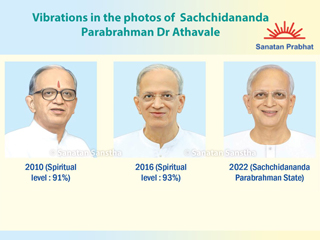 Sadguru (Dr) Mukul Gadgil’s analysis of the vibrations in the photos of Sachchidananda Parabrahman (Dr) Athavale, corresponding to His spiritual level at different times