
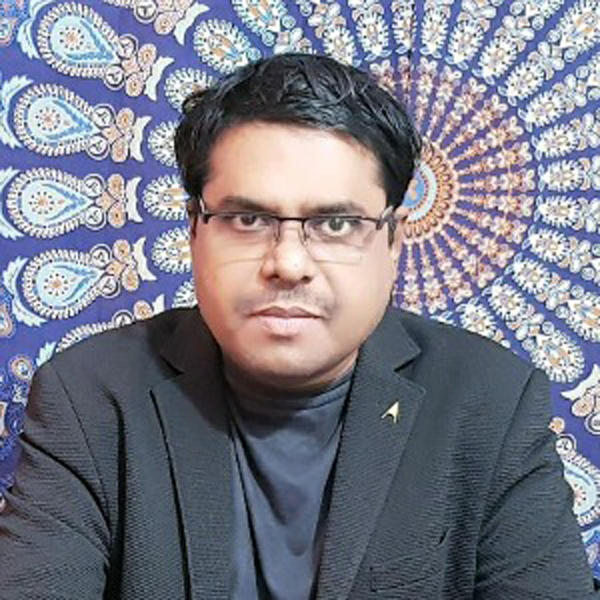
Former ISRO space scientist, and now prolific writer /researcher, Jijith Nadumuri Ravi has been quietly reshaping our understanding of ancient India. His meticulous research on the rivers mentioned in the Rigveda and the geography embedded in the Ramayana and Mahabharata has yielded findings that challenge long-held assumptions.
These insights are captured in his trilogy : Geography of the Rivers of the Rigveda (2022), Geography of the Ramayana (2023), and Geography of the Mahabharata (2024). In the first of the trilogy, Jijith guides readers through the Rigveda’s vast landscape using its rivers as cartographic signposts. The second, based on Valmiki’s text, reconstructs the geography of Bharatavarsha as known to Rama, Valmiki, Agastya, and their contemporaries, uncovering several surprising dimensions of the Ramayana world. In the final volume, Jijith takes on the colossal task of analyzing the entire Mahabharata – all 1,995 chapters and 18 parvas – mapping events, timelines, and places of the Pandava era.
For those seeking authentic geographical data in the Rigveda and the epics / itihasas, Jijith’s books are an essential starting point. He invites scrutiny of his work, quoting the Vedic maxim : “Let noble thoughts come to us from every side.” But, he warns, ‘to counter my contentions, one must read the book.’ However, in these matters of historical data, scholars continue to contend over each other’s claims, and debates can get cantankerous and testy.
My interest in his work began with his spirited rebuttal to Devdutt Pattanaik in the article ‘No, Mr. Devdutt Pattanaik, Krishna Was Not a Negligent Father’, and extended to his philosophical dialogue ‘The Human Soul : A Dialogue Between East and West with American poet and composer Lawrence David Moon’, and his interview with Shrikant Talageri on the Aryan Invasion (AIT) and Out of India (OIT) theories.
Jijith’s scholarship matters because it addresses a longstanding criticism – that Hindus lack historical consciousness, that their past can be reconstructed only from foreign travelers’ accounts, and that their epics are unreliable as historical sources.
In an age of noisy debates about Arya vs. Dravida, oppressors vs. the oppressed, and Brahmins vs. Shudras, voices like his are reclaiming an evidence-based view of India’s civilizational past.
This intellectual renaissance is not being led solely by professional historians, but by independent scholars like Shrikant Talageri, Michel Danino, Vishwa Adluri, Joydeep Bagchi, and Jijith himself – thinkers who combine deep reading of primary texts with data-driven analysis. Their work helps us separate interpolations from original texts, map ancient landscapes, and reframe the question – ‘In the Indian context, what is history, what is myth, what is itihasa, and how do we tell one from the other ?’
Here are excerpts from an exclusive interview with Jijith Nadumuri Ravi :
How did your journey from ISRO scientist to researcher of the Vedas, Itihasas, and Purans – particularly their geography – begin ?
My fascination with the Vedas, Itihasas, Purans, and also with space exploration, the solar system, and planets began when I was just 10 years old. In the 6th standard, I would take blank maps of India – borrowed from my senior cousins – and trace the routes of the Pandavas across them. Later, after joining ISRO, I came across books on the discovery of the Sarasvati River in the office library, which reignited my passion for Vedic studies.
In 2004, I began contributing to Wikipedia, writing articles on each Janapada (kingdom) mentioned in the Mahabharata and Ramayana. But when I realized that Wikipedia entries could be altered by anyone, I decided to create my own dedicated platform – AncientVoice. Today, it hosts over 25,000 pages covering the four Vedas, the Itihasas, and the Vishnu Purana.
What inspired you to write your first book, Rivers of the Rigveda ? Could you also give us a brief introduction to it ?
My original plan was to write a book on the geography of the Mahabharata. I began work on it in 2020, but soon realized that to do justice to the subject, I first needed to study the Rigveda – our oldest text – as well as the Valmiki Ramayana. The evolution of Vedic-Aitihasic-Puranic culture begins with the Rigveda, which records the earliest settlements along rivers such as the Ganga, Yamuna, Sarasvati, Sutudri (Sutlej), Vipasa (Beas), Parusni (Ravi), Asikni (Chenab), Vitasta (Jhelum), Sindhu (Indus), Gomati (Gomal), Sarayu (Haro), and Kubha (Kabul River).
The geography described in the Rigveda matches that of the Indus Valley-Harappan civilization of northwest India, stretching from western Uttar Pradesh to eastern Afghanistan, and from Kashmir to eastern Maharashtra. This Rigvedic landscape eventually gave rise to the Aitihasic geography of the Rama and Pandava eras. Understanding this continuity is what led me to write Rivers of the Rigveda as my first book.
Many Left-leaning historians dismiss our Itihasas as mere mythology. Yet, you have meticulously mapped the geography of the Ramayana. How do you respond to such claims ?
I strongly disagree with the Leftist narrative. That said, without grounding the Valmiki Ramayana in the Rigveda, its occasional exaggerations and magical episodes can make it appear like mere fiction. The Rigveda, though poetic, is far more anchored in reality. For instance, in the Dasharajna battle, it records the participation of 6,000 warriors – a figure that feels historically plausible. This realism provides a solid foundation for analyzing the Valmiki Ramayana alongside the Rigveda and distilling the core historical truths from an Itihasa-Kavya.
The results are remarkably concrete. Evidence suggests that Rama and Shantanu – the great-grandfather of the Pandavas – both appear in the 10th Mandala of the Rigveda and were contemporaries living toward the end of the late Rigvedic period. Likewise, the data points to Ravana as a Harappan king who ruled along the Narmada River, with his Lanka being a Harappan seaport at the river’s mouth. This is consistent with accounts that Ravana’s grandfathers married daughters of the Narmada (Gandharvis), one of whom, Malyavat, hailed from the Malyavat Range of the northern Vindhyas near Yamuna.
It is fascinating that every state in India claims some connection to the Ramayana. How do you view this pan-Indian presence of the epics ?
The Ramayana is so deeply woven into the cultural DNA of India that almost every region has claimed a connection to it. Over time, this has led to numerous popular identifications of places mentioned in the epic – Nasik and Parnashala near Bhadrachalam as Panchavati, Hampi and a hill near Tirumala as Kishkindha, Lepakshi as the site linked to Jatayu, and southern Kanyakumari and present-day Sri Lanka as Lanka.
What are your findings on ‘Sarasvati-Sindhu-Narmada’ Civilization ?
One of the earliest labels for what we now call the Sarasvati-Sindhu-Narmada Civilization was ‘Harappan Civilization’. This name arose when the only known site was Harappa, near the Ravi River in present-day Pakistan. As excavations continued, other major settlements such as Mohenjo-daro along the Indus were discovered, prompting a rebranding as the ‘Indus Valley Civilization.’
Subsequent findings revealed that the largest concentration of sites lay along the Sarasvati River, leading to the term ‘Sarasvati-Sindhu Civilization.’ Later still, archaeologists uncovered settlements along the Narmada River in the south, extending as far as Daimabad in Maharashtra. Given this expanded geographical scope, the most accurate name for this vast civilization spanning the north-western Indian subcontinent is the Sarasvati-Sindhu-Narmada Civilization (SSNC).
Within this framework, the Valmiki Ramayana can be reinterpreted as the story of an expedition undertaken by a prince of Ayodhya, on the banks of the Sarayu River in present-day Uttar Pradesh, to a Harappan port city at the mouth of the Narmada River – from where he rescued his abducted wife.
Do you regard Shri Rama and Shri Krishna as figures of history rather than mythology ?
One of the key conclusions of my trilogy is that Shri Rama and Shri Krishna were indeed historical figures. Their actions, as directly described by Valmiki and Vyasa, reflect human experiences and realities. At the same time, from the perspective of Advaita Vedanta, they are divine, since this philosophy holds that every individual is inherently divine and unified with Brahman. Those who attain full self-awareness and express this Brahman consciousness most clearly are revered as divinities.
Over time, later poets and storytellers added numerous magical and supernatural elements to the Ramayana and Mahabharata, which shaped the evolved versions we know today. These embellishments have led to perceptions of Shri Rama and Shri Krishna as mythical or fictional, obscuring their historical foundations.
The epics and traditional texts are often dismissed as unreliable mixtures of myth, legend, and social biases perpetuated by Brahminical narratives. How do you respond to these criticisms ?
These allegations are unfounded. Our texts reflect a balanced interplay of masculine and feminine principles and are intended for all individuals who seek their wisdom, regardless of social status or classification. Given the great antiquity of our civilization, systematic record-keeping was far more challenging than in Western cultures that arose two to four thousand years later. As a result, some historical details became obscured over time.
Through my research and writings, I have demonstrated that a reasonable reconstruction of India’s distant past is indeed possible by deeply studying the Vedas, Itihasas, and Puranas.
My work extends the historicity of Indian kings well beyond the Mauryan era of Chandragupta to include figures like Parikshit, Yudhishtira, Shantanu, Rama, Sudas, Divodasa, Bharata, and even his ancestors up to Manu as genuine historical leaders.
Cross-referencing these texts is essential to establishing a coherent chronological sequence of events. Treating each text as an isolated source risks producing exaggerated or inconsistent dates that disrupt the historical narrative. For example, considering the Ramayana and Mahabharata separately and relying solely on archaeoastronomy yields inaccurate dates such as Rama living in 12,209 BCE and the Kurukshetra War taking place in 5561 BCE.
This conflicts with the historical continuity, as characters like Parashurama, Hanumat, Markandeya, Durvasa, Jambavat, Mainda, Dvivida, Vibhishana, and Vaisravana interact with both Rama and the Padavas. Their presence in both narratives indicates that the eras of Rama and the Pandavas followed one another closely, without a gap of several decades, let alone centuries.
What advice or message would you like to share with aspiring researchers ?
Always begin any chronological and geographical study of the Itihasas and Puranas with a solid understanding of the Rigveda’s chronology and geography. This grounding helps anchor your research in reality, preventing it from being swept away by the poetic imagination that often characterizes the later texts. Such an approach is essential for reconstructing pre-history beyond well-established historical kings like Chandragupta Maurya and Mahapadma Nanda.
One of the greatest challenges for researchers studying the Itihasas and Puranas is distinguishing fact from fiction woven into these narratives. The assumption that everything in these texts is equally real, or conversely, entirely mythical, is a false premise. A balanced, discerning approach is necessary, along with an openness to surprises.
Researchers should also have a strong background in related disciplines such as archaeology, the evolution of ancient technologies, and archaeoastronomy to properly interpret the data.
I encourage readers to support and amplify these Dharmic efforts by engaging with my books. Readers’ support helps sustain projects like these geochronology studies, the Dharma Digital platform, and the AncientVoice website. More importantly, I urge everyone to contribute to Dharma in whatever way possible – regardless of your profession or social background, as every effort counts.
(Courtesy : An interview by Mr Pradeep Krishnan, posted on indiafacts.org; 16.8.2025)
(Mr Pradeep Krishnan served in an Indian Government Department for 36 years. A passionate writer, he has been contributing articles for the past several years to several Periodicals and Online portals of repute, published in English, Hindi, and Malayalam.)
| The Ramayana is so deeply woven into the cultural DNA of India that almost every region has claimed a connection to it ! |
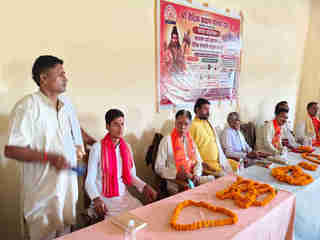 Jaunpur Hosts Seminar on Sanatan Dharma Awakening and Preservation of Vedic Culture
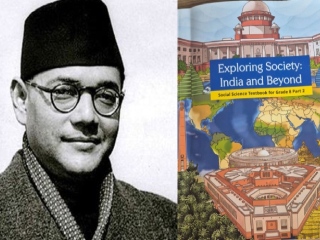 NCERT removes Hitler reference related to Subhas Chandra Bose from Class 8 textbook
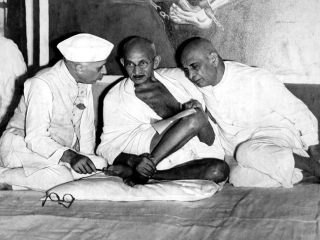 Nehruji’s Selection by Gandhiji for Congress Presidentship Again and Again
 Radiant Thoughts of Sachchidananda Parabrahman (Dr) Jayant Athavale
 We pay our obeisance a million times on the Birthday (as per Tithi) of
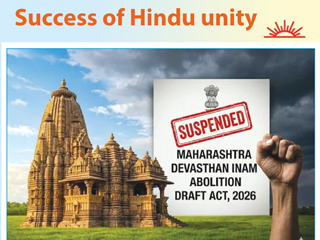 Major win for Hindu unity : Maharashtra Government suspends the controversial ‘Devasthan Inam Abolition Draft Act’