

1. Difference between ‘Varshik’ and ‘Mahalaya’ Shraddha
Shraddha performed annually in memory of a departed individual is called Varshik Shraddha, and that performed during Pitrupaksha is Mahalaya Shraddha. The sky is often considered to be a 360-degree sphere, and when the Sun enters the 6th Zodiac sign – Virgo – until it reaches Scorpio – a period of almost two months, Mahalaya Shraddha can be performed. It is said that from Krushna Pratipada, the first day of the dark fortnight of Bhadrapada till the Amavasya of Bhadrapad, Mahalaya Shraddha should be performed daily. Nowadays, performing Shraddha for 15 consecutive days is practically difficult, so it is usually performed only once, either on the death anniversary tithi of the father or on Amavasya. This is also acceptable.
In Varshik Shraddha, pinda offering is done only for 3 generations (mother, grandmother, great-grandmother or father, grandfather, great-grandfather). But in Mahalaya Shraddha, pinda offerings are made for all relatives.

2. For whom can the pinda offerings be made ?
- Pitru-trayi : Father, grandfather, great-grandfather,
- Matru-trayi : Mother, grandmother, great-grandmother,
- Matamaha-trayi : Mother’s father, grandfather, great-grandfather,
- Matamahi-trayi – Mother’s mother, grandmother, great-grandmother,
- Step-mother,
- Wife (if deceased),
- Son (if deceased after thread ceremony),
- Married daughter (if deceased),
- Paternal uncle (if his wife is also deceased, mention ‘with wife’; if his son is deceased, mention ‘with son’),
- Maternal uncle (same as above)
- Brother (if sister-in-law is deceased, mention ‘with wife’),
- Paternal aunt (if her husband is deceased, mention ‘with husband’; if her son is deceased, mention ‘with son’),
- Maternal aunt (if her husband is deceased, mention ‘with husband’; if her son is deceased, mention ‘with son’),
- Own sister (if her husband is deceased, mention ‘with husband’),
- Father-in-law (if mother-in-law is deceased, mention ‘with wife’),
- Guru who gave Gayatri initiation (If its the father who has performed the thread ceremony then him and if thread ceremony is performed by someone else than the Guru),
- Acharya-Guru who gave knowledge and education, Moksha-Guru,
- Disciple,
- Friends, relatives not mentioned above but with whom we had affectionate relation or who did favours to us.
All deceased relatives’ names and gotras should be noted and a proper list be made under the guidance of a priest.
3. The four Dharma-pindas in Mahalaya
In addition, Mahalaya prescribes four Dharma-pindas.
- For friends, companions, animals, trees, or any beings who helped us knowingly or unknowingly.
- For those in the maternal, paternal, or Guru’s lineage who had no descendants to make pinda offerings and whose funeral rites were not performed.
- For those born blind, crippled, or deformed.
- For those suffering in the Hell called Kumbhipaka due to sinful deeds.
4. Ways of performing Mahalaya Shraddha
Many have faith in such rituals, but cannot perform full Mahalaya Shraddha due to their job or other constraints. They can perform it as mentioned ahead.
- Cooking and offering a full meal to 2-5 Brahmans or make symbolic Brahmans from darbha and perform sapinda Mahalaya.
- Offering Amanna (Provisions) as Ama Shraddha.
- Offering milk, bananas, or light refreshments as Hiranya Shraddha. No pinda offering in this case.
- Brahmarpana : Feeding 2-5 Brahmans; and if a married woman has passed away, then doing so accompanied by performing puja of a married woman. No pinda offering in this case.
- If financially or physically unable, offering even a Shami leaf-sized pinda (Shami leaf is of the size of a boiled rice grain) is acceptable.
- If nothing else is possible, stand in a forest facing south, raise both the arms, and with folded hands pray to the ancestors seeking forgiveness for not being able to perform Shraddha or offer pinda due to financial constraints. This is also accepted as Shraddha.
5. The offerings in Mahalaya Shraddha
Shraddha includes two aspects – Vikira and Prakira. Offerings made for cremated and non-cremated, miscarried, or unborn souls are offered one portion in the Mahalaya Shraddha. Even Deities who do not receive Soma offerings get a portion in Mahalaya Shraddha. The Ramayan mentions that while He was in the forest, Shriram offered tuber-pindas to King Dasharath.
6. How Kavya-bhaga (The food offering) reaches the ancestors
When the Sun enters the Zodiac sign of Virgo and till it reaches Libra, it is closer to Earth. The food offering to the ancestors first reaches the Suryamandal (Solar system), from there it goes to the Chandramandal (Lunar system). The Chandramandal is not self-illuminating, but the Sushumna Nadi of Suryanarayana illuminates it. On every Amavasya, the Suryamandal and Chandramandal are together; hence, the food offerings on Amavasya reach the ancestors faster. Between 10° Virgo and 10° Libra, the Sun-Earth distance is minimal, so the offerings reach quickly.
The Shraddha system is like a ‘money order’. If I send a Rs 500 note from Vengurla Post Office to my brother in Mumbai, he won’t receive the same note but an equivalent value in available currency. The same applies to food offerings. Whatever food we offer is received in the form suitable to the life-form our ancestor currently inhabits.
7. Do ancestors actually eat during a Shraddha ?
This is a big question nowadays. Even if we eat very little of the food cooked for a Shraddha, we often feel a kind of heaviness and lethargy. But when we have Prasad at a Yajna (Sacrificial fire ritual) or in a temple, and even if we eat to our fill, we do not feel heaviness and lethargy. Temple Prasad does not contain onion, garlic, or strong spices, yet it tastes delicious because it contains God’s grace; whereas, Shraddha food contains the attachment of the ancestors. This brings heaviness to the body. Normally, eating sweets like kheer (Rice pudding) and vada (Fried lentil snacks) does not cause lethargy. This difference can be actually experienced.
8. Why cooking is done at home during the Pitrupaksha
Cooking should be done at home and the food must be prepared in a sattvik (Spiritually pure) manner. Food prepared with one’s own hands for the forefathers is dearer to them than anything else. The love and gratitude in it can never be matched by food from a restaurant or catering service. A simple meal of varan-bhat (lentils and rice) prepared by a daughter-in-law or daughter is more pleasing to parents than a lavish feast. During Pitrupaksha, one should express gratitude to the forefathers, please them, and obtain their blessings.
– Vedamurti Bhushan Digambar Joshi, Vengurla, Sindhudurg, Maharashtra.
| During Pitrupaksha, one should express gratitude to the forefathers, please them, and obtain their blessings ! |
 SPECIAL EDITORIAL : The Constructive Spirit of American Youth!
 Committees to be constituted in Maharashtra to decide cases of passive euthanasia
 17,000 Hindus in South Africa gather to recite the Hanuman Chalisa !
 Actor Aamir Khan receives death threat from Lawrence Bishnoi gang over ‘Love Jihad’
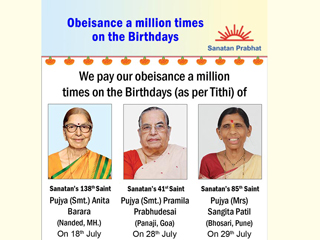 We pay our obeisance a million times on the Birthdays (as per Tithi) of
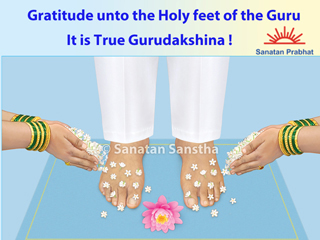 Offering gratitude unto the Holy feet of the Guru is true Gurudakshina !