

India must choose between appeasement-driven distortion and a just civilizational renaissance. True secularism begins when Hindus are no longer second-class citizens in their own homeland.
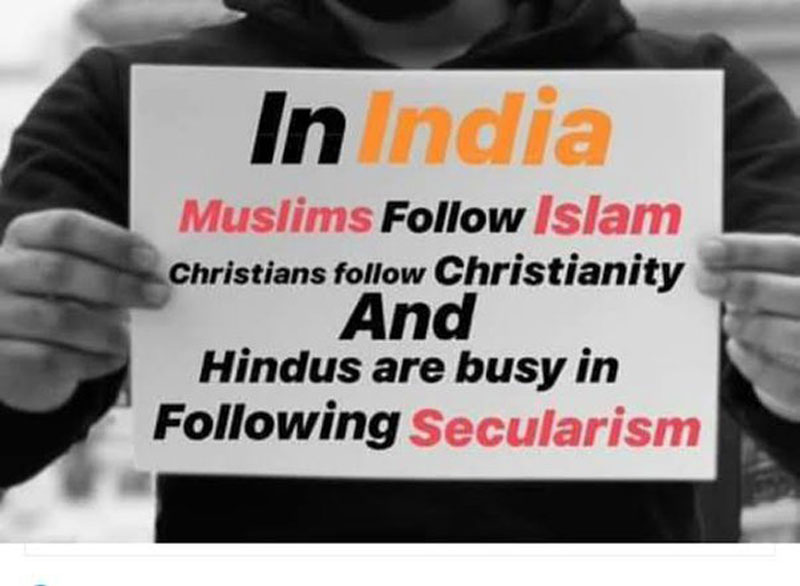
Behind the rhetoric of religious freedom lies a discriminatory legal framework that targets Hindu institutions, reforms only Hindu laws, and enables unchecked proselytization – undermining the very civilization that gave India its pluralistic character.
In Part 1 of this Article, we read – India is a Hindu-majority Nation – nearly 80% of its population identifies as Hindu. One would, therefore, assume that Hindus would be culturally secure and institutionally empowered in their own Homeland. In the global imagination, carefully curated by Western academia and Indian secular elites, Hindus are cast as the dominant group, allegedly oppressing minorities, particularly Muslims and Christians. Yet, India’s legal and constitutional framework tells a far grimmer tale : Not of dominance, but of slow, calculated strangulation of the very civilization it emerged from. And about :
1. Article 25 : Right to Propagate or License to Proselytize ?
2. Articles 28 & 30 : Religious Texts Allowed in Classroom – Provided They Aren’t Hindu
3. State Control of Hindu Temples – But Not Mosques or Churches
Family Law Reforms – Only for Hindus
Between 1955 and 1958, the Indian Parliament passed a series of laws collectively known as the Hindu Code Bills, which marked a significant shift in the personal law landscape for Hindus. These included the Hindu Marriage Act (1955), the Hindu Succession Act (1956), the Hindu Minority and Guardianship Act (1956), and the Hindu Adoptions and Maintenance Act (1956). These legislative reforms were championed by Prime Minister Jawaharlal Nehru and were intended to codify and modernize Hindu personal law.
The reforms sought to abolish discriminatory practices such as the denial of inheritance rights to daughters, introduced monogamy as a legal standard, and made divorce legally accessible within Hindu marriages. However, these ‘progressive’ reforms were selectively applied only to Hindus – a term defined broadly in law to include Jains, Buddhists, and Sikhs under the Hindu Marriage Act (Section 2).
Muslim and Christian personal laws, by contrast, were left untouched. The Muslim Personal Law (Shariat) Application Act of 1937 continued to govern matters such as marriage, divorce, maintenance, and inheritance among Muslims, preserving provisions like polygamy and unilateral divorce (talaq). Christian personal law remained governed primarily by the Indian Christian Marriage Act (1872) and the Indian Divorce Act (1869), with only minor amendments.
Nehru acknowledged the controversy these Bills generated. In the Lok Sabha debates of 1955, he stated, “I do not think that there is any doubt that this Bill is the most important measure… for our country” (Lok Sabha Debates, May 5, 1955). Despite opposition from within his own party and resistance from traditional Hindu leaders, Nehru pushed ahead, viewing Hindu reform as a necessary civilizational step. However, his reluctance to introduce comparable reforms for Muslim or Christian communities – citing communal sensitivities and political risk – exposed the selective moral and legal framework of the Indian state.
This asymmetrical approach created an enduring disparity. Hindu society was subjected to uniform legal codes enforced by the state, while minority communities retained their traditional and often patriarchal norms under the protective cover of religious freedom. This dichotomy persists today. Muslim women’s rights remain constrained by religious personal laws, and successive Governments have shied away from confronting these issues directly for fear of political backlash.
Several legal scholars and jurists have noted this imbalance. In Ahmedabad Women’s Action Group v. Union of India (1997), the Supreme Court declined to intervene in Muslim Personal Law, deferring instead to the legislature. The continued exemption of minority personal laws from scrutiny has entrenched legal pluralism, often at the cost of gender justice and equal rights.
In effect, Hindu personal law was nationalized and reformed, while Muslim and Christian personal law was left to religious authorities. This selectively imposed reform reflects not only a legal inconsistency but also a deep ideological reluctance to confront regressive practices within minority communities. For Hindus, however, the state acted with unparalleled urgency and authority, reshaping centuries of cultural and religious tradition through legislation.
Uniform Civil Code : One Law for All …Coming Since 1950
Article 44 of the Indian Constitution directs the state to ‘endeavour to secure for the citizens a Uniform Civil Code (UCC) throughout the territory of India.’ It was intended to create a common set of civil laws – governing marriage, divorce, inheritance, and adoption – for all citizens, irrespective of religion. Yet, more than seven decades since independence, this promise remains unfulfilled.
During the framing of the Constitution, leaders such as Dr. B.R. Ambedkar supported the principle of a UCC. However, instead of making it an enforceable right, it was placed in the Directive Principles – non-justiciable guidelines without legal force. This decision was driven by apprehensions of political backlash from religious minorities, and it laid the foundation for decades of legislative inaction.
One of the most striking examples of this retreat was the Shah Bano case (1985). The Supreme Court ruled that a Muslim woman was entitled to alimony under Section 125 of the Criminal Procedure Code, a secular provision applicable to all citizens. The judgment triggered intense protests from Islamic clerics and political groups, who accused the state of interfering in Muslim personal law.
The Government, led by Rajiv Gandhi, responded by passing the Muslim Women (Protection of Rights on Divorce) Act, 1986, which effectively overturned the Court’s verdict and curtailed the woman’s right to maintenance. Rather than upholding constitutional equality, the state yielded to religious orthodoxy for electoral convenience.
Since then, Article 44 has largely functioned as a rhetorical device. Political parties routinely invoke the UCC to appeal to Hindu voters but consistently avoid addressing the unequal application of personal laws across religious lines. Any proposal to reform minority personal laws is quickly dismissed under the banner of protecting religious freedom.
This selective approach has created an unequal legal system. Hindus are required to follow a uniform and modernized personal law, while minority communities continue to operate under religious codes that often remain patriarchal and regressive. The resulting legal pluralism not only undermines gender justice but also violates the constitutional guarantee of equality before the law (Article 14).
The Supreme Court has repeatedly expressed support for implementing the UCC, as seen in judgments such as Sarla Mudgal v. Union of India (1995) and John Vallamattom v. Union of India (2003). However, the Court has refrained from enforcing it, deferring instead to the legislature, where no meaningful action has followed.
As it stands, Article 44 remains symbolic rather than substantive – a constitutional ideal routinely showcased but rarely acted upon. It is used to signal reformist intent to the majority community while shielding minority practices from critical scrutiny. This duplicity entrenches a legal double standard, preventing India from achieving genuine legal equality.
Unless applied uniformly and fairly across all communities, the Uniform Civil Code will remain a constitutional aspiration – ignored in practice and exploited in politics.
Closing Remarks
As we have seen in this first part, the legal and constitutional framework of independent India has not merely neglected the rights of its Hindu majority – it has actively undermined them. From the selective reform of Hindu personal laws to the denial of religious education for Hindus (only) in schools, from the takeover of temples to the unchecked autonomy of minority institutions, a consistent pattern emerges : Laws framed in the name of secularism have, in effect, institutionalized discrimination.
This asymmetric legal treatment has not gone unnoticed – it has sown a deep and growing resentment within the Hindu community. Many Hindus now feel like second-class citizens in their own civilizational homeland, forced to comply with legal burdens that others are exempt from. And yet, this is only the tip of the proverbial iceberg.
This Article is being re-published in Sanatan Prabhat with the explicit permission of the Editorial Team of StopHinduDvesha.org
(Courtesy : Excerpts from an Article written by Ms Aditi Joshi, available on Stop Hindu Dvesha website)
Original Article on : https://stophindudvesha.org/weaponized-secularism-the-legal-assault-on-hindus-in-the-name-of-minority-rights-part-2/
| Hindus now feel like second-class citizens in their own homeland, forced to comply with legal burdens others are exempt from ! |
 We pay our obeisance a million times on the Birthdays (as per Tithi) of
 Offering gratitude unto the Holy feet of the Guru is true Gurudakshina !
 Messages of the Gurus on the occasion of Guru Purnima (29th July)
 Sadguru (Dr) Mukul Gadgil’s analysis of the vibrations in the photos of Sachchidananda Parabrahman (Dr) Athavale, corresponding to His spiritual level at different times
 Projects of funding commercial complexes worth Rs 246 crore using temple funds cancelled by Tamil Nadu Government
 Salutations unto the Guru !