
Swatantryaveer Vinayak Damodar Savarkar was inspired by the autobiography of Italy’s great revolutionary Giuseppe Mazzini. The year was 1907. At the age of 24, Savarkar wrote a book in England titled ‘The Indian War of Independence 1857’, which boldly challenged the British narrative of the 1857 uprising as merely a revolt. He ensured that copies of the book were sent to India through fellow revolutionaries to inspire young Indians. However, even before the book was published, the British imposed a ban on it. This was perhaps the first recorded instance of a pre-publication ban.
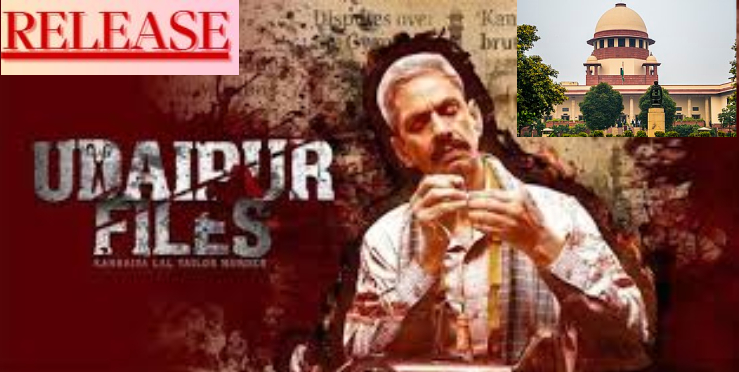
A similar instance is now unfolding with the recently released film ‘Udaipur Files’. The Delhi High Court has stayed its release. On 16th July, the Supreme Court upheld this stay, instructing the Union Government to take a decision on the matter at the earliest. Ironically, those who otherwise scream about freedom of expression, and use it to corner Hindus, the so-called progressives and Congressmen, are the ones throttling this very freedom today. Senior Congress leader and advocate Kapil Sibal is campaigning vigorously to have the film banned. The hardline Islamic organisation Jamiat Ulema-e-Hind has filed a petition in Court objecting to the film.

A medieval-times murder
Let us understand the background of this film. In 2022, the then BJP spokesperson Nupur Sharma allegedly made objectionable remarks against Prophet Muhammad. In response, Islamic countries mounted diplomatic pressure on the BJP-led Government of India. Muslims in India launched violent protests. Blood-curdling slogans such as ‘Gustakh-e-Nabi ki ek hi saza, sarr tan se juda, sarr tan se juda’ (There is only one punishment for insulting the Prophet – Decapitate the blasphemer !) were raised. As a result, the BJP suspended Nupur Sharma for six years from the Party.
Against this backdrop, a Hindu tailor named Kanhaiya Lal of Udaipur, Rajasthan, posted in support of Sharma on Facebook. Opposition to this led to his arrest and imprisonment. After securing bail, on 28th June 2022, while he was working in his shop, Riyaz Attari and Muhammad Ghaus entered and brutally beheaded him, shouting ‘Sarr tan se juda’. The film ‘Udaipur Files’ is based on this chain of events.
Such a medieval-times act should have been widely condemned, but the opposite happened. During a hearing of Sharma’s case, the Supreme Court observed that her remarks had incited violence across the country and that she should apologise to society. This observation amounted to the trampling of a fundamental human right – the freedom of expression. It was not just cultural but a civilisational beheading.
Three years have passed, yet the trial of the Jihadis in Rajasthan is still incomplete. Kanhaiya Lal’s widow and two sons continue to wait for justice. Meanwhile, within just three days of its release, a stay has been imposed on a film that brings their tragic story before the world. The same incident, the same system; yet, such glaringly contradictory justice ? This is bound to strike the common man as deeply unjust.
Undoubtedly, the judiciary must be respected. As the third pillar of Democracy, maintaining its credibility is essential to prevent chaos. However, when such decisions are seen, over a billion Hindus are disappointed. Who has an answer to their anguish ?
For the first time, the judiciary has directed the Union Government and Prime Minister Modi to take a decision on the film’s release. It is not that the Censor Board gave the film a green signal without scrutiny; as many as 50 cuts were suggested and were accepted too. Yet a stay has been imposed, raising serious questions about the authority and relevance of the Censor Board.
And the Board itself is far from untainted. Over the last 30 years, several films ridiculing Hindu Deities, traditions and Saints have been cleared by this very Board. Films such as PK, Mohalla Assi, Laxmi Bomb, Oh My God, Water, Lajja, Fire, Tumbbad, and Bombay trampled upon Hindu sentiments. To document and expose the narratives that consistently targeted Hindu faith, there even exists an organisation named ‘Gems of Bollywood’. This alone is evidence enough of the scale of Hinduphobia.
The one and only solution
Some legal experts are now warning that anti-Hindu elements are attempting to establish a dangerous precedent using the judiciary. Whenever a film about atrocities on Hindus is about to be released, the Censor Board first mutilates it with cuts. Then, it is dragged to Court, where a stay is granted. In the current case, ‘Udaipur Files’ and its possible consequences are being pinned entirely on the Union Government. This film is not just a release – it is a warning bell for Hindus and the Union Government alike.
Recently, filmmaker Manpreet Singh Dhami released a film titled ‘His Story of Itihas’, which exposed the anti-Hindu narrative in school textbooks. Theatres denied it screenings. Soon, ‘The Bengal Files’ directed by Vivek Agnihotri will be released. It is expected to expose the atrocities Hindus have faced in Bengal – a State nearly slipped out of Hindus’ hands. Only God knows the opposition this film may face. But as of now, ‘Udaipur Files’ has already been metaphorically beheaded. The solution to this grave problem lies only in one place, which happens to be the first pillar of Indian Democracy – the Parliament. The Parliament is formed through people’s votes. Now, millions of Hindus across the Nation must compel the Government to allow the film’s release. And when challenges arise, they must stand firmly behind the Government. Only then will Kanhaiya Lal’s family receive even a semblance of justice. Otherwise, this barbaric mindset that celebrates beheadings will keep triumphing in this divided Nation.
| Legal experts are now warning that anti-Hindu elements are attempting to establish a dangerous precedent using the judiciary ! |
 Criminal case against 11 members of a Christian organisation who claimed that “Hindu is an abusive term, meaning thief, bandit and slave” will not be quashed !
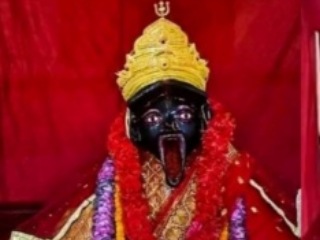 Fanatical Muslims attack historic Shri Kalimata Temple in Bangladesh
 Radiant Thoughts of Sachchidananda Parabrahman (Dr) Jayant Athavale
 We pay our obeisance a million times on the Birthday (as per Tithi) of
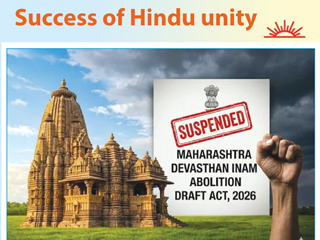 Major win for Hindu unity : Maharashtra Government suspends the controversial ‘Devasthan Inam Abolition Draft Act’
 Mumbai-based advocate Siddhavidya, who is trying to stop trafficking through surrogacy (artificial pregnancy) and animals, and animal killing