

The sacrifice of the soldiers and generals for the Hindavi Swarajya as envisaged by Chhatrapati Shivaji Maharaj is supreme. Similarly, in the present times, many devout Hindus and patriotic citizens of this country have been striving to protect the Nation & Dharma.
The ‘Warriors of Hindutva’ is a series of articles that sheds light on their life and their struggle to protect Hindu Dharma. We hope that it serves as a catalyst for the mission of establishing the ‘Hindu Rashtra’ and inspires many others. – Editor
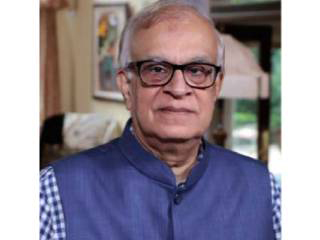 Sanatan Prabhat asked Mr Malhotra : “To begin under-standing your literature and grasp the global narrative against Hindu Dharma, which book should one read first ?” He replied : “Start with Being Different – read it slowly, and read it closely”.
Like every awakened Hindu, Sanatan Prabhat regards Mr Malhotra as a true Hindutva warrior – a visionary who propelled Hindu Dharma from being dismissed as fringe to standing confidently on the global stage. A fierce intellectual, a tireless civilizational sentinel, and often the lone Hindu voice in the West, his contributions are legendary.
1. From Tech Executive to Dharmik Crusader
Mr Rajiv Malhotra’s journey from a successful technology executive to a champion of Hindu civilization is as remarkable as it is inspirational. Born in 1950 and educated in physics at St. Stephen’s College, New Delhi, he went on to pursue Computer Science at Syracuse University in the United States
By the early 1990s, Mr Malhotra had become a senior Fortune 100 executive and an entrepreneur heading over 20 IT companies across multiple countries.
Yet, at the peak of his corporate career, he felt a higher calling. In 1994, at age 44, he took early retirement to dedicate himself entirely to civilizational research with an intellectual zeal. This bold pivot marked the emergence of an ‘intellectual Kshatriya’, a warrior-scholar fighting in the realm of ideas and narratives.
Mr Malhotra founded the Infinity Foundation in 1994 in Princeton, New Jersey as the vehicle for his new mission. The Foundation celebrated the completion of its 30 years in April 2024 with great fervor in a Divine atmosphere in New Jersey. However, its path has been strenuous, selflessly dedicated and relentlessly devoted to the Dharmik cause.
Since its inception three decades ago, the Foundation’s purpose was clear : To counter widespread misrepresentations of ancient Indian traditions and to highlight ‘Hindu’ India’s contributions to world civilization.
Mr Malhotra understood that the battles for Hinduism in the 21st century would not be fought with swords, but with scholarship, media, and discourse. He began convening resources to support scholarly work on Indic knowledge systems. Over the years, Infinity Foundation has distributed more than 400 grants for research, education, and community projects worldwide.
In effect, Mr Malhotra started building an institutional base for a long-term Hindu renaissance, even bringing Indic perspectives into mainstream academia. As one profile describes, he has ‘disrupted the mainstream thought process’ among intellectuals by offering fresh, provocative positions on Dharma and Bharat.
2. Infinity Foundation’s Vision : Challenge entrenched Western narratives head-on
The Infinity Foundation became the staging ground for Mr Malhotra’s intellectual interventions. With virtually no full-time staff besides himself, the Foundation punched above its weight in influence. Its stated goals were unapologetically civilizational – to fight the misrepresentation of Hinduism and to document India’s global contributions.
Rather than ceding the academic space to entrenched Western narratives, he sought to influence it from within by funding research and chairs that approached Indic traditions on their own terms. This approach sometimes ruffled feathers in academia. Scholars of religion saw Infinity Foundation as a vigilant watchdog monitoring how Hinduism was portrayed in academia. Mr Malhotra had no qualms about this. He openly encouraged Indian-American donors and thinkers to form what he called a ‘home team’ in scholarship, as opposed to leaving India studies to the ‘outsider’ view.
“My hope is to spur the genesis of what I call a ‘home team’ of intellectual leaders who would research, reposition and articulate Hinduism in a responsible way,” Mr Malhotra has written.
This clarity of purpose imbued his work with an assertive, mission-driven quality that has inspired many young Indians and diaspora members. At Infinity Foundation India, he has been actively mentoring youth and scholars to carry forward this vision. The Foundation launched the Swadeshi Indology conferences and an Intellectual Kshatriya platform – forums where emerging scholars present research to challenge entrenched Western narratives. Through these, he is effectively training an army of intellectual Kshatriyas, armed with rigorous research and rooted pride, to ensure the Hindu civilizational voice is robustly represented in academia and media for generations to come.
3. Breaking India : Exposing the Threat Within and Without
No profile of Mr Malhotra is complete without discussing his game-changing publications, each of which addresses a critical battlefront in the war for Hindu India’s civilizational soul. One of the first and most explosive was Breaking India (2011), co-authored with Aravindan Neelakandan. In this landmark book, he peeled back the layers on how Western intervention and ideology have fostered internal fault lines in India. Breaking India argued that India’s integrity was being actively undermined by well-organized global networks supporting divisive movements – specifically, the Dravidian separatist movement for a distinctive North-South Divide – with the goal of fracturing the country along ethnic and caste lines. It marshaled evidence that foreign agencies, often through academic and religious fronts, were supplying the intellectual frameworks and funds to fuel these identities in opposition to pan-Indian unity. The book’s thesis introduced the now-popular term ‘Breaking India forces’ into the patriotic lexicon, referring to external and internal players that collaborate – overtly or covertly – to balkanize India along civilizational cracks. In fact, a decade later commentators noted that Breaking India had been ahead of its time by over a decade, warning of dangers that would become far more obvious in the 2020s.
The book’s impact was such that it became a big hit among thoughtful Indians worldwide and seeded a new consciousness about the need for civilizational vigilance. A decade later, Mr Malhotra revisited this theme with even greater depth in Snakes in the Ganga : Breaking India 2.0 (2022), co-authored with Vijaya Viswanathan. If Breaking India highlighted overt networks and faultlines, Snakes in the Ganga uncovers a more insidious new incarnation of the same civilizational threat. The book alleges that a nexus of Western academic theories, radical ideologies, and even India’s own elites is enabling a stealth re-colonization of India. It zeroes in on Harvard University and other Ivy Leagues as ‘the helm’ of this project, effectively taking the place that Oxford University once held during the British Raj.
In a chilling parallel to colonial times, Snakes in the Ganga reveals that many wealthy Indians and NGOs are actually funding this agenda. Indian billionaires and foundations, often enamored by Western academia, are pouring resources into Harvard’s programs that train Indian scholars and activists in these theories.
The revelations of Snakes in the Ganga are startling and have further cemented his reputation as a sentinel for Indian civilization. With this book, he has effectively taken the battle against Hinduphobia and neo-colonial thought to the heart of the global elite. It is a call to action for Indians to recognize the new ‘snakes’ in their sacred Ganga – the toxic ideas and alien frameworks infiltrating society – and to organize a counter-movement in defense of their civilizational continuity.
4. Being Different : Challenging Western Universalism
Parallel to exposing external threats, Mr Malhotra has been just as vigorous in reviving pride in the Hindu civilizational ethos itself. Another of his seminal works, Being Different : An Indian Challenge to Western Universalism (2011), addresses a long-standing psychological battle – the tendency of Western thought to universalize its own worldview and sub-sume others. He turns the gaze around : He systematically contrasts Dharmik traditions (Hinduism, Buddhism, Jainism, Sikhism) with Western religious and secular philosophies, arguing that India’s spiritual worldview is fundamentally distinct and not just a variation of Abrahamic or Western paradigms. Being Different insists on the right of Indian traditions to be understood on their own terms, without being digested into Western frameworks.
He warns that many Hindu ideas (like yoga, meditation, etc.) have been ‘digested’ into Western culture – stripped of their Dharmik context and re-presented as Western innovations – leaving the original tradition weaker and denuded. The book doesn’t stop at diagnosis; he calls for ‘mutual respect’ between civilizations rather than one-way tolerance, and even proposes provocative defensive strategies.
It prompted many to question their own colonized lenses and to proudly assert a Hindu identity that is unafraid of being truly different.
(Ref.: SanatanPrabhat.org/english/)
| Mr Malhotra’s game-changing publications address a critical battlefront in the war for Hindu India’s civilizational soul ! |
 Criminal case against 11 members of a Christian organisation who claimed that “Hindu is an abusive term, meaning thief, bandit and slave” will not be quashed !
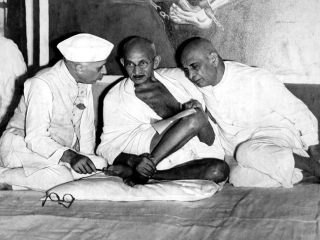 Nehruji’s Selection by Gandhiji for Congress Presidentship Again and Again
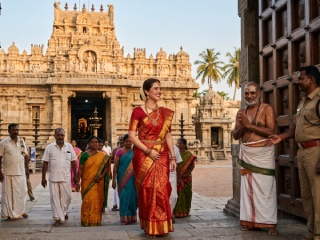 A person’s nationality or foreign name cannot determine their faith in Hindu Dharma !
 Radiant Thoughts of Sachchidananda Parabrahman (Dr) Jayant Athavale
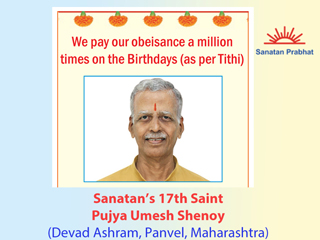 We pay our obeisance a million times on the Birthday (as per Tithi) of
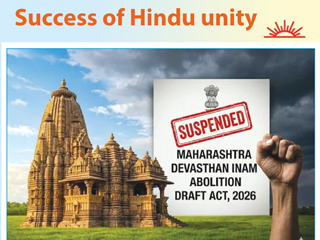 Major win for Hindu unity : Maharashtra Government suspends the controversial ‘Devasthan Inam Abolition Draft Act’