

In Bharatiya culture, immense importance is given to Shri Guru and His lineage. In fact, the very utterance of the word ‘Guru’ evokes feelings of reverence, gratitude, and surrender unto the Guru, who is none other than the manifest form of God. The mind overflows with devotion unto the Guru, and seekers and disciples alike yearn to obtain His blessings and grace.
Sant Eknath Maharaj explained the importance of Shri Guru in these words – ‘A disciple should have firm faith that the Guru is truly the Supreme God’. Similarly, Shankar Vaidya, the famous poet and writer from Maharashtra has said – ‘There is no other refuge for the disciple except the Guru’.
Shri Guru, who has been described thus, assumes countless forms depending on the mission, and all of them ceaselessly work for the welfare of the world. The Guru Principle operates through Incarnations, Deities, Sages, and devotees during different times for different missions.
The glory of Sachchidananda Parabrahman (Dr) Athavale, the living embodiment of the Guru, is so vast that any attempt to describe it will remain incomplete. Yet, with whatever little I have understood through my limited intellect, I offer it at the Holy feet of Shri Guru with devotion and bhav (Spiritual emotion).
1. Guru
When one attains the spiritual level of 70%, he becomes a Saint, and at 75% spiritual level, he is elevated to the level of a Guru and spiritually guides others in spiritual practice, Liberation, and Moksha. For example, Gurudev Ramkrishna Paramhansa guided Swami Vivekanand, thus ensuring His spiritual progress.
2. Kula Guru
A Kula Guru is one who takes responsibility for an entire lineage (Kula). The Kula Guru ensures every family member follows their Dharmik (Dharma-related) traditions and guides on their material and spiritual welfare. For instance, Sage Garg was the Kula Guru of the Yadav clan, and Sage Shandilya of the Nanda clan. It was Sage Garg, who had decided on the names of Shrikrushna and His brother Balaram, and guided both of them to abide by Dharma and perform spiritual practice.
3. Yoga Guru
A Yoga Guru guides disciples through Paths such as Jnanyoga, Bhaktiyoga, Karmayoga, Dhyanyoga, Hathayoga, Shaktipatyoga, and so on. Sage Patanjali performed Yoga-sadhana and taught His disciples Shaktipatyoga, Jnanyoga, etc. as per their basic constitution. He devised asanas (Body postures) and taught Ashtanga (Ashta [eight] + anga [branches]) Yoga, which includes Yama (Detachment from sense organs), Niyam (Virtuous habits and observances), Asan (Body posture), Pranayam (Meditation), Pratyahar (Retreat), Dharana (Concentration), Dhyan (Meditation), Samadhi (A superconscious state of meditative union with the Absolute God Principle), thus revealing the Path to God through Hathayoga. On the battlefield of Kurukshetra, Bhagawan Shrikrushna also guided Arjun in practicing Ashtanga Yoga. In Kaliyug, Yogatadnya Dadaji Vaishampayan, an Incarnation of Deity Datta, guided many disciples in Yoga practices for their spiritual upliftment.
4. Diksha Guru
According to the Path of Shaktipatyoga, when a seeker receives Diksha (Initiation) from Shri Guru, his dormant Kundalini Shakti (Divine Energy) is awakened. The Guru who imparts this initiation and accepts the disciple is called the Diksha Guru. For example, while travelling across Bharat, Adi Guru Shankaracharya once initiated a man named Giri, who was intellectually dull. Due to the diksha, Giri’s Kundalini Shakti was awakened, and he attained Self-realisation. Overwhelmed with devotion, Giri composed a bhav-enriched ashtak (Eight-verse hymn), the Totakashtak. Upon hearing it, Shankaracharya was very pleased and named him Totakacharya.
5. Guna Guru
Every being in the Universe, whether animate or inanimate, has qualities to learn from. The process of identifying virtues or flaws in others and learning the right lesson from them is called ‘Learning from all of Creation’. In this way, every being becomes a Guna Guru (Guru of qualities). For example, Bhagawan Dattatreya despite being the embodied Guru Himself, recognised and learnt from various beings ranging from insects to pythons, and designated them as His 4 Gurus and 24 sub-Gurus. He identified and learnt from their virtues and vices. All of them became His Guna Gurus.
6. Anubhavi Guru
Those whose experiences become a source of learning for others are called Anubhavi Guru. For instance, after the Mahabharat war when Bhagawan Shrikrushna visited Bhishmacharya, who was lying on the bed of arrows, He instructed Yudhishthir to seek Bhishma’s counsel. Surprised, Bhishma asked Shrikrushna, ‘Why do you send Yudhishthir to me when You yourself are Omniscient ?’ Shrikrushna replied, ‘Though I possess knowledge, I do not have your experience. That is why I have asked him to learn from you’. Bhishma then narrated his unpardonable mistakes committed while abiding by Rajdharma, such as :
• Splitting the Hastinapur kingdom due to his vow.
• Remaining silent while Dushasan was disrobing Draupadi at Duryodhan’s command.
• Supporting adharma (Unright-eousness) by siding with the Kauravas in the war.
Through these confessions, he taught Yudhishthir how a king should truly abide by Rajdharma.
7. Upay Guru
Some Gurus, known as Upay Gurus, provide solutions to relieve individuals suffering from physical, supernatural, or spiritual problems. For example, when the Deities face trouble from demons, they seek refuge in Shiva or Vishnu, who then offer them solutions and guidance, thus acting as their Upay Gurus. Similarly, in Sanatan Sanstha, Sadguru (Dr) Mukul Gadgil offers seekers practical, spiritual remedies for various types of physical, mental, intellectual, and spiritual distress. These remedies include chanting the Names of Deities and performing nyas (Focussing of energy flow through the medium of the fingers tips) and mudra (A body or hand posture used for directing the flow of spiritual energy).
8. Mantra Guru
A Mantra Guru is the one who emancipates a disciple by giving him a mantra.
1. Deity Shiva giving the Mahamrutyunjay Mantra to child Markandeya : Young Markandeya was destined for untimely death at the age of twelve. As death approached, he began worshipping Shiva intensely. Pleased, Shiva revealed the Mahamrutyunjay Mantra to him. Markandeya continuously chanted it in the forest. When Yama came to take his life, Shiva Himself appeared, protected the boy, and granted him the boon of immortality for seven Kalpas (Kalpa is a unit of time equal to 4.32 billion years). Due to Shiva’s grace, Sage Markandeya became immortal and authored the Markandeya Puran and the sacred Text Saptashati (of Goddess Durga).
2. Maharshi Durvasa giving vashikaran mantras to Kunti : Pleased by Kunti’s devoted service, Sage Durvasa gave her various vashikaran (Black magic done so as to entice and control someone) mantras that allowed her to invoke Deities. Using these, she gave birth to Yudhishthir from Deity Yama, Bhim from Deity Pavan, Arjun from Deity Indra. She later passed the mantras to Madri (King Pandu’s second wife), who invoked the Ashwini Kumar twins Dastra & Nasatya and gave birth to Nakul and Sahadev.
9. Upasya Guru
At times, moved by intense devotion and yearning, the worshipped Deity bestows Divine knowledge upon the devotee and becomes the Upasya Guru. For example,
• Yama Dharma granted profound Atmajnan (Spiritual knowledge) to Nachiket due to his intense yearning.
• In Dwaparyug, Shri Ganesh Incarnated as Gajanan and killed Sindhurasur. He then blessed His ardent devotee King Varenya by narrating the Ganeshgeeta, which illumines the Path of Yoga, grants all accomplishments, removes ignorance and reveals the purpose of human life.
10. Shakti Guru
The Guru whose guidance or devotion rekindles a being’s lost self-confidence and awakens his Atma-shakti (Inner power) is called a Shakti Guru. For example, when Indrajit cast the Nag-pash (A powerful arrow capable of vast destruction) at Shriram and Lakshman, rendering them unconscious, the entire army of Vanars was demoralised. Hanuman then gave them courage and strengthened their morale. As a result, new energy flowed through the entire Vanar army, and they began fighting Ravan’s forces. Even today, through the Path of devotion and strength-oriented worship of Hanuman, those who are disheartened regain their self-confidence and become strong.
11. Bhakti Guru
A Bhakti Guru is one whose inspiration awakens devotion in the individual, leading to his emancipation. For example, Uddhav, a great devotee of Shrikrushna, developed pride in his Brahmajnan and began to consider the gopis, who follow the Path of devotion, as inferior. To remove this ego, Shrikrushna asked him to go from Mathura to Vrundavan to meet His supreme devotees – the gopis and Radha. Shrikrushna wrote a letter for the gopis and gave it to Uddhav.
On reaching Vrundavan, the gopis became so eager to receive this letter that each of them tugged at it, tearing it into pieces. Uddhav was annoyed by this. At that moment, he met Radha, Shrikrushna’s dearest devotee. Uddhav got a vision of Shrikrushna with Radha. Awestruck, he surrendered at Radha’s feet. Radha explained the importance of the Path of devotion and imparted spiritual knowledge to him. Thus, Uddhav’s ego in his knowledge was destroyed and he became immersed in devotion unto Shrikrushna. In this instance, it is due to Radha that devotion awakened in Uddhav; hence, Radha is his Bhakti Guru.
12. Jnan Guru
A Jnan Guru is one who uplifts the disciple by imparting him Atmajnan. Sant Meerabai’s Guru, Sant Raidas gave Her such knowledge. Similarly, Sant Jnaneshwar, Sant Sopandev, and Sant Muktabai obtained knowledge from Sant Nivrittinath. When Sant Namdev developed ego about His devotion unto Deity Vitthal, Sant Visoba Khechar humbled Him by imparting Him Atmajnan. Similarly, when Sage Sanak and others developed ego about their knowledge, Shiva faced the southern direction, sat in a meditative posture, and imparted Atmajnan that is Sanak (Ancient), Sanatan (Eternal), Sanandan (Ever Blissful), and Sanat (Ever youthful) to them. This destroyed their ego. Hence, this form of Shiva as the Guru who imparts knowledge came to be known as Dakshinamurti.
13. Mukti Guru or Uddharak Guru
A Mukti Guru or Uddharak Guru is one whose guidance or grace leads to Final Liberation (Moksha). Sage Naradmuni advised Valya Koli – a dacoit – to chant Shriram’s Name. After chanting it for thousands of years, Shriram appeared before him and emancipated him. Valya Koli was freed from his sins and became Sage Valmiki. Thus, Naradmuni was his Mukti Guru (Guru who grants Moksha) or Uddharak Guru (Guru who emancipates).
As Indra violated Ahilya’s chastity, her husband Sage Gautam cursed her, saying, ‘You shall turn into a stone and remain so’, and gave her a counter-blessing, ‘Shriram will liberate you’. While in the stone-form, Ahilya chanted Shriram’s Name continuously. Years later, after slaying the demoness Tratika, Shriram and Lakshman arrived at Sage Gautam’s Ashram along with Sage Vishwamitra. When, at the command of Sage Vishwamitra, Shriram touched the (Ahilya-form) stone with His foot, the stone transformed into Ahilya, thus liberating her from her inert state. In this way, Sage Gautam and Sage Vishwamitra were Ahilya’s Mukti Guru or Uddharak Guru, while Shriram was the actual Muktidata (Bestower of Liberation).
14. Atma Guru
Here is the translation of a line from Bhajan No. 79 from the Marathi Text ‘Sant Bhaktaraj Maharaj Virachit Bhajanamrut’ written by Saint Bhaktaraj Maharaj – ‘Without the grace of the Guru, it is not possible to find out who resides in my heart.’
The implied meaning of these lines is – with the Guru’s grace, the veil of ignorance (Maya) that engulfs the individual is lifted, and the inner soul awakens and begins guiding the individual from within. This is called the Antarik Guru (Inner Guru or Atma Guru).
For instance, Swami Vivekanand used to ask Ramkrishna Paramhans various questions about Spirituality. Through His answers, Ramkrishna would guide Swami Vivekanand. Pleased with his intellect and yearning for truth, Ramkrishna blessed him saying, ‘From now on, you will obtain answers from within. I Myself will reside in you as your soul and guide you at every step’. In this way, through the grace of Ramkrishna Paramhans, who was the embodied form of the Guru Principle, Swami Vivekanand was blessed with his Atma Guru.
In 1893, guided by his Atma Guru, Swami Vivekanand attended the Parliament of World Religions in Chicago and proclaimed the greatness of Hindu Dharma to the world, thereby spreading its fame across the world.
15. Margadarshak Guru
A Margadarshak Guru (Guiding Guru) is one who understands the disciple’s needs, appears in various forms or circumstances to guide him. A disciple may obtain guidance from several Gurus or Saints throughout his life; not all may be the Moksha Guru, but they help with specific forms of knowledge. Hence, they are called Margadarshak Guru.
For example, Sachchidananda Parabrahman (Dr) Athavale obtained guidance on Numerology from Param Pujya Bhau Masurkar (from Sindhudurg, Maharashtra), knowledge of Mudras from Param Pujya Vhatkar Maharaj, guidance on distress due to negative energies and its remedies from Param Pujya Dabralwale Baba. Thus, while Saint Bhaktaraj Maharaj is Sachchidananda Parabrahman (Dr) Athavale’s Moksha Guru, the others are His Margadarshak Gurus.
16. Samashti Guru
A Samashti Guru not only helps His devotees attain Moksha but also guides them to spread Dharma and Spirituality in society. The term Samashti Guru means Guru who ensures collective welfare.
Saints who were Incarnations of Deity Datta such as Shripad Shrivallabha, Swami Narayan Saraswati, Swami Samartha, and Gulavani Maharaj travelled extensively to uplift countless people, freed many from distress caused by negative energies, made the destiny of many individuals bearable and helped them attain Liberation.
17. Sadguru
A Sadguru is one who constantly experiences the state of Sat-Chit-Anand.
Sadgurus not only guide spiritually curious individuals, mumukshus (A seeker with intense desire for God-realisation), seekers, and disciples, but also other Saints at the vyashti (Individual) and samashti (Collective) levels about their spiritual practice. For example, Sadguru Ramanandacharya of the Vaishnav sect guided Saints such as Sant Kabir, Sant Raidas, and Sant Pipaji, elevating them even beyond the stage of Sainthood.
18. Paratpar Guru
A Paratpar Guru is one who continuously strives for the welfare of the Universe and is also called Paramhansa Guru.
For example, Yogi Arvind was a Paratpar Guru. During World War 2, when Hitler resolved to invade India, Yogi Arvind fought the negative energy in Hitler in the subtle dimension and defeated it, thus protecting India from the possible attack by Hitler. (Reference: Website Search for Light)
19. Moksha Guru
Just as a bound individual cannot free another, one who has not attained Moksha cannot guide others to Moksha. Only one who has attained Moksha can lead others to it. Such a spiritually elevated individual is respectfully called Moksha Guru.
Gurucharitra mentions that Sage Sandipani tested His disciples Aruni, Sandipak & Upamanyu, and then granted them Atmajnan and led them to Moksha.
When King Parikshit was cursed by Sage Shrungi that he would die of a snakebite in seven days, Shukdev, the son of Sage Vyas, imparted him the knowledge of the Shrimadbhagawadgeeta for seven continuous days. On the seventh day, Parikshit died from the snakebite and attained Moksha. Thus, Shukdev was his Moksha Guru.
20. Avatari Guru
When the Divine form of the God Principle descends on Earth for the welfare of society or establishment of Dharma, such a Guru is called an Avatari (Incarnation) Guru.
20A. Vyashti Avatari Guru : Sant Tulsidas was the Incarnation of Sage Valmiki, who had Hanuman Principle in Him. While Sage Valmiki wrote the Ramayan in Tretayug, Sant Tulsidas wrote the Ramcharitmanas in Kaliyug. Chaitanya Mahaprabhu, an Incarnation of Radha, spread Shrikrushna’s devotion and emancipated countless people. Swami Narayan, a fractional Incarnation of Shri Vishnu, promoted devotion to God, emancipated the downtrodden, and brought prosperity to society.
20B. Samashti Avatari Guru : To help the people of Maharashtra enjoy Swarajya (Self rule) and good governance, Samartha Ramdas Swami guided His disciple Chhatrapati Shivaji Maharaj on Kshatra-dharma and Rajdharma, which enabled him to establish the ‘Hindavi Swarajya’.
Similarly, Arya Chanakya guided Chandragupta Maurya to unite India’s fragmented States and establish a unified ‘Hindu Rashtra’. Vidyaranya Swami guided Harihar and Bukka to establish the Hindu Vijayanagar Empire in South India.
21. Sachchidananda Parabrahman (Dr) Athavale : The Param Guru endowed with every quality of the Guru Principle
Sachchidananda Parabrahman (Dr) Athavale, the visionary and main proponent is the adhvaryu (from adhvara, meaning Yajna) or the chief Ritvik (Priest) who conducts the ritual of the ‘Hindu Rashtra’. All Divine attributes of various types of Guru described so far are seen in Him. Such a spiritually complete Guru is Param Guru Sachchidananda Parabrahman (Dr) Athavale. Hence, He is seated in the Absolute Guru position. This is the highest and most supreme seat in Spirituality. Only Gurus who possess all the virtues of other Gurus and are Absolute Incarnate Principle like Shriram and Shrikrushna can be seated at this level.
– Ms Madhura Bhosale (Spiritual level : 65%), (Knowledge obtained through the subtle dimension), Sanatan Ashram, Ramnathi, Goa. (20.4.2023)
| Sant Eknath Maharaj says about Shri Guru – ‘A disciple should have firm faith that the Guru is truly the Supreme God’ !
All Divine attributes of various types of Guru are in Sachchidananda Parabrahman (Dr) Athavale : A spiritually complete Guru ! |
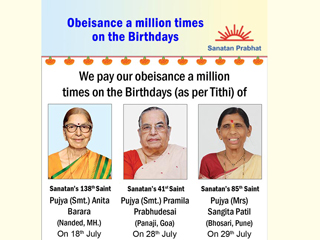 We pay our obeisance a million times on the Birthdays (as per Tithi) of
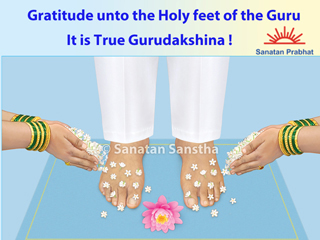 Offering gratitude unto the Holy feet of the Guru is true Gurudakshina !
 Messages of the Gurus on the occasion of Guru Purnima (29th July)
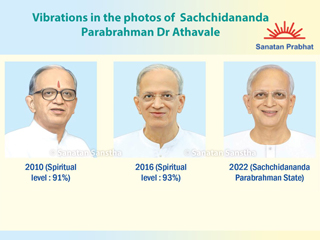 Sadguru (Dr) Mukul Gadgil’s analysis of the vibrations in the photos of Sachchidananda Parabrahman (Dr) Athavale, corresponding to His spiritual level at different times
 Projects of funding commercial complexes worth Rs 246 crore using temple funds cancelled by Tamil Nadu Government
 Salutations unto the Guru !