
Claim by former Union Home Ministry Under Secretary and Padma Shri awardee RVS Mani
Smuggling carried out under the garb of ‘people-to-people contact’
Drug trafficking funded 30% of Pakistan-sponsored terrorism in India
(‘People-to-people contact’ between India and Pakistan refers to exchanges involving artists, sportspersons and others from the two countries.)
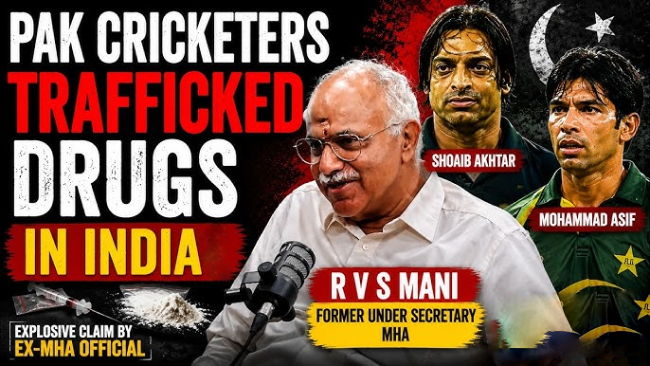
New Delhi – Several members of the Pakistan cricket team who toured India were involved in drug smuggling. The money generated through this smuggling was used to finance terrorist attacks, claimed former Union Home Ministry Under Secretary RVS Mani. In an interview, Mani named cricketers Shoaib Akhtar, Mohammad Asif, Saleem Malik, Shahid Afridi and Hasan Raza while making this claim. He also alleged that Pakistan’s intelligence agency, the ISI, was behind these activities.
Mani, who received the Padma Shri award in 2026, cited an example in support of his claim. He said that in October 2006, Akhtar and Asif admitted to the Pakistani High Commission that they had brought narcotic substances with them during their tour of India. They were subsequently sent back to Pakistan by the High Commission. Both players claimed that the drugs were for their personal use, but Mani alleged that this was merely a pretext and that the entire background behind the incident needed to be understood.
🚨 SHOCKING EXPOSÉ: Drugs, Cricket & Terror Funding 🚨
Former MHA Under Secretary & Padma Shri awardee R.V.S. Mani alleges Pakistani cricketers smuggled narcotics during India tours.
He further alleges narcotics were smuggled under the guise of "people-to-people contact"… https://t.co/gD9IYH23Pf pic.twitter.com/DVVYqlVAFE
— Sanatan Prabhat (@SanatanPrabhat) July 15, 2026
Pakistani coach Bob Woolmer was killed for opposing the smuggling: Mani
Mani said that the matter was not limited to personal drug use by a few individuals. Akhtar and Asif were sent back on 16th October 2006, and within just six months, in March 2007, Pakistan’s English coach Bob Woolmer died under suspicious circumstances. Mani claimed that Woolmer had been murdered because he opposed the drug smuggling activities of Pakistani cricketers. “If you connect all these incidents, the broader picture becomes clear,” he said. |

Erstwhile Home Minister P. Chidambaram ignored reports from the Union Home Ministry
When asked whether intelligence agencies had not issued warnings about such activities, Mani said that many intelligence reports simply remained in the Home Ministry because the role of intelligence agencies was only to alert the authorities or provide information. Thereafter, it was for the concerned department to take action. Citing two or three examples, Mani said that some members of Pakistani delegations would disappear for a few hours and later return. “All this was happening, but we could do nothing because the intelligence agencies only had suspicions. If I wanted the investigating agencies to question them, neither the Home Ministry nor the Home Ministers of that time—whether Shivraj Patil or P. Chidambaram—ever granted permission. On the contrary, Chidambaram went out of the way and took the initiative to assist the Pakistani delegates.” Mani further said, “With the help of the intelligence agencies, we prepared highly detailed dossiers, but Chidambaram ignored them. Instead, he preferred to get reports prepared through his favoured CBI.” (Chidambaram was one of the proponents of the ‘saffron terrorism’ narrative. Through this, he intended to portray devout Hindu organisations as terrorist organisations. At least on the basis of these claims by Mani, the Modi Government should arrest Chidambaram, conduct a thorough interrogation and take strict action against him! – Editor) |

Pakistani players, poets and writers smuggled drugs during their visits to India
Mani said that Pakistani delegations used to bring narcotic substances into India and that, according to intelligence assessments at the time, 30% of the funding for terrorist attacks in India came through the drug trade. “Flooding India with drugs or smuggling them into the country was Pakistan’s official policy. That is why we used to say that if the opium crop in Jalalabad, Afghanistan, was good, there would be more terrorist attacks here. That was our assessment,” Mani said.
He further stated that such smuggling was never carried out by official political delegations visiting for water-sharing negotiations. However, it was carried out under the guise of ‘people-to-people contact’, through sportspersons, poets, writers, artists and others. “People-to-people contact was the biggest deception,” he said.
 Rise in thefts of bedsheets, blankets and towels from air-conditioned railway coaches !
 Touching a woman’s chest does not amount to an attempt to rape: High Court
 Yerawada (Pune) Police Station’s Inspector Anjum Bagwan involved in anti-Hindu and anti-social activities
 Announce date for construction of Shri Krishna temple before 9th August, then no need for Karseva : Kali Sena
 Shri Ram temple needs a devotee, not a government-appointed officer : Saints demand
 Bengaluru to establish the country’s first Government AI University !