
Ayurveda for a healthy life- 54/2025 on 16.6.2025
8. What are the symptoms of deficiency of water in the body ?
8A. Causes
1. If the intake of water is less, e.g. in unconscious patients or patients with difficulty in swallowing.
2. If water is lost in a large quantity as in gastroenteritis, excessive sweating, vomiting, diarrhoea or excessive urination as in diabetes.
Deficiency of water in the body is known as dehydration. Infants are likely to get dehydrated very fast as their water requirement is more and the stock of water in the body is less. The manifestations of dehydration are thirst, dryness of the tongue and skin, loss of lustre of the eyes, depressed soft spot (Fontanelle) on the head, reduction in the frequency and quantity of urine, weak voice, restlessness and finally loss of consciousness.
9. Cold and warm water
9A. What are the indications to drink cold water ? : Cold water subdues Pittaand increases Kapha and Vata doshas. Cool water
is useful in individuals suffering from thirst, vomiting, burning sensation, fainting, giddiness with irrelevant talk, bleeding tendency and poisoning. It is useful in people undertaking heavy work. It is better to avoid drinking ice cold water or cold drinks as ice cold water lowers the temperature of the stomach to such an extent that the digestion comes to a standstill for half an hour.
1. One should avoid drinking cold water in diseases due to Kapha and Vatadoshas, cold, hiccups, abdominal distension, the initial few days of fever, vomiting, on taking medication for diarrhoea and after consuming oil and ghee.
9B. What are the indications to drink warm water ? : Boiled water becomes light and easy to digest and it does not increase the Kapha dosha in the body. Individuals suffering from cold, cough, sore throat, hoarseness of voice, sinusitis, pleurisy, asthma, fever, indigestion, abdominal pain, diseases of the kidney and urinary bladder and obesity should drink hot water. It is useful in all diseases due to Kapha dosha. Warm water is useful in diseases due to Vata dosha. Water which is boiled with suntha (Dry ginger) subdues Kapha dosha. Water which is boiled with ajamoda (Celery) subdues Kapha and Pitta doshas. Hot water should be avoided in diseases due to Pitta dosha.
10. Boiling of water
10A. According to dosha : Water boiled till one quarter of its original quantity evaporates, subdues diseases due to Vata (Vataroga).
Water boiled till half its original quantity evaporates, subdues diseases caused by Vata and Kapha.
Water boiled till three quarters of its original quantity evaporates, subdues all the three doshas.
10B. According to seasons :In autumn (Sharad), water should be boiled till one eighth its quantity evaporates.
In early winter (Hemant), water should be boiled till one quarter of its quantity evaporates.
In late winter (Shishir), spring (Vasant), summer (Grishma), water should be boiled till half its quantity evaporates.
In the rainy season (Varsha), water should be boiled till seven eighths of its quantity evaporates, i.e. till one eighth of its quantity remains.
11. Who should drink water which is cooled after boiling ?
Water which is cooled after boiling can be taken by those suffering from piles, tuberculosis, abdominal distension, swelling, anaemia, hoarseness of voice, wounds, diabetes, diseases of the eyes, loss of taste, loose motions and diseases due to the Vata dosha.
In general, all should drink water after boiling so as to maintain good health.
Balanced Diet
1. What is good nutrition ?
Good nutrition means a well-balanced diet which supplies all the essential nutrients, i.e. proteins, fats, carbohydrates, vitamins and minerals in an adequate quantity.
A well-nourished person is well-built and strong. He is neither obese nor thin. His skin is smooth, lustrous and pink. His hair is thick and shiny. His arms and legs are firm and strong. He is active all the time and does not get tired easily. A well-nourished child grows and develops steadily and satisfactorily. He is happy and contented. He can easily withstand physical and mental stress.
2. Principles for calculating calories in the diet
The aim of a dietician or a physician is to prescribe a balanced diet, i.e. a diet supplying optimum requirement of calories as well as essential nutrients. This is achieved by keeping in mind the following seven principles.
1. The diet must contain at least one item from each food exchange in a day.
2. One should ensure that one takes an adequate supply of proteins and calories.
3. For vegetarians, it is essential to have two exchanges of milk to ensure adequate supply of first class proteins.
4. After ensuring that there is adequate protein intake from the necessary amount of milk, meat and cereal exchanges, fat and sugar exchanges should comprise of the remaining calories.
5. Vegetable and fruit exchanges are taken mainly for roughage, vitamins and mineral contents.
6. Vegetable exchanges 1 and 2 provide minimum calories and can be taken by obese people to feel satiated.
7. As the quantity of condiments used in a daily diet is very small, this exchange is not considered while calculating calories. Salt is an important mineral for the sustenance of life. It should be restricted in certain disease conditions such as high blood pressure and kidney, heart or liver diseases.
Generally in India, breakfast should constitute only 1/6th of the caloric requirement. In chilly winter,particularly in North India, one should consume a breakfast giving approximately 1/4th of the calories required for the day.
 Consumer Disputes Redressal Commission penalises Reliance Retail shopkeeper
 Maharashtra Clinical Establishments Act to be enacted : Health Minister Prakash Abitkar
 Illegal church in Solapur and misconduct by a municipal employee to be investigated
 Radiant Thoughts of Sachchidananda Parabrahman (Dr) Jayant Athavale
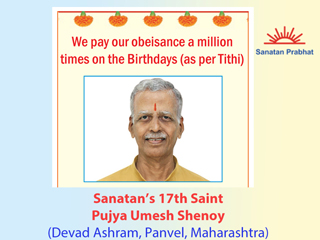 We pay our obeisance a million times on the Birthday (as per Tithi) of
 Major win for Hindu unity : Maharashtra Government suspends the controversial ‘Devasthan Inam Abolition Draft Act’