
KEY FACTS
3 civilian ships struck in 3 days
All vessels had Indian crew members
3 Indian seafarers killed
Omani Navy involved in rescue operations
IMO has called for an investigation
India has termed the use of force against civilian ships "unacceptable"
Introduction
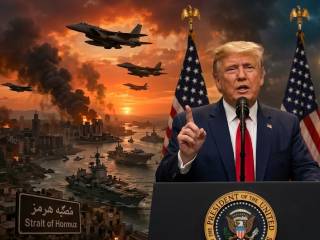
The Strait of Hormuz has emerged as the centre of an escalating maritime security crisis after multiple civilian vessels with Indian crew members were reportedly struck during United States military operations between 9 June and 11 June 2026. The incidents resulted in the deaths of three Indian seafarers and have triggered diplomatic concerns regarding the safety of civilian shipping, the legality of military interdiction measures, and the potential implications for India-US relations.
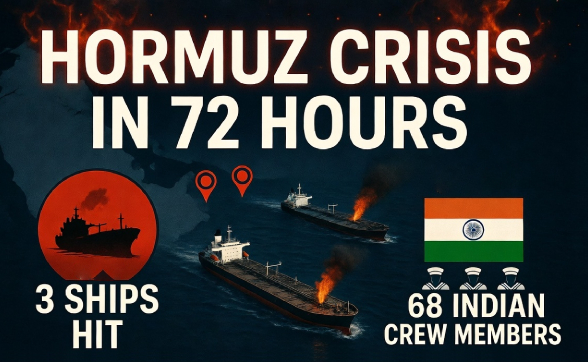
9 Jun-11 Jun 2026. Three days. US military attacks three civilian ships in Hormuz, ALL with Indian crew. 3 Indians killed. The continuing Hormuz crisis has thus acquired a significant India dimension.
Confirmed US Attacks.
(Details of the Vessels Involved)
1. 9 Jun 26. MT Marivex. Flag – Palau. 24 crew. Indian. All rescued.
2. 9 Jun 26. MT Settebello. Flag – Palau. 28 crew. 24 Indian, 3 dead, 21 rescued by Omani Navy. 4 non-Indian crew – status unclear (Possibly 2 Pakistani, 1 Russian, and 1 Ukrainian). Engine room hit by a US missile, off the Omani coast.
3. 11 Jun 26. MT Jalveer, an asphalt/bitumen tanker, was struck near the port of Shinas in Oman. Flag – Guinea-Bissau. Hit by two U.S. Hellfire missiles. 20 crew. Indian. All rescued.
Basic Timeline
| Date | Vessel | Crew | Outcome |
| 9 Jun 2026 | MT Marivex | 24 Indians | All rescued |
| 9 Jun 2026 | MT Settebello | 24 Indians | 3 killed |
| 11 Jun 2026 | MT Jalveer | 20 Indians | All rescued |
Reactions
4. The US has firmly defended its military attacks on civilian shipping.
5. Shipping Operator Contradicts U.S. Claims.
5.1 No Warning Given: iOS Marine (the operator of the MT Settebello) released a public statement denying US CENTCOM’s claims. They asserted that “no warning call, message, or communication was ever successfully established” before the US opened fire.
5.2 They also stated that the tanker had “remained stationary at its position for approximately 10 days prior to the incident and had made no movement whatsoever during that period” – and was hence not transitioning through the area or “engaged in any aggressive or evasive manoeuvres”.
6. The International Maritime Organisation (IMO) Secretary-General Arsenio Dominguez has strongly condemned the escalation of violence in the region and explicitly labelled the attacks on civilian mariners as “simply unacceptable“.
7. The IMO has called for a full and transparent investigation into the circumstances surrounding the MT Settebello missile strike.
8. India’s Diplomatic Pushback. India rejected the US operational justifications, explicitly telling the US that using deadly force against civilian ships is “unacceptable and undermines international maritime commerce”.
WHO SAID WHAT?
| Stakeholder | Statement |
| 🇺🇸 United States | Defended the military attacks on civilian shipping. |
| 🚢 IOS Marine | No warning call, message, or communication was received before the strike. |
| 🌍 IMO | Attacks on civilian mariners are “simply unacceptable”. |
| 🇮🇳 India | Use of deadly force against civilian ships is unacceptable and undermines international maritime commerce. |
Bottom Line
8. The issue is no longer merely about sanctions enforcement or freedom of navigation. It now concerns the safety of civilian mariners, the legality and proportionality of maritime interdiction measures, and the diplomatic fallout arising when nationals of major powers become casualties of military operations.
9. Enforcement operations have many non-lethal options like physical interception, boarding, or electronic disabling.
(For further clarity, kindly refer to the table below.)
Enforcement Options
| Non-Lethal | Lethal |
| Boarding | Missile Strike |
| Inspection | Armed Attack |
| Diversion | Destruction |
| Electronic Disabling | Direct Kinetic Action |
10. The deaths of three Indian seafarers have transformed a regional maritime confrontation into a matter of direct strategic concern for India. India-US relations could be impacted.
Article by Mr Sanjay Agarwal

Former Security Advisor to the Ministry of Home Affairs, Government of India, Sanjay Agarwal, analyses important incidents and their wider strategic significance.
 Racial discrimination against Indian truck drivers working in Australia
 Our DNA and India’s DNA are the same !
 Every graveyard in Kashmir contains the graves of Pakistani terrorists !
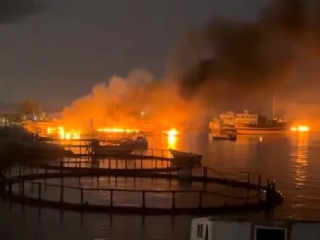 US attacks Iran’s Chabahar Port
 Fanatical Muslims attack historic Shri Kalimata Temple in Bangladesh
 US ceasefire agreement with Iran ends !