
The very fact that Hinduism is still a dynamic and all-encompassing religion stands as ample testimony to the deeds of Adi Shankaracharya. Apart from being the champion of Advaita philosophy, one of His invaluable contributions towards Hinduism was the reordering and restructuring of the ancient Sannyasa order. These Sannyasis help the eternal code of life contained in the Vedas still flow as the dynamic force underlying and unifying all humanity reach the masses.
Bhagawan Adi Shankaracharya is considered to be the ideal Sannyasi. It is commonly accepted that He lived about one thousand two hundred years ago though there are historical sources that indicate that He lived in an earlier period. He was born in Kalady, Kerala and in His short life span of 32 years, His accomplishments seem a marvel even today, with our modern conveyances and other facilities. At the tender age of eight, burning with the desire for Liberation, He left home in search of his Guru. Read on, for a very brief introduction to His life.
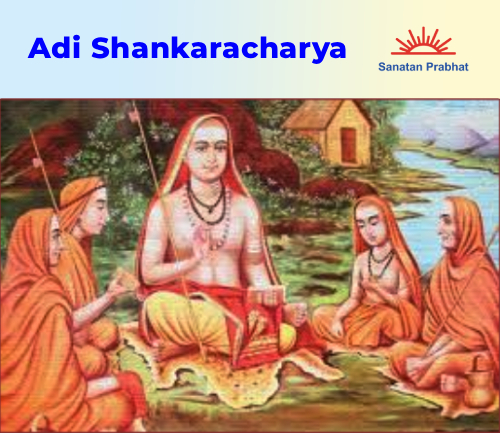
From Kerala, the young Shankara walked about 2,000 kilometres – to the banks of the River Narmada, in the central plains of India, to His Guru – Govindapada. He stayed there serving His Guru for four years. Under His teacher’s compassionate guidance, the young Shankaracharya mastered all the Vedic scriptures.
At the age of twelve, His Guru deemed that Shankara was ready to write commentaries on major scriptural texts. At His Guru’s command, Shankara wrote commentaries elucidating the subtle meanings hidden in the teachings of the scriptures. At the age of sixteen, He dropped His pen having completed writing all the major treatises.
There is a legend about the young disciple during this period of His stay with the Guru.
From the age of sixteen to thirty-two, Shankaracharya went forth, travelling across the length and breadth of ancient India bringing to the hearts of the masses the life-giving message of the Vedas. “Brahman, Pure Consciousness, is the Absolute Reality. The world is unreal. This is the correct understanding of the Sastra, and is the thundering declaration of Vedanta”.
ब्रह्म सत्यं जगन्मिथ्या जीवो ब्रह्मैव नापरः।
अनेन वेद्यं सच्छास्त्रमिति वेदान्तडिण्डिमः।।(ब्रह्मज्ञानावलीमाला)
In essence, the individual is not different from Brahman. Thus by the statement ‘Brahma Satyam Jagan Mithya, Jeevo Brahmaiva Na Para’, He condensed the essence of the voluminous scriptures.
In those days ancient India was sunk in a quagmire of superstitions and scriptural misinterpretations. Degraded ritualism flourished. The essence of Sanatana Dharma, with its all-embracing message of Love, Compassion and the Universality of Humankind was completely lost in the blind performance of these rituals.
Shankaracharya challenged eminent scholars and leaders of various religious sects in vigorous disputes. They championed their own interpretations of the scriptures but the prodigious boy-Sage was easily able to overcome all of them and make them understand the wisdom of His teachings. These men of stature then accepted Shankaracharya as their Guru.
They started to practice in accordance with His guidance, and this change in their lives also wrought a change in the lives of their innumerable followers, who came from all strata of society.
Shankaracharya established four Ashrams in four corners of India and entrusted His four disciples to teach and propagate Advaita through them. (Please read the box alongside.)
In Shankara’s time, there were innumerable sects following their own narrow philosophies and systems of worship. People were totally blind to the underlying common basis of the One God. For their benefit, Shankaracharya formulated the six sect system of worship which brought to the fore the main Godheads – Vishnu, Siva, Shakti, Muruka, Ganesha and Surya. He also formulated the rituals and rites to be followed in most of the major temples in India.
Apart from His immense intellectual and organisational abilities, Shankaracharya was an exquisite poet, with a heart brimming with Love for the Divine.
He composed 72 devotional and meditative hymns like Soundarya Lahari, Sivananda Lahari, Nirvana Shalkam, Maneesha Panchakam. He also wrote 18 commentaries on the major scriptural texts including the Brahma Sutras, the Bhagawad Gita and 12 major Upanishads. He also authored 23 books on the fundamentals of the Advaita Vedanta philosophy which expound the principles of the non-dual Brahman. These include Viveka Chudamani, Atma Bodha, Vaakya Vritti, Upadesa Sahasri, among others.
Considered to be an incarnation of Lord Siva, Sri Shankara lived only a short life span of 32 years. There are many inspiring legends about Him (Please read the portion given below).
Shower of Gold
Before He was eight, as a young Brahmachari, the young Shankara went to a house to beg for His daily food. The hostess was a kind but very poor lady. All she could give Him was a small amalaki goose-berry fruit. Shankara was deeply touched by the sincerity of this poor lady and He invoked Goddess Lakshmi (the Goddess of wealth) by singing spontaneously the Kanakadhara Stotra. Legend has it that the Goddess showered golden amalaki fruits into the house.
Changing the course of the Purna River
Shankara’s mother used to go a long way every day to take her bath in the Purna River. One day the young Shankara found her lying unconscious, due to exhaustion. He prayed to the Lord and the next morning the River started flowing by the side of His house.
Guru Govindapada’s blessings
During the rainy season, the River Narmada was in spate. The floodwaters rose and were about to enter the cave in which His Guru was sitting, deeply immersed in Samadhi. His disciples did not dare to disturb Him, though His life was in danger. Then Shankaracharya placed His kamandalu (Water pot) at the entrance of the cave saying that it would absorb all the waters of the flood. His words came true. The floodwaters could not disturb His Guru’s meditation. Guru Govindapada blessed Him saying “Just as you contained the floodwaters in Your kamandalu, You should write commentaries containing the essence of the Vedantic scriptures. By this work, You will gain eternal glory.”
Sannyasa
When Shankara broached the topic of his embracing the Sannyasa way of life, His mother was reluctant to give her permission and blessings. One day, however, when He accompanied His mother for a bath in the River, a crocodile caught hold of His leg and started dragging him. His mother could only stand and watch helplessly. Then Shankara called out to His mother, asking her to permit Him to become a Sannyasi at least during these last moments of His life. She agreed and miraculously the crocodile let go of Shankara’s leg. To console His mother He promised that He would come back at the time of her death and perform the last rites.
Final rites of His mother
Shankaracharya was somewhere in North India when He came to know of His mother’s impending death. By using his Yogic powers, He travelled through the air to reach her quickly. At her request, He granted her Divine visions.
When He tried to arrange the cremation of His mother’s body, His relatives refused to help Him on the grounds that as a Sannyasi He was not permitted to perform funeral rites. Normally this would have been a serious setback as a cremation involves rituals, which would require physical assistance by a few people. So Shankaracharya performed a miracle. He made a funeral pyre out of plantain stalks. After placing the body on the pyre He took some water and after chanting a few mantras He sprinkled the water on the pyre. Immediately the pyre caught fire. Thus, He was able to complete the funeral rites without help.
Four Muths – Char Dhams – established by Shankaracharya
During His travels across the length and breadth of India, He established four Muths (Ashrams) to unify the scattered and diverse groups of Sannyasis.
Around 700 AD, these Muths were founded in four different corners of India. He selected his senior-most disciples to lead each Muth, entrusting them with preserving one of the four Vedas and a Maha Vakya.
Shankaracharya also reorganised Sannyasis into ten main groups, known as the Dasanami Sannyasa Tradition, aligned with these Muths.
Historical and literary evidence also suggest that the Kanchi Kamakoti Muth at Kancheepuram, Tamil Nadu, was founded by Shankaracharya.
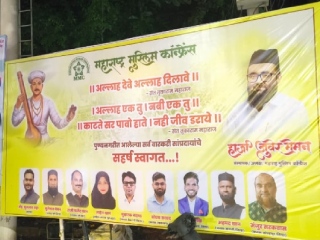 Maharashtra Muslim Conference puts up banners saying ‘Allah Deve Allah Dilave’ during Wari in Pune
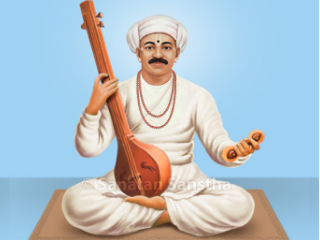 Jagadguru Sant Tukaram Maharaj’s Palakhi departs from Dehu amid devotional fervour
 Radiant Thoughts of Sachchidananda Parabrahman (Dr) Jayant Athavale
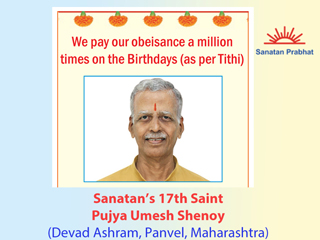 We pay our obeisance a million times on the Birthday (as per Tithi) of
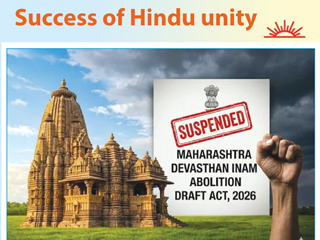 Major win for Hindu unity : Maharashtra Government suspends the controversial ‘Devasthan Inam Abolition Draft Act’
 Mumbai-based advocate Siddhavidya, who is trying to stop trafficking through surrogacy (artificial pregnancy) and animals, and animal killing