
In a session organised in December, I asked the youth attendees some questions on the birth time of Prabhu Shriram, Bhagawan Shrikrushna, Narasimha Avatar, Hanumanta, etc.
The children seated there were between 13 and 23 years of age, from highly educated and economically well-off families, studying in reputed private schools; yet, they could not answer any of these questions.
I then asked them to name different vegetables, leafy greens and fruits, and to explain what nutrients we obtain from consuming them. They could not answer these questions either. Let us understand other similar aspects from this Article.
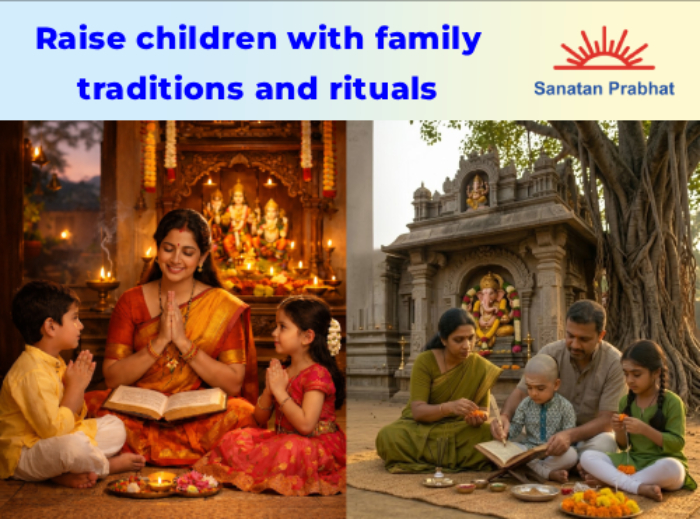
1. Children unable to answer Dharma-related questions
When asked, ‘If you are alone at home and feel hungry, what will you make for yourself, almost all of them said ‘Maggi noodles’, ‘pasta’ or ‘jam toast’. Questions such as ‘What religious observances take place in your home during the month of Shravan ?’, ‘When the Idol of Shri Ganapati is taken out of the house for immersion, what do we say at the threshold ?’, ‘Why do we perform Saraswati Pujan or worship books on Gudhi Padwa, Dussehra and the Padwa day of Diwali ?’, ‘Can you draw Saraswati on the slate ?’, ‘How is Panchamrut prepared ?’, ‘How is a Naivedya leaf arranged ?’, ‘How is Chaitra-angan drawn ?’, ‘What is Chaitra Gauri ?’, ‘What is done on Khande Navami ?’, ‘What is the importance of Ashadhi Ekadashi ?’ – not a single child could say anything. This truly disturbed me.
2. No knowledge of family rituals or traditional prayers
When asked ‘How many blades of Durva are there in one bunch ?’, ‘How is a garland for Deities prepared ?’, ‘How is Aukshan done – with an oil or a ghee lamp ?’, ‘Do you know how some Aratis are performed ?’, ‘How is a dhoti worn ?’, ‘Do you know who is your Kuladev and Kuladevi ?’, the experience was no different.
Many even said, ‘We do not celebrate such festivals at home. They are observed at our ancestral place or at our relatives’ homes.’ Most boys who had undergone the thread ceremony did not even know why the ceremony is performed.
Children do not know shlokas. They do not know the abhangs of Saints. Except for the Arati of Shri Ganapati, they do not know other Aratis. They are unfamiliar with the works of great poets. They have not read travelogues. They do not visit libraries. They cannot write even a simple four-line letter. They do not know the order in which an address is written on an envelope.
At most, some may know Ganapati stotra, Ramraksha or Maruti Stotra; but they do not know Mahishasurmardini Stotra, Pandurangashtak, any chapter of the Shrimabhagawadgeeta, Pragya-vivardhan stotra or Adityahridaya stotra. They do not know Manache shloka or Karunashtakas. Many do not even know the complete ‘Vande Mataram’.
3. Lack of practical life skills
When asked, ‘What would you do in an emergency ?’, they could not respond. How will you call an ambulance ? What would you do if there is a gas cylinder leakage ? What if someone is stuck in a lift ? Can you check CCTV footage ? Can you make an offline railway reservation ? Can you deposit a cheque in a bank ? Can you read an electricity bill ? Can you travel around Pune by bus independently ? Can you clean grains before cooking ? What is the difference between hot-pressed oil and cold-pressed oil ? What is palm oil ? What is vanaspati ghee ? What is cholesterol ? – no answers !
4. How will children receive holistic nourishment through education ?
All this became painfully clear before me. It disturbed me and I found it difficult to overcome the feeling. The cultural foundation necessary for a child’s formation seemed absent. If young people between 13 and 23 years of age lack such basic knowledge, parents must realise the seriousness of the situation.
Securing high marks and obtaining a lucrative ‘package’ cannot alone make life complete. The children and their parents must understand this. Moreover, are they even academically sound ? Often, this too is not the case. Despite years of reading, speaking and listening to Marathi, many do not understand the difference between similar words. Marathi speech is heavily mixed with Hindi and English words.
Writing in Devanagari is weak. In science, they may draw a circuit diagram from a textbook, yet they cannot assemble an actual circuit. Even changing a simple LED bulb is difficult for them. How can the students of science not know this ? Do they understand why artificial soft drinks are harmful ? Then, how exactly are they studying science ?
Do they possess a social, cultural, intellectual, emotional, educational, environmental, scientific, economic and national character-oriented outlook towards life ? How will these children obtain such holistic nourishment ? From where ? Who will provide it ? Have we reflected upon this ?
5. Schools, families and society must collectively frame a policy
Seeing these issues clearly, we organised a session for parents. I asked them, ‘What do you expect your children to learn ?’ Most parents focused solely on high marks in school examinations. Scoring well in ‘National entrances’ was their primary concern – nothing beyond that.
Can money alone determine the quality of life ? Why are our children becoming socially, culturally and intellectually fragmented ?
If this is the situation, it is not merely the fault of the education system. Society itself must determine the policy for shaping the next generation. No textbook curriculum or mark sheet can lay the foundation for a healthy, wise and balanced life. If schools, families and society come together and frame clear policies, the picture can change. Unless every member of society accepts this as personal responsibility and participates actively, the fabric of our future generations’ lives will continue to tear and there will not be enough patches to mend it. Book learning, academic learning and skill learning are three distinct things.
Therefore, dear parents, change your perspective towards the summer holidays. The true curriculum for shaping a child is vast. To pass in it, we ourselves must enter the field.
6. Parents must become proactive
Remember, your children need your active involvement the most. This responsibility cannot be outsourced. Merely giving birth does not make one a parent. Paying fees for schools and activities does not mean that proper upbringing has taken place.
If we wish to sculpt our children’s personatities well, we must learn that art ourselves along with the teachers. Without enduring the blows of the chisel, excellence cannot emerge, and unless we ourselves take up that chisel, our parenthood will not become fruitful and complete.
Only if we take up parenthood as a Vrat (Vowed observance) sincerely, we will benefit from it.
Else … !
– Mr Mayuresh Umakant Danke (Psychologist, Director and Career Counsellor, Astha Counselling Centre, Pune)
Gurukul is a type of residential schooling system in which the shishya (Student) lives with the Acharya or Guru. The Acharya feeds him, teaches him, and treats him as one with the family. The shishya helps the Guru in His day-to-day work and learns from His conduct as well. This is the way education was imparted to everyone during the Vedic period and Mahabharat period well up to the 18th century till the British introduced an alternative day-boarding system.
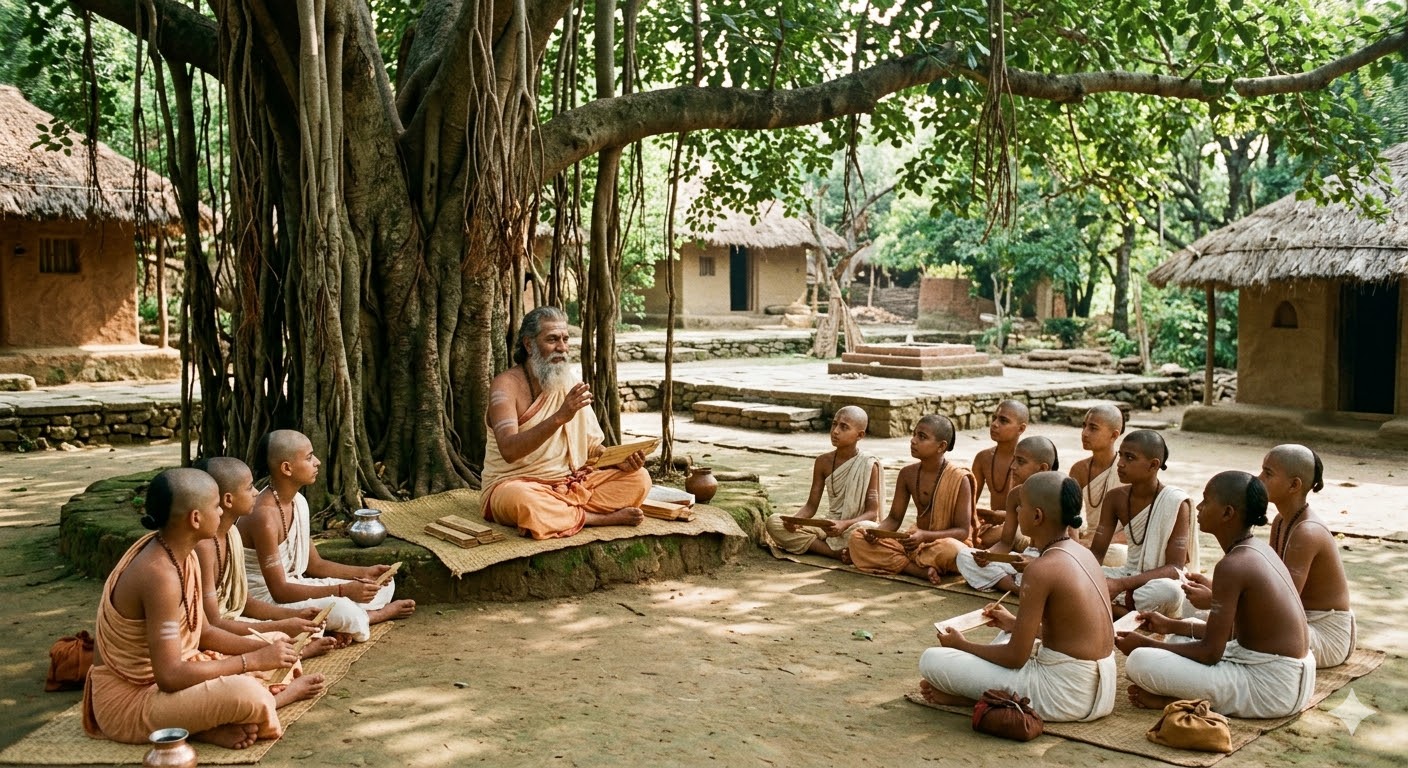
The British used it to impart religious as well as secular teachings in India.
In Gurukuls, Brahmacharis (Students), or Satyanveshi Parivrajakas from far-off places used to come to complete their learnings. Those Gurukuls were of all kinds, small or big.
Sages who nourished ten thousand Sages or students and gave education were called the Kulapati (Vice-Chancellor). Some of the famous Rishis/Gurus who find mention in the Indian Epics Ramayan and Mahabharat also had famous Gurukuls. Prabhu Shriram and Bhagawan Shrikrushna also studied in Gurukuls under Sage Vashishtha and Sage Sandeepani respectively.
(Courtesy : vediconcepts.org)
| Do children possess a social, cultural, intellectual, emotional, educational, environmental, scientific, outlook towards life ? ! |
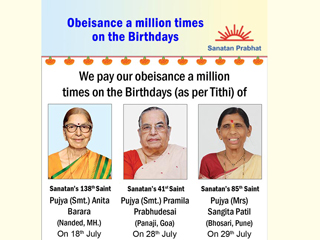 We pay our obeisance a million times on the Birthdays (as per Tithi) of
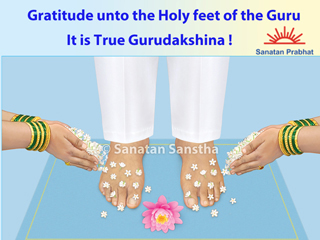 Offering gratitude unto the Holy feet of the Guru is true Gurudakshina !
 Messages of the Gurus on the occasion of Guru Purnima (29th July)
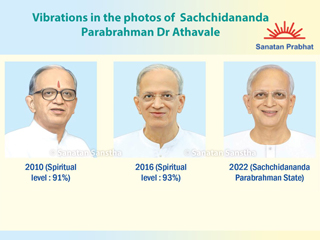 Sadguru (Dr) Mukul Gadgil’s analysis of the vibrations in the photos of Sachchidananda Parabrahman (Dr) Athavale, corresponding to His spiritual level at different times
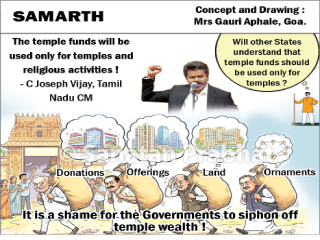 Projects of funding commercial complexes worth Rs 246 crore using temple funds cancelled by Tamil Nadu Government
 Salutations unto the Guru !