
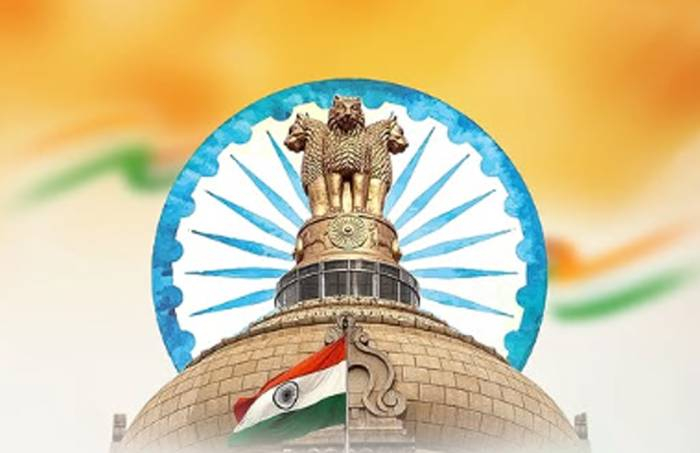
Seventy-six years have passed since the establishment of the modern republican system in Bharat. On 26 January 1950, India adopted a new Constitution. As the world today stands at the threshold of a major transition, it becomes the need of the hour to reflect on this journey on the occasion of India’s 77th Republic Day.
A republic literally means the rule of the people. While this system is considered modern and ideal today, such a form of governance has existed in Bharat since time immemorial. India’s second President, Dr. Sarvepalli Radhakrishnan, once observed, “Indian politics is the expression of an ancient moral order. Long before modern democracy, Indian civilization had accepted the principles of restraint on rulers (the supremacy of Dharma over political power), public accountability, and ethical governance.”
Renowned Gandhian thinker Dharampal took this idea further. In his book The Beautiful Tree, he writes, “Indian villages, institutions, organizations, and communities governed themselves through consensus and collective decision-making. British colonialism disrupted an already functioning indigenous republican system.”
Such reflections by thinkers like Dr. Radhakrishnan and Dharampal highlight the distinctiveness of Indian democracy and republicanism.
India’s present Constitution has been drafted by borrowing elements from the constitutions of Britain, the United States, Ireland, Canada, Australia, the Soviet Union, Japan, and Germany – essentially Western models. While administrative experiments may evolve with changing times, the underlying moral framework and intellectual foundations must remain rooted in the native culture. This is not the case with modern Indian constitution.
During six decades of Congress rule, these foundational principles were discarded, resulting in the systematic erosion of Indian society. It’s now in public domain as in how Hindu temples were brought under the government scanner, and how the constitution was kind of tweaked irrevocably in the favour of the Indian minorities. There are numerous articles in the Constitution which are contradictory to each other, and give the benefit of doubt to the minority, treating the majority Hindus as second class citizens. Articles 29 and 30 (Cultural and Educational Rights) allow minorities based on religion or language to establish and administer their own educational institutions. This creates a disparity, as Hindus cannot set up and manage their own institutions with the same freedom. Furthermore, Article 28 (Religious Instruction in Institutions) restricts religious instruction in state-aided educational institutions. This ultimately leads to the state discouraging the teaching of traditional Hindu texts, such as the Bhagavad Gita or the Ramayana, in public schools, while minority institutions protected under Article 30 remain unrestricted. While Article 25(2)(b) (State Regulation of Temples) guarantees freedom of religion, it also authorizes the state to make laws for social reform and to throw open Hindu religious institutions of a public character. Dr. Anand Ranganathan has categorically stated these facts in his 2023 book – Hindus in Hindu Rashtra – Eighth Class Citizens of a State-sanctioned apartheid. The world knows, how during the state of emergency, the words “secular” and “socialist” were inserted in the Preamble of the Constitution by Indira Gandhi. Today, even if slowly, efforts are being made to reverse the damage caused by those policies. Though this task may take generations, the corrective journey has at least begun.
A Strong Economy ?
A true ruler is one who understands the welfare of the people. Today, Bharat has found in Prime Minister Narendra Modi a resolutely nationalist (a Hindutvanishth), philosophical, religious, and spiritual leader. Under his leadership, India has achieved remarkable success across multiple sectors. India has emerged as the world’s fourth-largest economy and is poised to surpass Germany to become the third-largest in the coming years.
Centuries ago, India alone contributed nearly 33% of the global GDP. Islamic invaders and British colonialists looted and impoverished the nation. Yet, owing to the inherent civilizational strength embedded in the Indian people, Bharat is once again rising to reclaim its historical stature.
However, one must not overlook that despite a total GDP of approximately $4.18 trillion, India’s per capita income remains a modest $2,800. A comparison with populous China and the United States is instructive – China’s per capita income stands at $13,800, while that of the US is $89,600. Among 197 countries, India ranks 144th in per capita income. According to IMF projections, this figure may rise to $4,000 by 2030.
This clearly illustrates how far India still has to go in terms of economic empowerment. To meet the challenges posed by the Prime Minister’s vision of “Developed India 2047,” the Indian Republic must cultivate the necessary capacity over the next 21 years.
Cultural Renaissance
Alongside economic strength, cultural empowerment is equally essential. It is often said that winds of cultural nationalism are blowing today. Ancient Hindu temples are being restored. Ayodhya has been liberated after 550 years of Islamic encroachment, but what about countless other sacred sites?
Just last Friday, on the occasion of Vasant Panchami, Hindus had to struggle merely to worship Saraswati Devi at the Bhojshala. Kashi Vishwanath, the Harihar Temple in Sambhal, the Taj Mahal, and innumerable Hindu sites must be freed from centuries of hostile occupation.
A major obstacle in this process is the Places of Worship Act, 1991. This blemish on India’s constitutional framework must be erased.
At the same time, while pilgrimage corridors and beautification projects are being undertaken, one must ask whether the sanctity and spiritual purity of these sacred spaces are being compromised. Prominent Odia Hindu thinker Shri. Anil Dhir warns that the faith, emotion, and spiritual vibrations of pilgrimage sites must not be destroyed in the name of development. For example, rather than modernizing the temple campuses, temple devotees be given the autonomy to manage the temples, mechanisms be implemented to protect not only the heritage, but also the sanctity of the temples etc.
Consider Goa, one of India’s most spiritually vibrant regions. While the government seeks to promote spiritual tourism, instead of branding “Goa is much beyond Sun, Sand, and Sea,” it should be asserted that Goa is not Sun, Sand, and Sea, its temples must be highlighted. This would attract devotees rather than casual tourists with no spiritual intent. Today, even those devoid of devotional sentiment casually enter temples, raising concerns about the dilution of temple culture. This warrants serious introspection, and temple committees must be consulted to preserve spiritual integrity.
India’s cultural renaissance demands nothing short of Herculean efforts.
“Dharmeṇa Jayati Rāṣṭram” – A Nation Triumphs Through Dharma
India must also intensify its efforts in foreign policy, defense preparedness, and strategic autonomy. On this 77th Republic Day, citizens must assess what has been achieved and decide the path ahead.
At this critical juncture, the thought of eminent civilizational scholar Shri. Rajiv Malhotra deserves mention. He observes, “ Indian democracy is an expression of Dharma-based pluralism, not Enlightenment liberalism.”
According to him, Bharat must never abandon Dharma. The moment Dharma is forgotten, the nation risks returning to the decay witnessed during decades of Congress rule. Protect Dharma, and Dharma will protect you.
“Dharmeṇa Jayati Rāṣṭram” — Through Dharma, the Nation Prevails.
 Who are the true comedians ?
 Special Editorial | An Assault on Shri Ram? Beyond the Ayodhya Temple Theft
 Make sacrifices for the Nation
 Special Editorial – India’s Nuclear Readiness: What SIPRI’s Latest Report Reveals
 Kerala election results and their implications for Hindutva politics.
 Passenger Jihad !