
Key Highlights
|
Defence Terms Explained
| NFU | No First Use |
| SSBN | Submersible Ship Ballistic Nuclear-powered (a nuclear-powered ballistic missile submarine) |
| Deterrence | Preventing an attack by threatening retaliation |
| Second Strike Capability | Ability to retaliate after being attacked |
| SIPRI | Stockholm International Peace Research Institute |
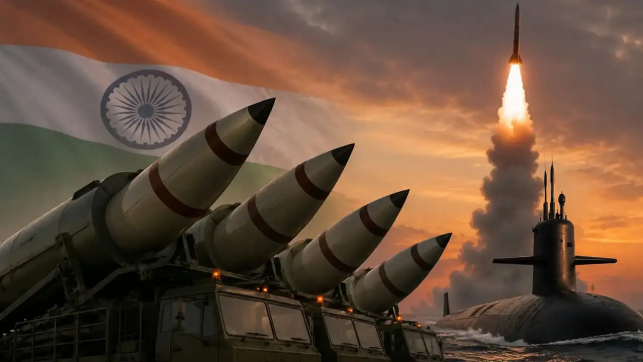
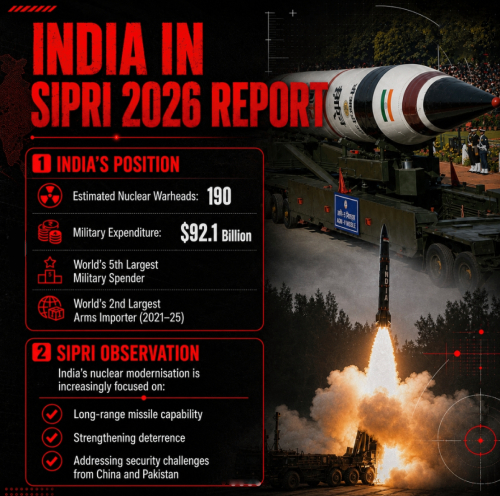
The nuclear weapons that India has developed are no longer mere showpieces. For the first time, they have reportedly been placed in an active state of readiness to deter and, if necessary, counter India’s adversaries, namely Pakistan, China, Türkiye, and others. Recently, the Stockholm International Peace Research Institute (SIPRI) released a report on nuclear weapons worldwide. According to the report, India has deployed at least 12 of its 190 nuclear warheads in an “active” operational status.
India’s Nuclear Position at a Glance
| Indicator | India |
| Estimated Nuclear Warheads | 190 |
| Active Readiness Warheads | 12 |
| Nuclear Policy | No First Use |
| Main Adversaries | China, Pakistan |
| Sea-Based Deterrent | Arihant Class SSBNs |
| Source | SIPRI 2026 |
This development must be viewed as a fundamental shift in India’s war doctrine. Earlier reports described India’s nuclear arsenal as a “stockpile” rather than as actively deployed weapons. Operationally deployed warheads reduce response times and strengthen the credibility of deterrence. It should, however, be noted that this remains a claim. Nevertheless, SIPRI enjoys an excellent reputation worldwide as an independent and highly credible authority on international security, military expenditure, and arms trade. Established in 1966 and funded primarily by the Swedish government and independent organisations such as the United Nations, SIPRI is known for its rigorous and objective research methodology. Therefore, there is little reason to dismiss its assessment regarding India. Moreover, whether it is India or any other nuclear power, nations rarely reveal the precise manner in which they prepare for war. Such secrecy is an inherent element of military statecraft.
The Strategy of Offensive Defence
SIPRI’s report states that these nuclear weapons are continuously deployed aboard Indian warships, submarines, and other delivery platforms. This implies that if any nation attempts a nuclear strike against India, India is prepared to launch an immediate nuclear counterstrike.
India’s embrace of this approach may have come later than strategists such as Veer Savarkar had advocated decades ago. Numerous examples of this vision can be found in the book Savarkar’s Historical Statements. In 1965, when the Tashkent Agreement was being negotiated to end the Indo-Pak war, and Prime Minister Lal Bahadur Shastri was preparing to travel to Uzbekistan, Savarkar observed that only a response matching the nature and intensity of Pakistan’s aggression could deter further attacks. Friendly relations with Russia and the United States alone would not suffice. India, he argued, must urgently equip itself with every type of nuclear weapon and missile. Until the government acted in that direction, all talk of goodwill and friendship would remain meaningless.
Timeline of India’s Nuclear Journey
| 1998 | Pokhran-II tests |
| 2003 | Formal NFU doctrine |
| 2016 | Defence Minister Parrikar comments on NFU |
| 2020 | Galwan standoff |
| 2025 | Operation Sindoor |
| 2026 | SIPRI active readiness report |
The relevance of Savarkar’s ideas is evident today. Adopting a similar outlook, Defence Minister Rajnath Singh has declared, “This is a New India. It will enter your territory and strike back. (Ye naya Bharat hai. Ye ghusega bhi aur marega bhi.)” The same Savarkarian military philosophy underlies India’s actions against Pakistan-sponsored terrorists, whom India has targeted within their own territory. Whether it was Operation Sindoor, the surgical strikes of 2016 and 2019, or the successful confrontation against powerful Chinese forces in Ladakh in June 2020, all these developments indicate that the government and the armed forces are increasingly guided by the doctrine of “offensive defence.”
Significant shift in India’s defense strategy?
According to the latest SIPRI report, India has deployed 12 ‘active’ nuclear weapons on missiles for the first time, marking a change in its decades-old nuclear policy.
The report also claims India spent ₹27,000 crore ($3.2B+) on… pic.twitter.com/qTFb3YtmGD
— Sanatan Prabhat (@SanatanPrabhat) June 10, 2026
A closer look at SIPRI’s report reveals that major military powers such as Russia, the United States, the United Kingdom, France, and China have long maintained substantial portions of their nuclear arsenals in an active operational posture.
China’s Expanding Nuclear Arsenal
Consider China. It reportedly has 34 nuclear weapons in an active posture, nearly three times India’s number. In addition, China is constructing missile bases near India’s borders from which it could launch DF-26 nuclear-capable missiles with a range of approximately 4,000 kilometres. One such base at Golmud in Qinghai Province lies only about 900 kilometres from the Indian border. Missiles launched from there could strike deep inside Indian territory.
If China were to launch a sudden attack, India’s reported nuclear readiness would enable it to respond immediately. Over the past three years, China has increased its nuclear arsenal from 500 to 620 warheads. During the same period, India expanded its stockpile from 164 to 190 warheads – a significant increase of about 15 per cent. This represents an important strategic transformation, particularly in the aftermath of Operation Sindoor.
According to Manoj Joshi, a distinguished fellow of the strategic affairs think tank, Observer Research Foundation (ORF), as few as five to ten nuclear weapons could devastate an entire nation.
To illustrate the logic of deterrence, consider a hypothetical scenario. Even if China were to neutralise a substantial portion of India’s arsenal, India would retain sufficient second-strike capability to inflict unacceptable damage on the aggressor.
Sushant Sareen, another senior fellow at the ORF, explains, however, that the size of a nuclear stockpile is primarily intended to demonstrate nuclear deterrence. In his view, the objective is not the number of weapons themselves, but the ability to convince an adversary that any nuclear attack would invite a devastating response.
Pakistan and Regional Nuclear Deterrence
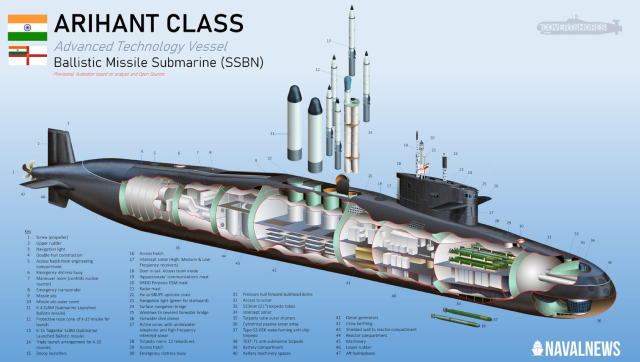
Pakistan, for its part, continues to issue nuclear threats against India. Maintaining nuclear readiness is therefore equally necessary to deter Pakistan. Furthermore, aboard ballistic missile submarines such as INS Arighat and INS Aridhaman, the indigenously built nuclear-powered ballistic missile submarines (SSBNs) of India’s Arihant class, nuclear warheads and missiles cannot be kept completely separate, which has also influenced India’s strategic posture.
Nor should India overlook Türkiye. In recent years, Ankara has emerged as one of Pakistan’s most outspoken international backers. Its alignment became particularly evident during Operation Sindoor in May 2025, when Pakistan reportedly employed Turkish-made drones against India. Such actions underscore the emergence of a broader strategic nexus that seeks to constrain India’s rise and challenge its security interests. Although geographically distant, Türkiye lies well within the operational range of India’s Agni-IV and Agni-V ballistic missiles, highlighting the reach and credibility of India’s deterrent capability.
A report by the ‘International Campaign to Abolish Nuclear Weapons (ICAN)’ claims that global spending on nuclear weapons reached a record high in 2025. India also increased its expenditure on nuclear weapons. A total of $119 billion was spent on nuclear weapons worldwide in 2025. According to the report, the United States spent $69.2 billion, China spent $13.5 billion, and India spent $2.8 billion (₹26,711 crore) on nuclear weapons. This underscores the emphasis India has placed on the development and deployment of nuclear weapons.
However, despite these expenditures, significant modernisation challenges remain. Veterans frequently caution that a significant portion of India’s defence budget is consumed by revenue expenditure (salaries and pensions) rather than capital acquisitions (new weapons and technology), which can limit rapid modernisation. In standard Indian defence budgets, the allocation for the Ministry of Defence (MoD) is split unevenly. For example, looking at the defence budget allocations, the share available strictly for Capital Outlay (modernisation) has historically hovered at or below 30% of the total budget.
Following the 2020 Galwan standoff, veterans have highlighted a significant shift in infrastructure deployment. The Border Roads Organisation (BRO) has completed hundreds of strategic roads, bridges, and all-weather tunnels along the Line of Actual Control (LAC). Veterans note that this has drastically cut troop deployment times from weeks to just a few hours in the event of Chinese aggression.
Should India Revisit Its No First Use Doctrine?
Still, India’s “No First Use” (NFU) policy, that it will not be the first to use nuclear weapons, should now be reconsidered. India should modify this doctrine and reserve the option of employing nuclear weapons first if circumstances demand it. This viewpoint, however dangerously escalatory, is endorsed by Retd – Group Captain TP Shrivastava of the Indian Air Force.
Former Commander-in-Chief of the Strategic Forces Command (SFC) Lieutenant General B.S. Nagal (Retd) said in his article “Checks and Balances”, in Force Magazine (Special Issue on Nuclear Deterrence) – “If the leadership is aware that an adversary is likely to launch a strike or has initialized the launch, it is bound by the doctrine to accept the first strike, accept massive destruction, and only then retaliate… Is the leadership ready to accept massive destruction? In a democracy, the leadership is accountable to the people… It would be a better option to review the doctrine to allow ‘first use’ or ‘pre-emptive strike’ to protect the nation.”
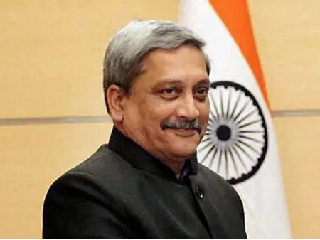
Ex Defence Minister (Late) Manohar Parrikar
In November 2016, at a book launch, Manohar Parrikar shook up the international diplomatic community by questioning the rigidity of the NFU: “Why should I bind myself? I should say I am a responsible nuclear power and I will not use it irresponsibly. Instead of saying ‘No First Use’, you can say ‘we are a responsible nuclear power’.”
George Washington, the first President of the United States, famously observed that “To be prepared for war is one of the most effective means of preserving peace.” The growing closeness between Bangladesh and Pakistan, Nepal’s increasing proximity to China, and Pakistan’s ambitious space programme supported by China all pose significant geopolitical challenges for India.
Whether it is the China-Russia partnership challenging American influence, or the United States’ use of the Quad framework to counter China’s growing dominance in Asia through cooperation with India, the best path for India is constant vigilance and robust self-defence.
Recently, the brave Indian soldier Praveen Prabhakar Janjal was posthumously awarded the Kirti Chakra. The sight of his mother, Shalu Prabhakar Janjal, overcome with emotion, and President Murmu consoling her was deeply moving. Such sacrifices not only stir the hearts of ordinary Indians but also strengthen the government’s resolve to ensure that acts of aggression don’t go unanswered. The reported readiness of India’s nuclear arsenal appears to reflect the same determination.
For that reason, India must continue to follow Savarkar’s principle in a Sanscritik “Charaiveti, Charaiveti” fashion – “Keep moving forward”- and strengthen its nuclear capabilities. This difficult path is unavoidable.
Key Strategic Insight
A nuclear-armed India adopting a posture of offensive defence is the most effective path of self-preservation and the strongest answer to its adversaries.
FAQs (Frequently Asked Questions)
Q1 – What is SIPRI? |
| Ans – The Stockholm International Peace Research Institute is an independent global research organisation specialising in military expenditure, arms control and security studies. |
Q2 – How many nuclear warheads does India possess? |
| Ans – According to SIPRI estimates, India possesses approximately 190 nuclear warheads. |
Q3 – What is India’s No First Use policy? |
| Ans – India’s doctrine states that it will not be the first country to use nuclear weapons in a conflict. |
Q4 – What is second-strike capability? |
| Ans – The ability to launch a retaliatory nuclear attack even after suffering a first strike. |
Q5 – Why are ballistic missile submarines important? |
| Ans – They provide a survivable nuclear deterrent because they are difficult to detect and destroy. |
 Call to suspend financial aid to Pakistan and visas for Pakistani nationals
 SPECIAL EDITORIAL : The Constructive Spirit of American Youth!
 Pakistan Army handed over bodies of soldiers killed in Kargil War to Hindus !
 Case where a Christian couple was burned alive in brick kiln!
 14,000-page chargesheet filed against Al Halimi Foundation
 United Nations expresses concern over crackdown on protesters in Pakistan-occupied Kashmir