
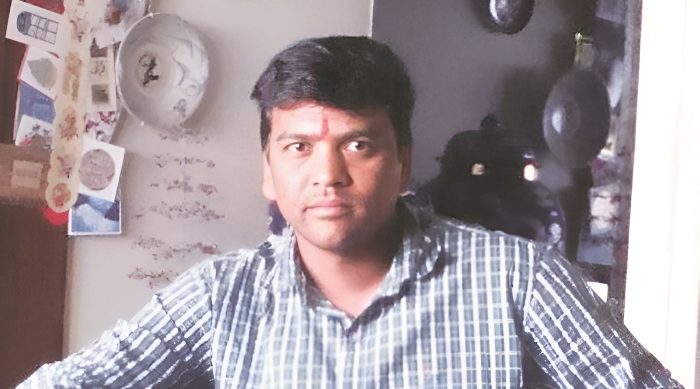
On January 20, Sanatan Sanstha seeker Sameer Gaikwad passed away suddenly at the young age of 43. On one hand, communist and anti-Hindu media outlets indulged in shameless mudslinging even after his death, running headlines such as “Prime accused in the Pansare murder case dies”, thereby continuing a media trial to satiate their ingrained Hinduphobia. This smear campaign was not merely a violation of Sameer’s human rights; it amounted to inhuman persecution even in death.
On the other hand, Hindutva-aligned organizations such as Sanatan Sanstha and the Hindu Vidhidnya Parishad stood firmly in his support, objectively highlighting how the communist ecosystem and the overall system were responsible for his death. The sequence was disgraceful: first branding Sameer as the assassinator, then accusing other people, yet incarcerating him for 19 months, subjecting him to relentless harassment, and finally destroying his social reputation. Hence, it would be more accurate to call this not a natural death, but a killing executed by the system. The case of the innocent Sameer Gaikwad starkly demonstrates how essential Hindu unity and organization truly are.

Absence of Prudence
While striving to build a broad-based organization of nationalists and dharmic forces, prudence and alertness are equally vital. Recently, an incident occurred in which nationalist forces themselves came into direct conflict with one another. Since “such mistakes must not occur in the name of national interest”, it becomes our duty to place the facts before the public objectively. For the larger national good, this incident deserves serious reflection.
What transpired was this
In one Indian city, a group of nationalists organized an ideological event. A fiercely nationalist author was invited, who had written a book exposing the true face of an Islamic aggressor. A panel discussion on this book was planned. However, local nationalists had long alleged that the organizing body was part of the communist ecosystem. One to two years ago, the same organization had invited a writer with an anti-national mindset to one of its programs. Since then, the organization had become a target of nationalist anger. Another reason for resentment was that the government had permitted this organization to use a prestigious government auditorium, one that is otherwise denied to private organizations. This selective permission further intensified opposition.
At the same time, it must be noted that some office-bearers of this organization are staunch nationalists. Hence, whether the organization is truly communist or not remains a matter requiring deeper investigation. Against this backdrop, fierce opposition erupted not against the organization directly, but against the book of the nationalist author invited to the event. A nationalist newspaper published a report opposing the event and targeted the book, questioning: “Why reopen the history of Islamic aggression?” and “What is the necessity of this?”
It appears that, in its eagerness to oppose the organizing body, the daily chose to oppose a component of the event and ended up targeting the nationalist author’s book. This triggered a chain reaction. Several nationalist organizations, without adequate thought or due diligence, began opposing the author and his work. This incident highlights why opposition must be discerning and informed. Before opposing any author, it is imperative to study his background, ideology, and contribution. A position taken after proper evaluation is more likely to be accurate and truly serve national interest.
Instead, disregarding this basic prudence, nationalist organizations adopted an ultimatum-like stance: “Remove the author and the panel discussion on his book, or the event will not be allowed to take place.” The opposition snowballed. Some ministers and senior professors even publicly supported this demand.
Throughout this entire process, no one paused to reflect: “In opposing the organization, are we inadvertently hurting one of our own nationalist warriors?” or “Are we even attempting to understand his side?” Ultimately, due to mounting pressure, the organizers were forced to cancel the discussion involving the author and his book.
Who Is Truly at Fault?
A rational observer may argue that the nationalist daily should be held responsible. This is partly true. If an organization is suspected of being communist, opposition should be grounded in clear ideological principles, and the direction of protest must be carefully chosen. However, blindly trusting a single media report and then turning against a nationalist author is itself an act of self-sabotage by nationalist organizations.
Potential Dangers
The matter did not end there. Anti-national forces immediately began exploiting the situation. A notorious anti-national news portal reported the incident, attempting to portray how “nationalists themselves are pulling down fellow nationalists.”
It is also learned that the affected nationalist author is considering legal action against the concerned nationalist daily. Worse still, a discredited anti-national journalist was given an interview on the issue by the author himself, during which internal ideological differences among nationalists were openly exposed before adversarial forces. This entire sequence should serve as a wake-up call for nationalists and Hindutva-aligned forces alike. It demands introspection and maturity so that a strong, resilient nationalist ecosystem can be built for India’s future. The honest intention behind this editorial is simple: such self-destructive episodes must never be repeated again.
| Nationalists must remember that while acting in the interest of the nation, constant vigilance is absolutely essential. |
 Who are the true comedians ?
 Special Editorial | An Assault on Shri Ram? Beyond the Ayodhya Temple Theft
 Make sacrifices for the Nation
 Special Editorial – India’s Nuclear Readiness: What SIPRI’s Latest Report Reveals
 Kerala election results and their implications for Hindutva politics.
 Passenger Jihad !