
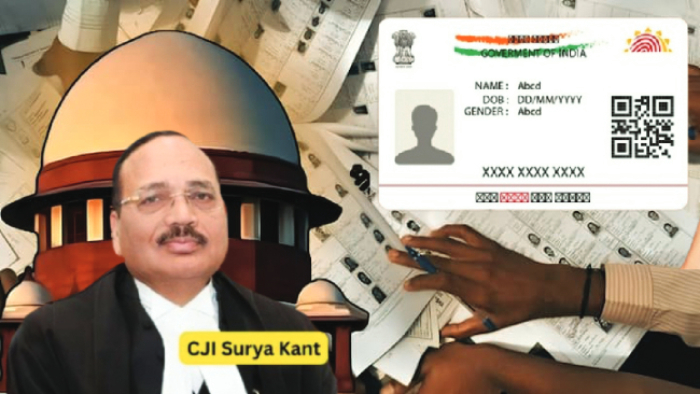
New Delhi – “Suppose certain people come to India from other countries, work here, and reside here. Someone may work as a rickshaw puller, another as a construction labourer. If you issue them an Aadhaar Card – which enables them to receive subsidised grain or any other welfare benefits – then, under our constitutional framework, they become beneficiaries of state welfare. This reflects our constitutional morality. But does this automatically mean that they should also be granted the right to vote merely because they receive such benefits ?” Chief Justice Surya Kant raised this pointed question during the hearing of a case related to the Special Intensive Revision of electoral rolls. The remark came when senior advocate Kapil Sibal, representing the States of Bengal and Kerala, argued that voters were being excluded from electoral rolls despite possessing Aadhaar Cards.
Chief Justice Surya Kant observed that Aadhaar was created under a valid law and serves a defined statutory purpose. Benefits and subsidies are granted on its basis. “Ultimately, Aadhaar was created for a specific purpose. There is no reason for anyone to dispute that,” he remarked.
Errors in genuine cases will be corrected
Citing the example of the Special Intensive Revision process carried out in Bihar, Chief Justice Surya Kant stated that objections were extremely minimal. “If there are cases where an individual is a bona fide resident, a citizen of India, yet has been excluded from the electoral roll, we are waiting to examine such cases so that any errors can be corrected,” he said.
Will not interfere with the Special Intensive Revision process
Chief Justice Surya Kant firmly stated that the power to conduct a Special Intensive Revision is constitutionally and statutorily vested in the Election Commission, and the Court will not halt the process. At the same time, he assured that corrective measures would be taken if any irregularities were brought to light.
He added that in Bihar, after the process was refined under the Supreme Court’s directions, no objection was filed against the updated electoral roll. Although claims were made that crores of voters’ names were being removed, the Court found that the deletions mostly included individuals who had died or migrated out. “No objections were raised. We found no adverse consequences,” the Chief Justice noted.
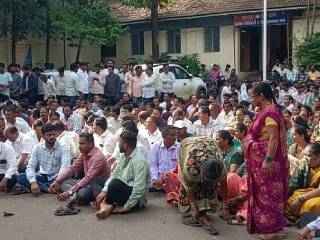 Villagers march to Kagal (Kolhapur district) Police Station in the ‘Love Jihad’ case and demand that the Hindu young woman be handed over to her parents !
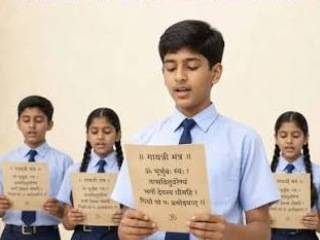 School prayer circular upheld : High Court dismisses petition challenging recitation of Gayatri Mantra in schools !
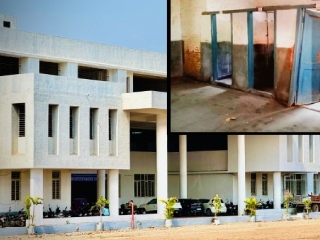 It revealed that 181 colleges in Maharashtra lack basic educational facilities !
 ‘Muslim Personal Law’ is not above the law of the land: Allahabad High Court
 Taj Mahal should be surveyed to establish that it is ‘Tejo Mahalaya’ !
 Presenting the 60-year-old demand for a ‘Tamil nation’ as history is not sedition !