
Pakistan reacts to Defence Minister Rajnath Singh’s statement, ‘Sindh can return to India’
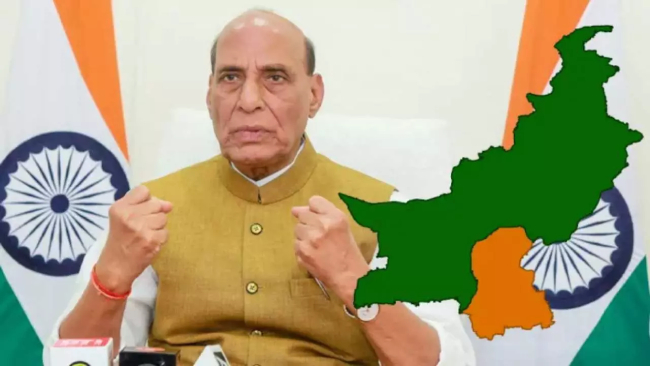
New Delhi / Islamabad – “Today, I am quoting one of his (L.K. Advani’s) statements. Today, Sindh may not be a part of India geographically; however, culturally, Sindh will always remain a part of India. As for the land itself, no one can say when borders may change; because tomorrow, Sindh may return to India. The Sindhi people, who consider the Sindhu (Indus) River sacred, will always be our own—no matter where they are”, India’s Defence Minister Rajnath Singh said on 23rd November. Pakistan’s Ministry of Foreign Affairs has reacted to it, stating, “These comments expose the Hindutva mindset that seeks to challenge eslishtabed realities. They clearly violate international law, recognised borders, and national sovereignty.”
All Hindus across India consider the Sindhu River sacred
Speaking at an event organised by the Sindhi community, Defence Minister Rajnath Singh referred to BJP leader L.K. Advani’s book and said that many Sindhi Hindus of Advani’s generation still find it difficult to accept that Sindh became separated from India. Pakistan was created after the 1947 Partition, and since then, the Sindh region along the Sindhu River has remained part of Pakistan. “I would like to mention L.K. Advani today. In his book, he wrote that many Sindhi Hindus — especially those of his generation — still have not accepted the separation of Sindh from India. Not only in Sindh, but throughout India, Hindus revere the Sindhu River. Some Muslims in Sindh also consider the river sacred. It was even said that the waters of the Sindhu are no less pure than the Zamzam water of Mecca. These are Advani’s own words,” Singh said.
The statement of India’s Defence Minister, Shri Rajnath Singh, is warmly welcomed by the national movement of Sindhudesh JSMM and the Sindhi nation from the depths of our hearts.
The Honourable Defence Minister of India, Shri Rajnath Singh, has recently made a historic and… pic.twitter.com/MFTGJIksRn— Shafi Burfat (@shafiburfat) November 23, 2025
‘Jai Sindh Muttahida Mahaz’ in Pakistan appeals
Islamabad-based ‘Jai Sindh Muttahida Mahaz’ has welcomed Rajnath Singh’s statement. The organisation’s head, Shafi Burfat, said, “The statement that ‘Sindh may reconnect with India in the future’ is encouraging for us. Sindh’s independence movement wholeheartedly supports this position. An independent Sindhudesh can maintain a federal-like relationship with India. The possibility of Sindh becoming part of India again is a historical concept. We reaffirm the national role for Sindh articulated by our guide Sain G.M. Syed. On the basis of mutual respect, autonomy, and cultural ties, we are ready for a federal agreement with India. We hope for support from Prime Minister Narendra Modi in this direction. It will strengthen Sindh’s liberation struggle. India must take a serious stance for Sindh’s independence.”
Sindh’s cultural identity
According to Burfat, Sindh is not only the land of the Sindhi people but also the cradle of ancient civilisations. The name of the Indian subcontinent itself originated here. The earliest human civilisations flourished in this region. Sindh’s cultural roots have always been connected with India and were never merged with Arab or Turkish traditions despite religious or political influence.
A new ray of hope for Sindhi nationalists
Burfat said that in 1947, the people of Sindh were deceived and pressured into joining Pakistan. Today, their language, heritage, and identity are endangered. The Pakistani state continually undermines Sindh’s existence. Against this backdrop, Rajnath Singh’s statement has given new hope to Sindhi nationalists.
In the future, he said, an independent Sindhudesh could form a federal relationship with India, strengthening the historical ties between the two regions. For this, a “Sindhudesh National Deliberation Commission” should be established, comprising Sindh scholars, Indian political representatives, and Sindhis living abroad.
Editorial Perspective
|
 Messages of the Gurus on the occasion of Guru Purnima (29th July)
 Projects of funding commercial complexes worth Rs 246 crore using temple funds cancelled by Tamil Nadu Government
 Eliminate personality defects, negligence and confusion for rapid spiritual progress
 Become devotees of God to obtain protection during the adverse times
 Jammu Court Seeks Records from the Police
 Rajasthan High Court dismisses petitions opposing demolition of illegal mosques and dargahs along the India–Pakistan border