
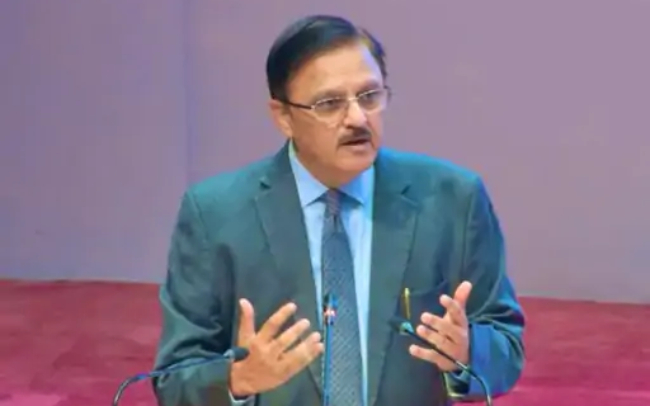
New Delhi – ‘No religion endorses environmental degradation or harm to living beings. Bursting firecrackers and using loudspeakers are not mandatory religious practices. Unfortunately, no politician has ever appealed to the public to refrain from polluting or damaging the environment during festivals. It seems the political class is unaware of this duty. The same can be said, with few exceptions, about our religious leaders’, Retired Supreme Court Justice Abhay Oka said. He was speaking during a lecture series organised by the Supreme Court Bar Association on 29th October.
🔥 Retired Justice Abhay Oka says – “No religion allows firecrackers or loudspeakers”
📍 Delhi lecture: Claimed bursting crackers & using loudspeakers not “essential religious practice”
📑 Cited Supreme Court & Bombay High Court rulings supporting bans
😷 Said pollution… pic.twitter.com/zQ7td0R249
— Sanatan Prabhat (@SanatanPrabhat) October 30, 2025
A bench comprising Justice Abhay Oka and Justice Narasimha had heard a case in 2023 related to air pollution caused by firecrackers in Delhi and the National Capital Region (NCR). They had ordered strict enforcement of the ban on firecrackers across Delhi and the entire country. This year, on 15th October, the Supreme Court permitted the sale and use of green (eco-friendly) firecrackers in Delhi and the NCR between October 18 and 21.
Justice Abhay Oka said:
1. Under Article 25 of the Constitution, which guarantees freedom of religion, bursting firecrackers, mass bathing in rivers by millions, idol immersion, and the use of loudspeakers during religious festivals are not protected activities.
2. The habit of justifying pollution under the garb of religion is growing; however, every religion teaches us to protect nature and all living beings.
3. Firecrackers cause immense suffering to the elderly, the sick, birds, and animals—so how can anyone find joy in that ? True happiness lies in celebrating festivals with family, relatives, and friends, not in loud noise or bursting firecrackers.
4. Speaking about Delhi’s pollution, he said those who can afford air purifiers can protect themselves, but not everyone has that privilege. Many people live in slums, and a large section works outdoors on the streets. For them, pollution becomes life-threatening in many ways.
5. Azaan and other religious ceremonies can be performed without loudspeakers. The Bombay High Court has ruled that such activities are not essential religious practices, and the Supreme Court has upheld that decision.
The Judiciary is the only institution capable of protecting the environment
Speaking about the role of judges and courts, he said, ‘The country’s judiciary must remember that protecting the environment is its duty, as judges are in a better position to take action than ordinary citizens. When we, as judges, deliver justice to the environment, we are not only doing justice to humans and all living beings, but also to planet Earth itself. In my personal view, given today’s circumstances, the judiciary or legal courts are the only institutions capable of protecting the environment’.
Society still lacks awareness about idol immersion
Former Justice Abhay Oka said that despite several court orders, idol immersion continues to cause pollution. Large idols made of plaster of Paris are immersed in seas, rivers, and lakes. However, the creation of artificial ponds by governments is a positive step. Still, there is a lack of public awareness. (In fact, there is also corruption in the construction of these artificial ponds—idols are later re-immersed into rivers or dumped into creeks. According to spiritual science, idols made of natural clay and immersed in flowing water do not cause pollution at all. – Editor)
He added that many religions and philosophies regard ‘nature as a divine power’, yet people conveniently ignore this principle.
Pollution must be considered a violation of fundamental rights
Justice Oka said, ‘Air and water pollution should be treated as a violation of fundamental rights under Article 21, which guarantees the right to live with human dignity. I firmly believe that without a healthy environment, it is impossible for humans to live with dignity’.
Editorial PerspectiveIf that is the case, why does Justice Oka remain silent about the five-times-daily Azaan through loudspeakers by Muslims and the firecrackers burst by Christians on New Year’s Eve ? |
 Villagers march to Kagal (Kolhapur district) Police Station in the ‘Love Jihad’ case and demand that the Hindu young woman be handed over to her parents !
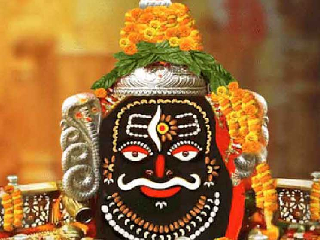 The Temple has fixed deposits worth ₹472 crore and gold and silver worth ₹300 crore !
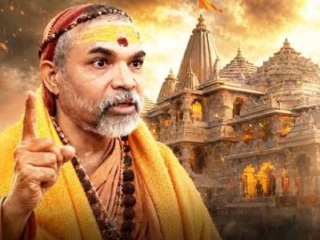 The Shri Ram Temple is an office of the BJP and the RSS; I will go for darshan when it truly becomes a Shri Ram Temple ! : Jyotish Peeth Shankaracharya Swami Avimukteshwaranand Saraswati
 Actor Aamir Khan is the ‘brand ambassador’ of ‘Love Jihad’; Boycott his films ! : Minister Nitesh Rane
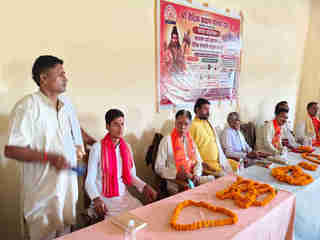 Jaunpur Hosts Seminar on Sanatan Dharma Awakening and Preservation of Vedic Culture
 Case registered against husband and wife for propagating Christianity at Sassoon General Hospital, Pune