
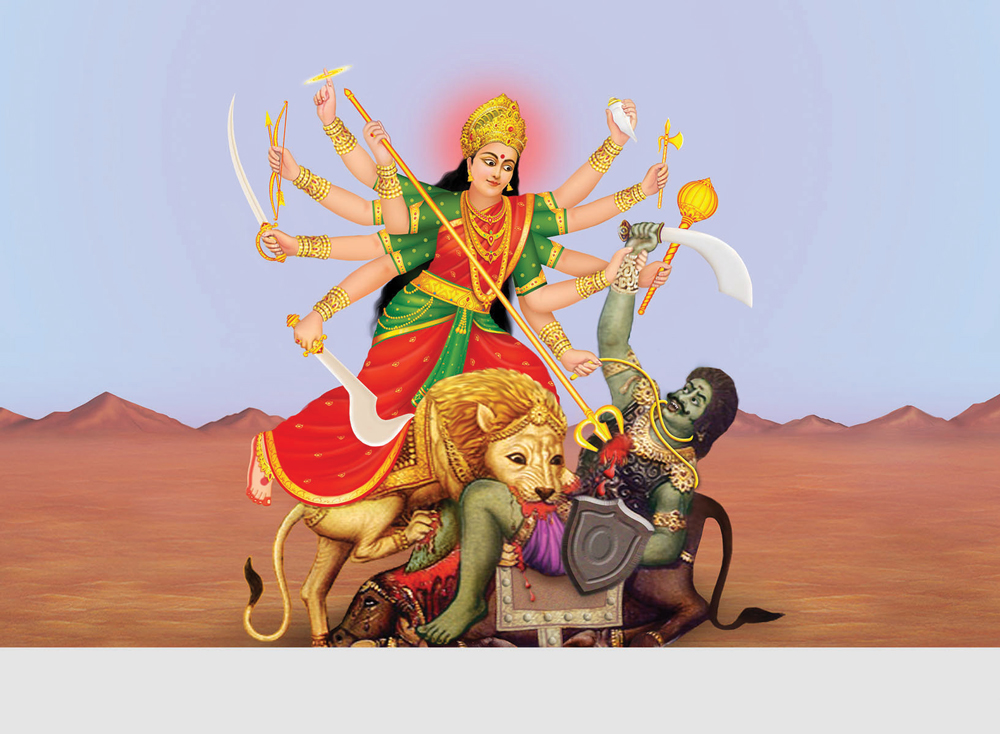
1. History of Navaratri
A. The Navaratri vrat was advocated by Sage Narad to Shriram so that He could kill Ravan. After this vrat, Shriram attacked Lanka and finally killed Ravan.
B. The Goddess fought the demon Mahishasur for nine days, from Pratipada to Navami, and finally killed him on the Navami night. Since then, She came to be known as Mahishasurmardini, the annihilator of Mahishasur.
2. Importance
A. Whenever the tamasik, demoniacal and cruel people become powerful and start troubling sattvik, righteous people, the Goddess incarnates to reinstate Dharma (Righteousness). This is the vrat of this Deity.
B. During Navaratri, the Goddess Principle is a thousand times more active than usual.
3. Method of performing the vrat
In many families, this vrat is performed as a family tradition. It begins on Ashwin Shukla Pratipada.
O’ Mother ! You are the personification of all that is auspicious, You are the benevolent form of Deity Shiva, You bestow Shakti (Divine Energy) and help people abide by Dharma, beget wealth, fulfill desires and Moksha; You are worthy of being surrendered to. Three eyes adorn You. O’ Narayani Devi, I pay obeisance to You !
A. In a sanctified place in the house, a vedi (sacrificial fireplace) is constructed and the Goddess with eight arms seated on a lion and the Navarna yantra are installed. Beside the yantra, a pot (also known as ‘ghat’) is installed and puja of both the pot and the Goddess is performed.
B. In the festival of Navaratri, as per the tradition, rituals of ghatasthapana and mala-bandhan should be done. A square base with height equal to that of two fingers should be prepared with sand brought from a farm and (five or) seven food grains should be mixed in it. These seven food grains are barley, wheat, sesame seeds, lentils, grams, rale and save (foodgrains found specially in Maharashtra).
C. In the pot of sand or copper, substances such as water, gandha, flowers, durva, akshata, betel nut, five specific leaves, five gems or coins should be placed.
D. If one does not know the Vedic mantras for installation of the seven food grains and the kalash (signifying Varun, the Deity of rain), then mantras from the Puranas should be recited. If one does not know even these, then one should say – ‘I offer’ समर्पयामि (the name of the substance offered), and chant God’s Name. A garland of flowers should be tied in such a way that it reaches inside the pot.
E. A kumarika (Virgin) is worshipped daily for nine consecutive days and is offered meals. A married woman signifies manifest energy while a kumarika represents unmanifest energy. Since some amount of manifest energy is utilised in a married woman, the total energy in a kumarika is more than that in a married woman.
F. The festival of Navaratri is celebrated according to one’s financial ability, with various programmes including continuous burning of a lamp, Chandipath (Recitation of verses of the Goddess), Lalita-pujan (Ritualistic worship of Lalita) and Saraswati-pujan (Ritualistic worship of Saraswati), fasting, keeping awake as a ritual, etc.
G. Even if a devotee is fasting, Naivedya should be offered to the Goddess as usual.
H. During this period, as part of good conduct one should not shave, should observe strict celibacy, should not sleep on a bed or mattress, should not cross the border of the village and should not wear footwear.
I. Attributing significance to the number of the day in the Navaratri, some fast even on the last day; although according to the Scriptures it should be concluded on the 9th day. On that day, after the Prasad in the form of food is served to Brahmans, if time permits all the Deities should be taken for Abhishek and Shodashopchar-puja performed. If there is no time, then the Abhishek and puja of all Deities should be done a day later.
J. During the immersion of the Idol of the Goddess, the saplings of grains sowed on first day are offered to the Deity. Women carry on their heads these saplings for immersion as the Goddess ‘Shakambhari’.
K. When installing and concluding Navaratri, it is necessary to sanctify the Deities. As usual, lemon, bhasma, etc. are used in the Abhishek. One should not use rangoli or powder used for cleaning vessels for the Abhishek.
L. Finally, the installed ghat and the Goddess should be immersed in flowing water.
M. In any religious ritual such as Navaratri, when a lamp is lit continuously as a part of puja, if it extinguishes because of wind or due to lack of oil or carbon formation, etc. these causes should be rectified and the lamp should be relit. As penance, the Name of the Deity should be chanted one hundred and eight or a thousand times.
N. Pray to the Goddess – O’ Goddess, we have become powerless, attached to Maya by pleasure and sensual enjoyments. O’ Mother, be the source of our strength. With Your strength we will be able to destroy evildoers.
O. Blowing into pots : On the day of Ashtami, women worship Goddess Mahalakshmi and blow into the pots.
P. Regional variations : In Gujarat, to symbolise the Matrushakti during Navaratri, a deep-garbha (Lit lamp placed in an earthen pot that has many openings) is worshipped. The word garbha-garbho-garbo or garba deleting the word deep became prevalent because of the ‘deep-garbha’ worshipped during the nine days, to represent female reproductivity.
4. What is the significance of worshipping Shakti (Divine Energy) during the nine days of Navaratri ?
The word asur is derived from असुषुरमन्तेइतिअसुर:, meaning the one who remains engrossed only in enjoying life and in the indulgence of pleasure of the objects is an asur (Demon). Such a Mahishasur is present in each human heart. And he has taken control over internal Divine qualities of the human being. It is necessary to worship Shakti to become free from the trap of Mahishasur, by realising his illusory form. Therefore, Shakti should be worshipped in the nine days of Navaratri. This victory is celebrated on the day of Dashami and is called Dussehra.
5. What Name should we chant during Navaratri ?
In Navaratri, according to one school of thought, Tama predominant Shri Mahakali is worshipped on the first 3 days to reduce Tama component in ourselves. The next 3 days, Raja predominant Shri Mahalakshmidevi is worshipped to enhance Sattva component in ourselves. On the last 3 days of Navaratri, worship Sattva predominant Mahasaraswati to intensify spiritual practice. Chant the Names of these respective Deities during these days.
Spiritual Science underlying the act of offering a specific flower to a specific Deity
| Deity | Flower to be offered |
| Shri Durga | Jasmine |
| Shri Lakshmi | Rose |
| Shri Saptashrungi | Magnolia |
| Shri Sharada | Nightqueen |
| Shri Yogeshwari | Michelia |
| Shri Renuka | Bakuli |
| Shri Vaishnodevi | Tuberose |
| Shri Vindhyavasini | Lotus |
| Shri Bhavani | Ground lotus |
| Shri Amba | Coral |
One prominent objective of worshipping a Deity is that the devotee should get optimum benefit for spiritual progress from the Chaitanya in the Idol of the Deity. Specific flowers have better ability to attract the subtlest particles of a specific Deity’s Principle. Naturally, when these flowers are offered to the Deity during worship, they help awaken the Idol and the devotee benefits from the Chaitanya in the Idol.
Hence, the importance of offering specific flowers to specific Deities. Accordingly, which flowers should be offered to which Deity is given in the table here.
In reality it is the specific fragrance from the flower that attracts the Deity’s Principle. The same benefit can be obtained by using incense-sticks of the same fragrance.
– Shrichitshakti (Mrs) Anjali Gadgil
Significance of bhav
1. When a devotee fully understands the science underlying various actions which are a part of ritualistic worship, he is able to perform them with required concentration. Such an effort awakens bhav (Spiritual emotion).
2. A mother-child relationship begins to evolve with the Goddess. Such bhav, helps attain oneness with the ‘Shakti’ Principle. The Bliss obtained at this point is unparalled; it makes him forget his own identity, one that is beyond description. While worshipping the Goddess with such intense bhav, the worshipper does not even realise when he crosses the barrier of duality to enter the state of non-duality. He then becomes recipient of Divine grace. Blessings showered upon him as a result of this grace, fulfill the objective of his human birth.
(Reference : Sanatan’s Text – ‘Shakti’)
| Whenever tamasik people become powerful and start troubling sattvik people, the Goddess incarnates to reinstate Dharma ! |
 Criminal case against 11 members of a Christian organisation who claimed that “Hindu is an abusive term, meaning thief, bandit and slave” will not be quashed !
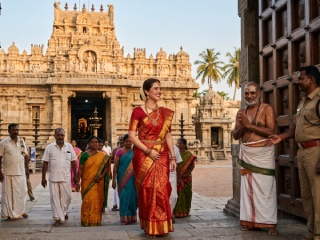 A person’s nationality or foreign name cannot determine their faith in Hindu Dharma !
 Radiant Thoughts of Sachchidananda Parabrahman (Dr) Jayant Athavale
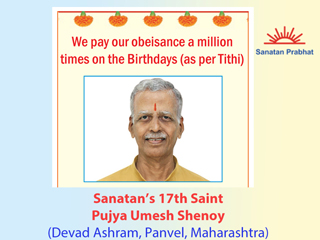 We pay our obeisance a million times on the Birthday (as per Tithi) of
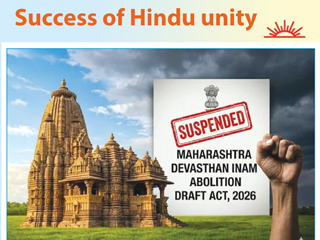 Major win for Hindu unity : Maharashtra Government suspends the controversial ‘Devasthan Inam Abolition Draft Act’
 Mumbai-based advocate Siddhavidya, who is trying to stop trafficking through surrogacy (artificial pregnancy) and animals, and animal killing