
Scientific research conducted by Maharshi Adhyatma Vishwavidyalay using the Universal Aura Scanner (UAS)

As per the guidance given by the Saptarshis through H.H.(Dr.) Om Ulaganathan, Shri Siddhivinayak, along with Riddhi-Siddhi, was brought auspiciously to Sanatan’s Ashram in Ramnathi (Goa) on Mahashivratri, that is February 21, 2020. To remove spiritual obstacles in the establishment of the Divine Kingdom, for the success of the mission of Dharma, to avert the Mahamrutyuyog (untimely death) of Sachchidananda Parabrahman Dr. Athavale and grant Him a long life, and to protect all seekers, the idol of Shri Siddhivinayak with Riddhi-Siddhi was consecrated in the temple within the Sanatan Ashram on May 12, 2020. Spiritual research was conducted by Maharshi Adhyatma Vishwavidyalay on the ‘Shri Siddhivinayak Installation Ceremony’ held from May 8 to 12, 2020. The Universal Aura Scanner (UAS) was used for this study. This device can measure negative and positive energy in objects, premises, and individuals.

The Universal Aura Scanner (UAS) was developed in 2005 by Dr. Mannem Murthy, a former nuclear scientist from Telengana. By using this instrument the energy and the aura of an object, a premises, an animal or an individual can be measured.
1. Brief information about the rituals held from May 8 to 12
1 A. Sankalp Vidhi (Ritual of resolve or intent) : On May 8, with the aim of averting the Mahamrutyuyog of Sachchidananda Parabrahman Dr. Athavale, removing subtle obstacles in the establishment of the Divine Kingdom, and overcoming obstacles in the spiritual practice of seekers, Shrisatshakti (Mrs.) Binda Nilesh Singbal and Shrichitshakti (Mrs.) Anjali Mukul Gadgil performed the ritual of resolve. After this, rituals such as Ganpati Pujan, Punyahavachan, Matruka Pujan, Nandishraddha, Acharyavaran (selecting a chief priest to perform a ritual and proceeding with the rituals under his guidance) were performed. The hosts for this puja were Sadguru Dr. Mukul Gadgil and Shrichitshakti (Mrs.) Anjali Gadgil. The rituals for the installation of Shri Siddhivinayak with Riddhi-Siddhi were performed by Shri Damodar Vaze of Sanatan Purohit Pathshala and other priests.
1 B. Jaladhivas Vidhi and other rituals : On May 9, the Jaladhivas Vidhi (Note) and other rituals were performed. Defects often arise when idols are made. To purify the idol and remove these defects, an Abhishek (consecration with water, milk etc) was performed by chanting Agnyuttaran Sukta. After this, Shri Siddhivinayak, along with Riddhi-Siddhi, was bathed with water from various kalashs (pots). Following this Abhishek, the Deity was worshipped, and aukshan (ritualistic worship of waving with 8 lamps) was done. After this act, honey and ghee were applied to the Deity’s eyes with gold. Then, the idol was placed on the pedestal, and Shayyadhivas (the act of putting the Deity to sleep) was performed.
Note – Jaladhivas Vidhi : Jaladhivas Vidhi is a ritual wherein the Deity is kept in contact with water, and various suktas (hymns) are chanted. This includes Vishnu Sukta, Asyavamasya Sukta, Mamagneyavarchasukta, Ashuhshishanasukta, Shanaindragni Sukta, Rakshohan Sukta, Ratri Sukta, and other suktas, while the Deity is kept in water.
1 C. Kalash (Dome) and Pindika (Pedestal) installation and Madhupark Puja of the idol, etc. rituals: On May 11, Kalash installation, Pindika installation (pedestal for placing the idols), Madhupark Puja of the idol, etc. rituals were performed. The installation ceremonies of the Kalash and Pindika were performed by Sadguru Dr. Mukul Gadgil, Shrichitshakti (Mrs.) Anjali Gadgil, and Shrisatshakti (Mrs.) Binda Singbal.
1 D. Pratishthapana Vidhi (Installation Ceremony) of the idol of Shri Siddhivinayak with Riddhi-Siddhi : On May 12, the installation of the idol of Shri Siddhivinayak with Riddhi-Siddhi, infusing the tattva (Divine principle) into the idol, Prana Pratishtha (consecration of life into the idol), Shodashopachar Puja (sixteen-step ritual worship) of Shri Siddhivinayak, and Arati of Shri Ganesh were performed. After this, Purnahuti (final offering to the sacrificial fire) was performed.
Reference: Daily ‘Sanatan Prabhat’
Research was conducted using the ‘UAS’ device on various components of the ‘Shri Siddhivinayak Pratishthapana Vidhi’ held from May 8 to 12, 2020. No negative energy was found in any of these components. The analysis of the readings from this study is given below.
2. Analysis of the readings from the study
2 A. Readings of Shri Siddhivinayak’s idol and related components, and the temple’s dome : All these components have a large amount of positive energy.
| Components | Positive Energy Aura (Metre) |
| 1. Idol of Shri Siddhivinayak | 358.7 |
| 2. Platform No. 1 for Idol | 32 |
| 3. Platform No. 2 for Idol | 48.2 |
| 4. Mouse made of stone next to the Idol | 28.9 |
| 5. Pedestal (Note 1) | 60.2 |
| 6. Somasutra (Note 2) | 28.4 |
| 7. Temple dome | 81.2 |
Note 1 – Pindika : When installing the Deity’s idol in a temple, it is not placed directly on the temple floor. A platform is built for it. This platform is called ‘Pindika’.
Note 2 – Somasutra : A specific vessel made for the discharge of water during Abhishek.
2 B. Significant increase in positive energy in components related to the rituals after the Jaladhivas Vidhi and other rituals : After the rituals, there was an increase in the positive energy of the following kalash (pots) – Saptamruttika (seven types of earth), Panchapallav (five types of leaves), Saptadhanya (seven types of grains), Pancharatna (five types of gems), Phalapushpa (fruits and flowers), Kusha-Durva-Gorochan, Varshajal (rainwater), and Sarvaushadhi (all herbs), and in the pot with water in which soil was mixed. This is evident from the readings given below.
| Components | Positive Energy Aura (Metre) |
| Before ritual | After ritual | |
| 1. Saptamruttika Kalash | 6.1 | 19.1 |
| 2. Panchapallav Kalash | 10.1 | 16.1 |
| 3. Saptadhanya Kalash | 7.5 | 20.4 |
| 4. Pancharatna Kalash | 15.1 | 21.6 |
| 5. Phalapushpa Kalash | 9.6 | 20.1 |
| 6. Kusha-Durva-Gorochan Kalash | 10.7 | 25.7 |
| 7. Varshajal Kalash | 7.2 | 12.9 |
| 8. Sarvaushadhi Kalash | 9.2 | 19.1 |
| 9. Soil-mixed water Kalash | 10.4 | 20.7 |
2 C. Significant increase in positive energy in Deity-related components after Madhupark Puja ritual
| Components | Positive Energy Aura (Metre) |
| Before ritual | After ritual | |
| 1. Small idol of Deity Ganesh | 24.1 | 34.1 |
| 2. Deity’s Mirror | 10.9 | 13.9 |
| 3. Utane (fragrant herbal powder) applied to Deity | 6.1 | 16.2 |
| 4. Oil-turmeric mixture applied to Deity | 5.8 | 14.3 |
| 5. Ghee-honey mixture applied to Deity’s eyes | 5.1 | 12.1 |
| 6. Gold wire for applying Ghee-honey mixture | 8.5 | 10.6 |
| 7. Deity’s Bed | 10.1 | 25.6 |
| 8. Deity’s Blanket | 7.7 | 18.4 |
| 9. Nidrakalash (Note 3) | 10.1 | 18.4 |
Note 3 – Nidrakalash : A kalash to be placed near the Deity’s head by invoking Nidradevi (Deity related to sleep).
2 D. Increase in positive energy in components related to the Homa (fire sacrifice) after the ritual, and significant positive energy in the smoke from the Homa
| Components | Positive Energy Aura (Metre) |
| Before ritual | After ritual | |
| A. Homa samidhas (offering of sticks in sacrificial fire) | ||
| 1. Rui | 5.9 | 14.2 |
| 2. Palash | 4.9 | 13.2 |
| 3. Khair | 7.1 | 12.7 |
| 4. Audumbar | 5.9 | 16.7 |
| 5. Peepal | 9.1 | 14.8 |
| 6. Aghada (Apamarga) | 5.7 | 13.8 |
| 7. Shami | 6.1 | 14.7 |
| 8.Durva | 10.3 | 18.2 |
| 9. Darbha | 8.1 | 16.3 |
B. Homa Kalash
| Components | Positive Energy Aura (Metre) |
| Before ritual | After ritual | |
| 1. Sampat Kalash | 9.3 | 20.1 |
| 2. Lokpal Kalash | 6.9 | 18.4 |
| 3.Vastu Kalash | 8.3 | 17.7 |
| 4. Navagraha Kalash | 9.1 | 17.2 |
C. Smoke from Homa
| Components | Positive Energy Aura (Metre) |
| Before ritual | |
| 1. . Smoke from Pradhanadevata Homa | More than 36 (Note 4) |
| 2. Smoke from Tattva Homa | More than 36 |
Note 4 – The maximum available space for measurement at the site was 36 metres. The aura of these components was more than 36 metres.
2 E. Significant increase in positive energy in ritual-related components after the Pratishthapana Vidhi of Shri Siddhivinayak with Riddhi-Siddhi
| Components | Positive Energy Aura (Metre) |
| Before ritual | After ritual | |
| 1. Gold wire to be placed under the idol | 7.1 | 23.1 |
| 2. Kurch for prokshana (sprinkling) (Note 5) | 18.3 (Note 6) | 20.2 |
| 3. Abhishek water | 13.8 | More than 36 |
| 4. Purnahuti coconut | 8.4 | 19.2 (Note 7) |
| 5. Arati tray | 10.8 | More than 36 |
| 6. Shri Ganesh’s Red Cloth | 8.1 | 14.8 |
| 7. Akshata (unbroken rice grains) | 16.2 (Note 8) | 26.4 |
| 8. Mogra garland | 7.3 | 17.1 |
| 9. Durva garland | 6.1 | 17.2 |
| 10. Mahanaivedya (Modak) | 7.1 | 13.5 |
Note 5 – Kurch : Darbha grass is tied in a specific knot to prepare it. This is called ‘Kurch’.
Note 6 – Before the ritual, the positive energy in the Kurch was 4.1 metres. After Sachchidananda Parabrahman Dr. Athavale touched the Kurch before the ritual, its positive energy became18.3 metres.
Note 7 – After Sachchidananda Parabrahman Dr. Athavale touched the Purnahuti coconut, its positive energy became 19.2 metres
Note 8 – Before the ritual, the positive energy in the Akshata was 5.9 metres. After Sachchidananda Parabrahman Dr. Athavale touched the Akshata before the ritual, its positive energy became 16.2 metres.
3. Spiritual analysis of the readings
3 A. Characteristics of Shri Siddhivinayak’s idol with Riddhi-Siddhi: This idol is carved from a single ‘Krishnashila’ (black marble stone) and weighs 500 kg. This idol was made similar to the famous Shri Siddhivinayak idol in Prabhadevi (Mumbai). The Shri Siddhivinayak idol is seated on a lotus and is 3 feet 1 inch tall. This idol was created as per the guidance of the Saptarshis (Sages).
3 B. The sculptor of the idol of Shri Siddhivinayak, Late Pujya Vivekanand Achari, having Guru’s blessings and creating the idol with great devotion and selfless service, thereby generating immense Chaitanya (Divine Consciousness) in it : This idol was created by sculptor Late Pujya Vivekanand (Nanda) Achari alias Guruji from Shirwad (District. Uttar Kannada), near Karwar, Karnataka. Pujya Guruji was a devotee of Shri Ganesh and had immense devotion. His Guru had blessed him, saying, ‘Any stone you touch will turn into the idol you wish to carve.’ He had carved more than 1,000 idols of Deities. Pujya Guruji was extremely detached and lost all body awareness while performing the service of carving idols. He had immense devotion towards Sacchidanand Parabrahman Dr. Athavale.
While carving the idol, Shri Ganapati gave him Divine visions in his dreams many times, indicating changes in the idol, and on the very next day, Sachchidananda Parabrahman Dr. Athavale would instruct similar changes to be made : While carving the idol, Shri Ganapati gave him Divine visions in his dreams many times, indicating changes in the idol. On the very next day of such a vision, he would receive a message that Sachchidananda Parabrahman Dr. Athavale had instructed similar changes to be made. It usually takes a sculptor about 1 year to create such a large idol. Pujya Guruji worked tirelessly and with great devotion and selfless service, created this idol in just 15 days and offered it to Sanatan. Due to his supreme devotion towards the Deity, faith, his spiritual practice, and the Divine guidance he received while carving the idol, immense Chaitanya was generated in the Shri Siddhivinayak idol. When Shri Siddhivinayak along with Riddhi-Siddhi arrived auspiciously at Sanatan’s Ashram on Mahashivratri, that is, February 21, 2020, a great deal of positive energy was found in the idol, and its aura was 142 metres. After the Pratishthapana Vidhi of Shri Siddhivinayak with Riddhi-Siddhi, the Chaitanya in the idol increased significantly, and the aura of its positive energy became 358.7 metres. Looking at the idol of Shri Siddhivinayak, one feels it is alive. One experiences spiritual emotion (bhav) upon seeing the idol. (When UAS readings of the idol were taken in January 2024, the positive energy aura was found to be 18 kilometres. This indicates a progressive and significant increase in the Chaitanya of the idol over the last 4-5 years.)
3 C. Significant increase in positive energy in ritual components after the Pratishthapana Vidhi of Shri Siddhivinayak with Riddhi-Siddhi : In the current era of Kaliyug-within-Kaliyug, Sacchidanand Parabrahman Dr. Athavale, who is an embodiment of Shri Vishnu, has commenced His mission of establishing the Divine Kingdom. His mission is receiving blessings from the Saptarshis, various Rishis-Munis, Shriram, Deity Shiva, Deity Hanuman, Durgadevi, Bhavani Devi, Vidyachaudeshwari Devi, and various other superior Deities. These Deities are helping in the Divine mission and are removing the obstacles in the establishment of the Divine Kingdom. Similarly, for the blessings of Shri Siddhivinayak (Shri Ganesh) along with Riddhi-Siddhi, known to endow success, and remove the subtle obstacles in the establishment of the Divine Kingdom, the installation rituals of His idol were performed from May 8 to 12. Through the guidance of the Maharshis (Sages), the idol of Shri Siddhivinayak with Riddhi-Siddhi was installed in the temple built within the ashram premises on May 12, 2020. All rituals under the Shri Siddhivinayak Pratishthapana Vidhi were performed with immense devotion. As a result, a great deal of Chaitanya was emitted from the rituals, making the atmosphere charged with Divine Consciousness. All components of the rituals also became charged with Chaitanya. Therefore, a significant increase in positive energy was observed in all components after the rituals.
– Mrs. Madhura Dhananjay Karve, Maharshi Adhyatma Vishwavidyalay, Goa. (8.1.2025)
E-mail : [email protected]
 Only Dharma can unite Hindus !
 We pay our obeisance a million times on the Birthdays (as per Tithi) of …
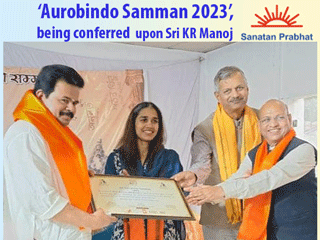 Acharya Sri KR Manoj : A distinguished personality who brought back over 8,000 Youths from the clutches of religious fanaticism into Sanatan Dharma
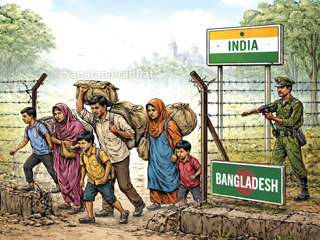 Bangladeshi infiltrators begin fleeing to their country out of fear of the Bengal Government
 Somanath Temple Restoration : How Nehruvian Secularism Failed to Stop Sardar Patel’s Sacred Vow
 If 250 million Muslims in India unite, they can break India into pieces ! : Bangladesh BNP Leader