
Key Players
| Name | Role |
| Sanjay Agarwal | Former Security Advisor |
| Marco Rubio | US Secretary of State |
| Micah Mark | Alleged TTI operative |
| Sergio Gor | US Ambassador |
| USCIRF | US Commission on International Religious Freedom |
| ED | Enforcement Directorate |
Two months ago, I wrote an article, Regulating Foreign Funds: A Necessary Tightrope Walk, about the proposed Foreign Contribution (Regulation) Amendment Bill, 2026. I argued that the debate was fundamentally about balancing transparency, sovereignty and civil society freedoms. Available on LinkedIn here, AND in the newspapers here.
Subsequent developments make the issue worth revisiting.
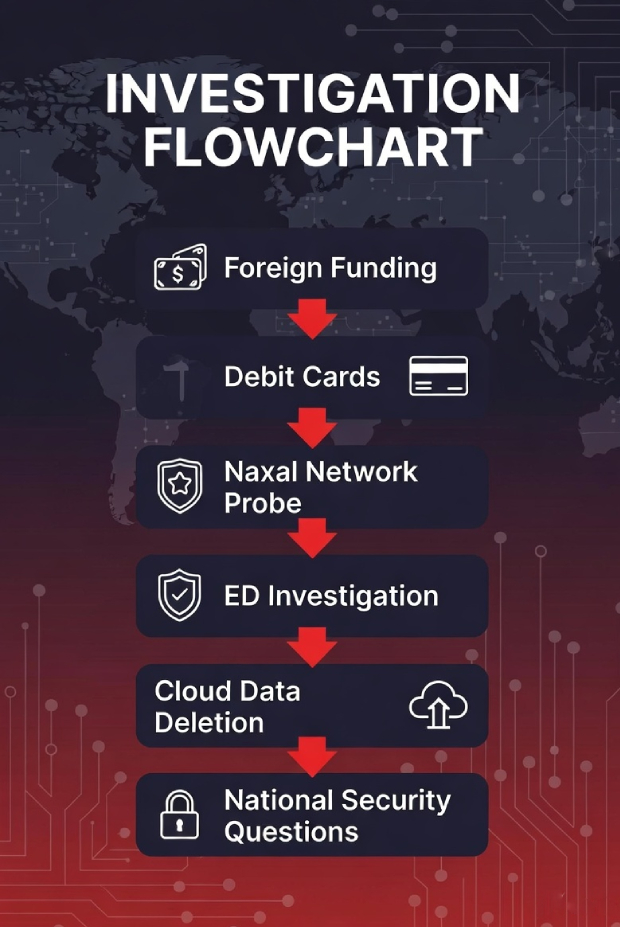
Since then, Indian investigations and revelations of a foreign-funding network operating in sensitive regions, the use of overseas-issued debit cards and cross-border financial transactions for opaque purposes, are disconcerting to say the least. Worse, the alleged deletion of backend electronic records hosted abroad highlights the growing challenge of investigating transnational funding ecosystems in a digital age.
Around the same period, in the United States, criticism of the proposed Indian FCRA amendments surfaced in US policy circles. At the same time, India continued to push back against the persistent and unfair USCIRF targeting of India.
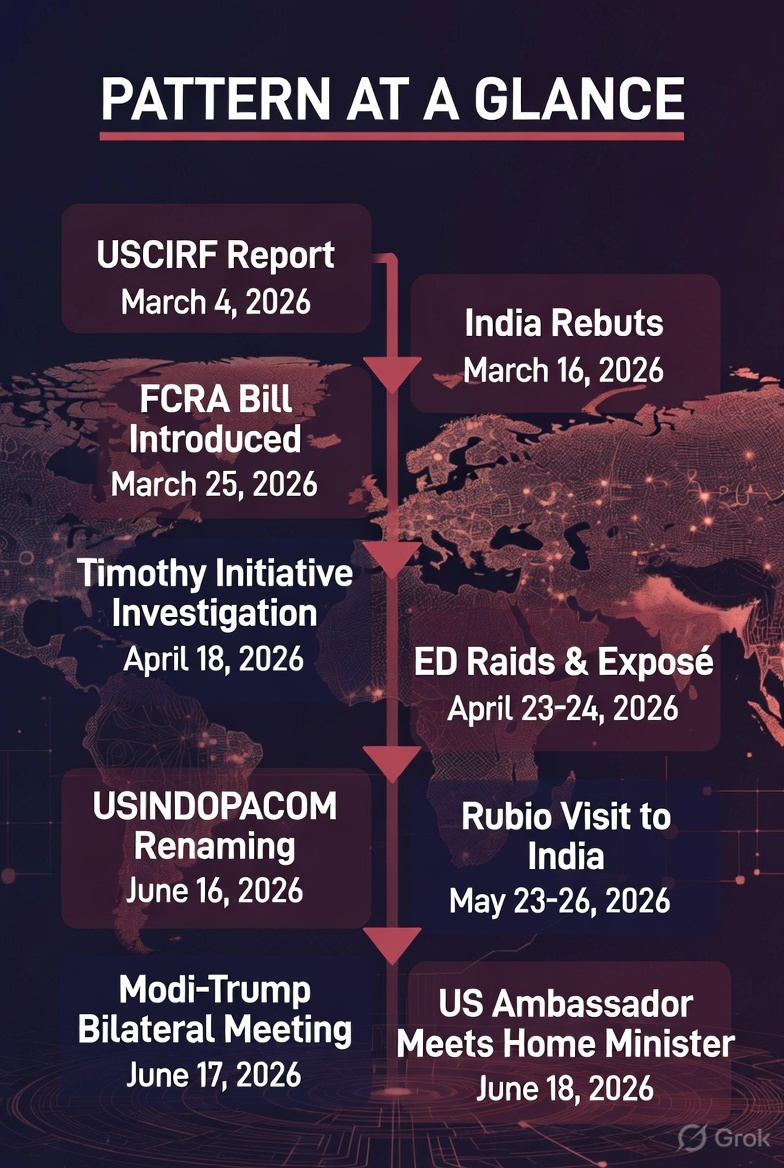
I am not rushing to conclusions nor inferring causation. But undoubtedly, strategic analysis requires more than examining events in isolation. It requires examining timing, sequence and strategic context. Presently, this examination provides no cause for cheer. I give the timeline below, merely as an intriguing pattern-recognition hypothesis, …leaving you, the reader, to draw your own conclusions.
THE CENTRAL QUESTION
Are these developments isolated events, or do they form part of a larger strategic pattern? The article does not claim causation. Instead, it invites readers to examine the chronology and draw their own conclusions.
The Timeline of Events
- 4 Mar 26. USCIRF releases its annual report, again targeting India. Read more here and here.
- 16 Mar 26. India rebuts it strongly.
- 25 March 2026. India introduced the proposed modifications to the FCRA Bill in the Lok Sabha (Lower House of the Parliament).
- 18 Apr 26. India exposes a funding network using US debit cards for Naxals. Intercepts Micah Mark, an operative tied to US-based missionary group “The Timothy Initiative” (TTI), at Bengaluru. He had 24 foreign debit cards issued by US-based Truist Bank. Multi-state raids will be initiated over the next two days.
- 23-24 Apr 26. The specific operation exposing the TTI and its foreign debit card funding network in Naxal-affected regions began unfolding.
- 24 Apr 26. Coordinated Enforcement Directorate (ED) raids across multiple states, unearthed Rs 95 crore in foreign funds and 25 debit cards issued by US banks.
- 23 May 26. US Secretary of State Marco Rubio started his India visit (23-26 May 26) by visiting Missionaries of Charity (Mother Teresa’s NGO) in Kolkata. Then went to Agra & Jaipur. Finally, to New Delhi for the QUAD summit. Some commentators said that his reception in India lacked warmth and that the media response was lacklustre.
- 11 Jun 26. An official, criminal FIR naming six individuals was registered under the Unlawful Activities (Prevention) Act (UAPA). India is investigating the systemic data trails, ledger accounts, and funding routes before executing formal arrest warrants for the remaining accused.
- Naxal funding by foreign debit cards. The remote deletion of server data by overseas handlers is established.
“Strategic analysis requires more than examining events in isolation. It requires examining timing, sequence and strategic context.”
Chronology of Data Deletion
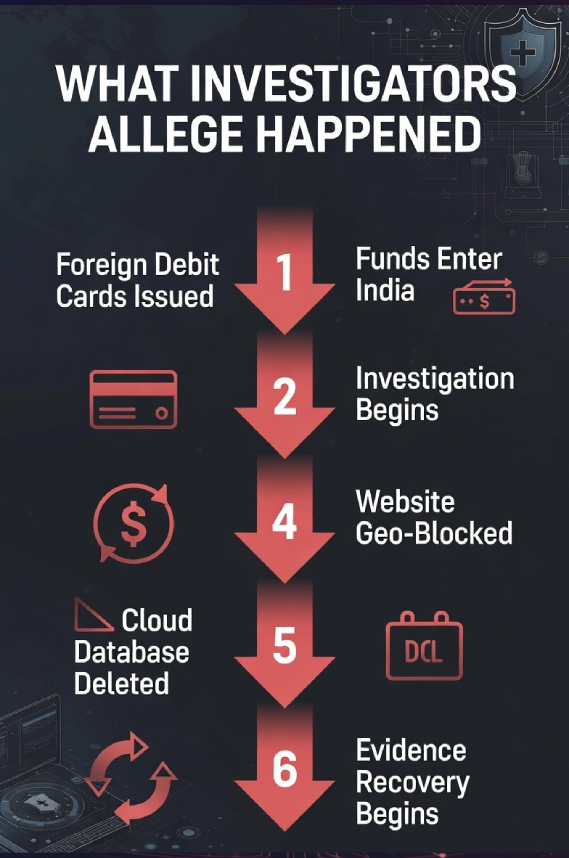
9.1 Immediate System Blackout: As soon as the ED launched its multi-state searches following Micah Mark’s airport interception on 18 Apr 26, the global portal of The Timothy Initiative (TTI) was deliberately geo-blocked and made entirely unavailable to users inside India. Here and here.
9.2 Remote Cloud Purge: Handlers operating servers controlled within the United States utilized remote access to execute a complete “blanket deletion” of cloud-based backend databases. This erased the direct digital records mapping the specific transaction histories of the 1,000+ foreign debit cards. Here.
9.3 Micah Mark’s Admission: During interrogation, intercepted operative Micah Mark reportedly admitted that a vital backend database account tracking the domestic financial ledger was completely wiped to hide the names of local field workers.
9.4 Legal and Investigative Fallout
- Destruction of Evidence Charges: Because these actions intentionally hampered the ongoing probe, the Bengaluru Kothanur Police officially added charges for the destruction of electronic evidence into the primary UAPA and BNS FIR registered on 11 June 2026.
- Forensic Retrieval: Cyber specialists from Indian central intelligence agencies are currently working with digital forensics teams to recover mirror data, cached logs, and localised transaction footprints from seized local devices to reconstruct the wiped US server pathways.
10. 13 Jun 26. In the USA, a bipartisan expression of concern and opposition emerges against India’s proposed FCRA modifications just before the G7 summit (15-17 Jun 26, in France). Here and here.
11. 16 Jun 26. US drops “Indo” from Indo-Pacific, and reverts the name of the US Indo-Pacific Command (USINDOPACOM) to USPACOM.
12. 17 Jun 26. Modi-Trump bilateral meeting, just hours after the renaming of USINDOPACOM. on the sidelines of the G7 Summit.
13. 18 Jun 26. US Ambassador to India Sergio Gor pays a visit to the Indian Home Minister. Publicly disseminated agenda: To discuss counter-terrorism, border security, and regional narcotics.
Questions Raised
|
The Bottom Line
Every democracy permits foreign funding under regulated conditions. The question is whether democratic states possess adequate mechanisms to ensure transparency, accountability and protection against external influence operations, which could be against core national interests.
As India debates the future of the FCRA framework, the issue is increasingly becoming one of sovereignty and governance, not merely compliance.
Sometimes, timing itself becomes part of the story.
#FCRA #Governance #NationalSecurity #ForeignFunding #StrategicAffairs #Geopolitics
Article by Mr Sanjay Agarwal
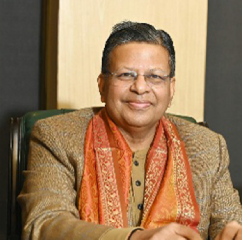
Former Security Advisor to the Ministry of Home Affairs, Government of India, Sanjay Agarwal, analyses important incidents and their wider strategic significance.
 “Statues of Chhatrapati Shivaji Maharaj are being installed to target Muslims !” : France 24
 USA to seek extradition of gangster Lawrence Bishnoi imprisoned in India
 US attacks 140 Iranian military sites
 Racial discrimination against Indian truck drivers working in Australia
 Our DNA and India’s DNA are the same !
 Every graveyard in Kashmir contains the graves of Pakistani terrorists !