
Landmark judgement by the Madras High Court
Court rules that Official documents must be submitted to prove ownership of a property!
Court says the Waqf Board cannot claim ownership over properties merely because they are associated with Islamic religious activities!
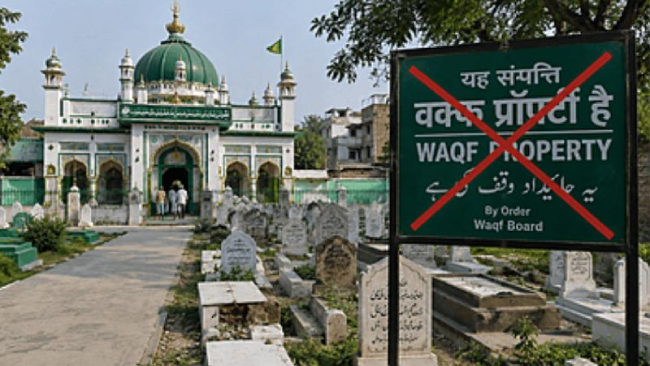
Chennai – “Every grave or dargah does not automatically become Waqf property,” ruled Madras High Court Justice K. Govindrajan Thilakavadi while rejecting the Waqf Board’s claim over a 240-year-old dargah in Chennai’s Triplicane area. With this the Court also set aside the Tamil Nadu Waqf Board’s order registering this dargah as Waqf property.
The Court said that the Waqf Board cannot automatically take over a property, merely because it is being used for Islamic religious activity. The Waqf Board must submit official documents to establish its claim over a property. According to Muslim law, a property becomes Waqf property only when a Muslim permanently donates it for religious purposes.
The Court also set aside the Tamil Nadu Waqf Board’s proposal to appoint a ‘Mutawalli’ (manager) for the Sayyad Habibullah Shah Qadri Arif Rabbani Hazrat Dargah in Triplicane. The Board had directed the registration of the property under the Waqf Act without completing the mandatory survey.
 Villagers march to Kagal (Kolhapur district) Police Station in the ‘Love Jihad’ case and demand that the Hindu young woman be handed over to her parents !
 “Statues of Chhatrapati Shivaji Maharaj are being installed to target Muslims !” : France 24
 The Temple has fixed deposits worth ₹472 crore and gold and silver worth ₹300 crore !
 The Shri Ram Temple is an office of the BJP and the RSS; I will go for darshan when it truly becomes a Shri Ram Temple ! : Jyotish Peeth Shankaracharya Swami Avimukteshwaranand Saraswati
 Actor Aamir Khan is the ‘brand ambassador’ of ‘Love Jihad’; Boycott his films ! : Minister Nitesh Rane
 Jaunpur Hosts Seminar on Sanatan Dharma Awakening and Preservation of Vedic Culture