
The Prototype Fast Breeder Reactor at Kalpakkam in Tamil Nadu has achieved criticality. This is a matter of immense pride for India. Scientific terminology related to nuclear projects and their functioning is often somewhat difficult for the common man to understand. Moreover, a valid question may arise – What impact will the achievement of criticality by a project have on our lives ?

To explain in simple terms, when a nuclear reactor becomes critical, it means that the chain reaction within it has become self-sustaining and stable. Simply put, this is a state in which a balance is achieved between the energy generated from the fuel and the energy being used. As a result, the reactor can generate electricity steadily.
At present, the fuel shortage created due to the war between Iran and the USA is well-known. Therefore, India is widening the scope of its electricity generation. Against this background, what has been achieved through the nuclear project at Kalpakkam is historic.
India has very limited reserves of Uranium. Its use is essential for electricity generation and pharmaceutical manufacturing. Since Uranium is scarce, we have to import it from other countries. However, out of the world’s total Thorium reserves, 25% is in India alone.
Thorium cannot be used directly in ordinary nuclear reactors. Achieving the process of criticality is the biggest step towards using Thorium in a new nuclear project. Once we begin using Thorium, India will not have to depend on any other country for electricity generation.
Through this process, the project will generate more fuel than the amount consumed in the reactors. Until now, only Russia had implemented a nuclear programme and achieved criticality. From this, one can understand the giant leap taken by our scientists and technologists in this field.
India’s founder of the nuclear programme, Dr Homi Jehangir Bhabha, ought to have been present to witness this strong step taken in the energy sector. Dr Bhabha had solved the puzzle of scarcity of Uranium and abundant reserves of Thorium as early as 1954, and with foresight, had implemented a three-stage nuclear energy programme to achieve self-sufficiency in energy generation. What has now been achieved at the Kalpakkam project is the second stage of that nuclear programme.
Exploitation in the name of sanctions
Today, the world is looking at India’s success with astonishment, because India has accomplished what even advanced countries could not. The path to reaching this stage was filled with many challenges. The USA, along with several Western countries, attempted to obstruct this programme by spreading false propaganda that India’s nuclear programme is meant for the production of nuclear weapons.
India conducted its first nuclear test in 1974. Thereafter, many sanctions were imposed on the country. After the second nuclear test in 1998, these sanctions became even stricter. Seeing India’s rapid progress in this field, the Western Nations were deeply disturbed.
Through the Nuclear Suppliers Group, pressure was exerted on India to sign the Nuclear Non-Proliferation Treaty. When it became clear that India would not yield, a rule was framed that no country should sell Uranium or any nuclear-related machinery to India. Why only that ? The supply of special steel required for nuclear reactors, highly advanced computers, and complex parts required for the fast breeder reactor was also stopped. These things could perhaps be manufactured somehow; but what about the technology ?
Indian scientists were prohibited from going abroad to study this technology or use foreign laboratories. These sanctions certainly caused delay in India developing its own technology; however, because of this, today India is not dependent on anyone. All paths were blocked for India; yet through immense organised effort, patience, perseverance and self-confidence, the Nation achieved success right under the nose of all these countries !
Indomitable willpower
The greatest challenge in this nuclear programme was the creation of the reactor’s design. The design was so complex that eight different buildings had to be erected on one massive foundation. Then our engineers and technologists got to work. Scientists at the Indira Gandhi Centre for Atomic Research in Kalpakkam stayed awake through thousands of nights to prepare the blueprint of this reactor, after which the reactor finally came into existence. The massive pumps required for transporting Sodium were not available in India, and other countries had refused to supply them. Indian scientists themselves developed all these pumps and machinery.
If there had been even a slight mistake in this, the entire project would have been endangered. Because of the proper coordination among India’s scientists, technologists and engineers, along with the support extended by many private establishments, the Kalpakkam reactor was built. This journey was truly thrilling and extraordinary.
Larsen & Toubro manufactured the main vessel of the reactor. This vessel was so enormous that transporting it by road was impossible; therefore, it was taken to Kalpakkam by sea route. While manufacturing it, even an error of 1 millimetre would not have been acceptable. The contribution of Walchandnagar Industries and Godrej & Boyce also cannot be forgotten.
Many obstacles and failures came while pursuing the goal; however, after absorbing them, our scientists and all those supporting them were not disheartened. Instead, they resumed work with renewed vigour. Many times, they learnt from mistakes, restarted the work afresh and eventually achieved success. Inspired by the goal that they must do something for the Nation and place India on the highest peak, they accomplished the seemingly impossible.
At present, film actors and cricketers are placed on a pedestal in our society; however, Indian scientists, technologists and engineers, who silently make unparalleled contributions for the Nation without any publicity, are not accorded due social honour. When society understands their true worth and adopts them as ideals, only then will India attain progress in the real sense !
For appropriate perspectives daily on News, visit : SanatanPrabhat.org/english/
 Radiant Thoughts of Sachchidananda Parabrahman (Dr) Jayant Athavale
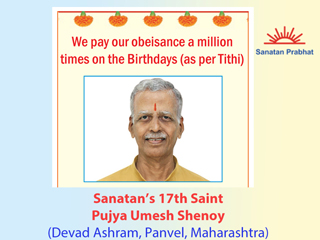 We pay our obeisance a million times on the Birthday (as per Tithi) of
 Major win for Hindu unity : Maharashtra Government suspends the controversial ‘Devasthan Inam Abolition Draft Act’
 Mumbai-based advocate Siddhavidya, who is trying to stop trafficking through surrogacy (artificial pregnancy) and animals, and animal killing
 Construction of Sanatan Dharma Complex halted due to threats in Bangladesh
 Cuba 2026 : Why Havana Suddenly Matters Again