
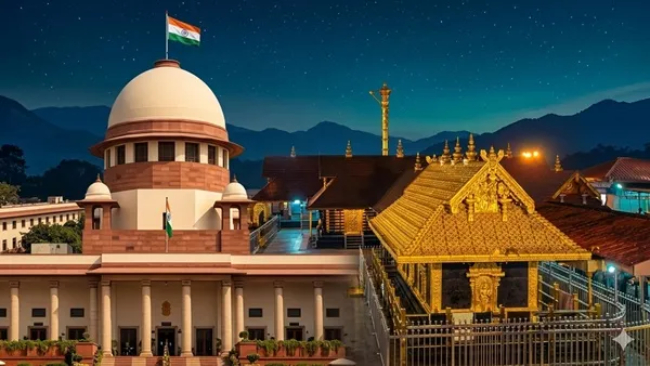
New Delhi – New Delhi – During the hearing of a case concerning discrimination against women at religious places, the Supreme Court observed, “The more people visit different temples and Muths, the stronger the religion will become !”
The Court further remarked that, excluding the Sabarimala case, if it is said that only Gaud Saraswat individuals should visit a particular temple, or that followers of Kanchi Muth should go only to Kanchi and not to other Muths (such as Sringeri), “this would not be appropriate.” On the contrary, the Court emphasised that greater participation across different temples and Muths strengthens the religion.
Centre’s submissions
Presenting its stance, the Union Government argued :
In certain South Indian temples, alcohol is offered as prasad. It was submitted that “one cannot object to such practices by insisting that alcohol should not be served.” Similarly, where vegetarian food is traditionally offered, an individual cannot claim a right to demand non-vegetarian food based on personal choice or conscience. Such a demand would amount to interference in established religious practices.
It was further submitted that if a temple seeks to remain exclusive to a particular community, then it “cannot simultaneously accept funds or donations from the Government or the general public.” Exclusion and public funding cannot coexist.
Referring to Article 26(b) of the Constitution, the Centre argued that a religious denomination has the right to decide who may enter the temple. If entry and worship are governed by religious tenets, they form an essential part of religion. Therefore, “a law mandating forced entry may infringe upon these rights.”
The Centre also cited historical examples, noting that in Kerala, the Portuguese had attempted to convert Syrian Orthodox Christians to Catholicism, and in Ireland, Catholics faced discrimination under British rule. It emphasised that “such religious matters are sensitive in nature, and courts have traditionally exercised restraint in intervening.”
Observations made by the Supreme Court
1. The Court underscored the significance of Article 17, observing that “the abolition of untouchability is a very powerful constitutional mandate.” It is not merely a statutory offence, but one that the Constitution itself treats as a grave violation.
2. On the interplay between social reform and religious rights, the Court observed that if the State enacts laws for social reform, their impact may extend to rights under Article 26. It clarified that “it cannot be said as a blanket proposition that Article 26 will remain unaffected.” The determination, the Court noted, must be made on a case-to-case basis rather than through abstract principles.
 Devotees duped online in the name of havan and puja at Maa Baglamukhi Temple in Madhya Pradesh
 Muslims will face no threat in a Hindu Rashtra if they accept the traditions of their ancestors: Yogrishi Ramdev Baba
 26/11 Mumbai attack was orchestrated jointly by the Congress and the ISI: RVS Mani
 A true Hindu treats everyone equally !
 No one has the right to pollute rivers in the name of religion !
 Case registered against Azam for stalking and molesting a Hindu woman doctor