
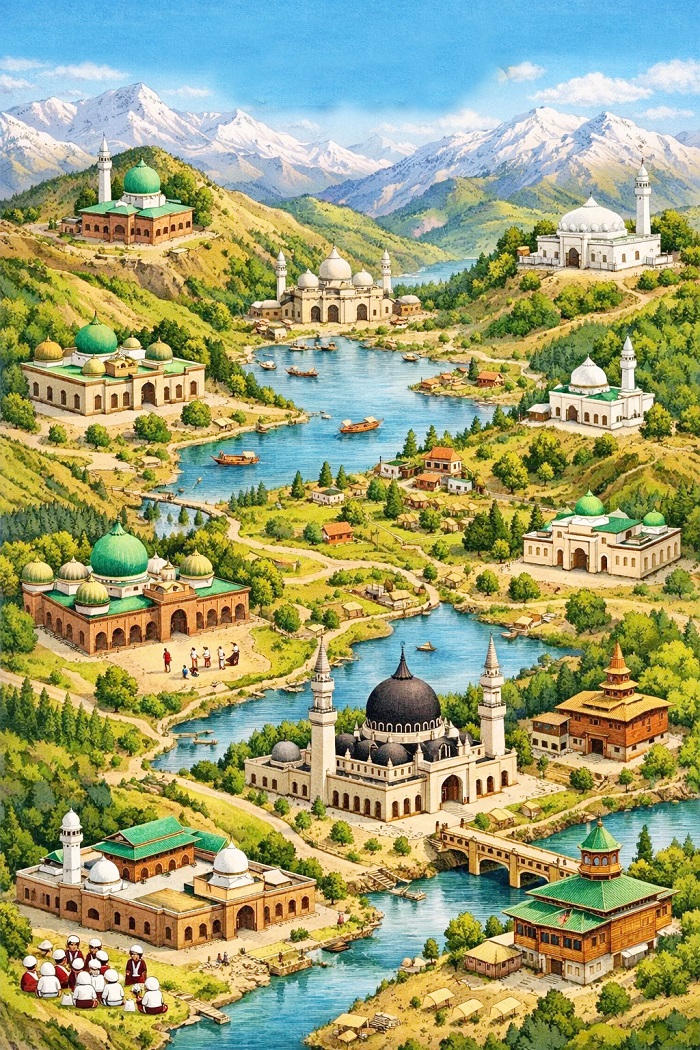
1. Information-collection drive regarding mosques and madarasas
From mid-January 2026, the Jammu & Kashmir Police issued multi-page questionnaires to mosques and madarasas across the region. Through these, information has been sought on sectarian affiliation (for example, Barelvi, Deobandi), seating capacity, land-ownership records and construction costs, details of monthly expenditure, specific sources of funding, as well as detailed information about Imams, Muezzins (those who give the azan), and members of the management committee. This includes their mobile phone details with IMEI numbers, social media accounts, bank account details, travel history, and related information.
2. Reasons given by the Police
The Police have said that this is an administrative process to ensure that religious institutions are not misused for political propaganda or pro-Pakistan rallies, to prevent the use of mosques by white-collar (educated) terrorist groups, to keep a watch on radical influences, and to fill gaps in official databases (secure data repositories) regarding changes in these institutions.
3. Objections of Muslim organisations and leaders to the information collection
Muslim leaders and organisations in the State have objected to this Government action. Noteworthy points among these objections are mentioned ahead.
A. MP Ruhullah, National Conference : A particular right-wing ideology is running the country. This is its project, and it reflects a clear desire to control other religions.
B. Muttahida Majlis Ulema (MMU), led by Mirwaiz Umar Farooq : Places of worship and internal religious matters cannot be arbitrarily monitored.
C. Mehbooba Mufti, former Chief Minister and President, People’s Democratic Party (PDP) : This is a deliberate attempt to distance Muslims from their religion.
D. Sajjad Gani Lone, President, Jammu & Kashmir People’s Conference : This is an attack on the secular structure. It is a completely condemnable and inhumane step that openly misuses authority while violating citizens’ fundamental rights.
E. Al Jazeera news channel : There is a perception among citizens that the Government is trying to control religious institutions in Kashmir.
F. Pakistan : This open interference in religious matters is a serious violation of the fundamental rights to religious freedom and faith, and another coercive attempt to intimidate and marginalise the Muslim population in an occupied territory.
It is worth noting how, whenever the Police take steps to curb terrorism, an outcry is immediately raised about violation of fundamental rights, an attack on secularism, and Government interference in religious matters. One should also observe how Government efforts are portrayed.
Mehbooba Mufti distrusts the Government even after complete Government control of temples
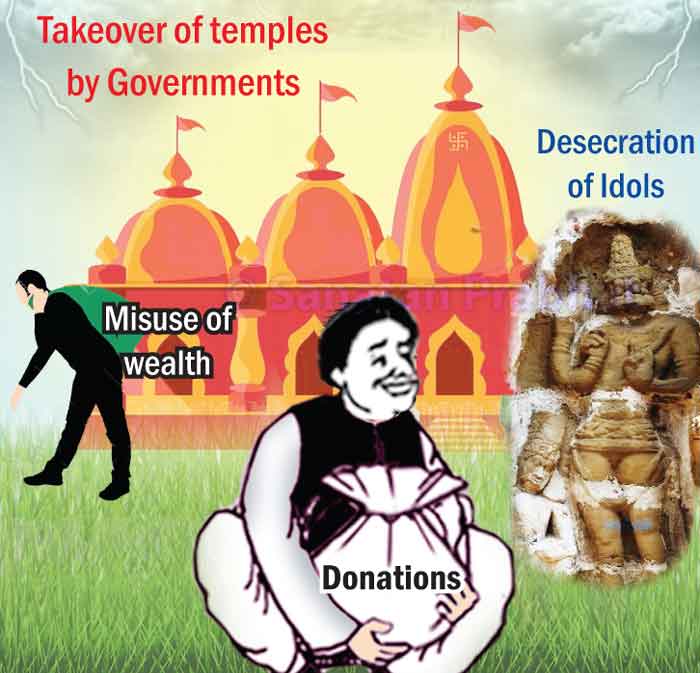
Mehbooba Mufti has attempted to draw a comparison between mosques and temples by pointing at temples. She says, ‘If the Government truly wants to monitor religious leaders, why not start with temples ? Verify which priests serve where, who has access to the sanctum sanctorum, and how much is paid for the entry. Mosques are for all Muslims. No worshipper is denied entry. Verify how much is charged for entry into temples, because nothing of that sort exists in our mosques.’
She may not be aware that in this country, almost all major temples that receive large donations have already been brought under Government control.
– Dr Durgesh Samant
4. What does control over mosques in Islamic countries indicate ?
Against this background, it is necessary to study how mosques are regulated in countries such as Egypt, Saudi Arabia, Jordan, Algeria, Kuwait, Bahrain, Türkiye, and Malaysia that are countries without terrorism like Kashmir, ruled by Islamic Governments, and where followers of other religions are an insignificant minority.
5. Government control over Friday discourse in mosques in other Islamic countries
In Egypt, Saudi Arabia, Jordan, Algeria, Kuwait, Bahrain, Türkiye, Malaysia, and Singapore, the khutbah (Discourse) delivered by preachers such as mullahs, especially on Fridays, are regulated. This control determines what should and should not be said, ensures that Government policies are conveyed, and prevents the spread of radicalism. Guidelines for this are issued by Government agencies.
In Egypt, all Imams are instructed to deliver a uniform, pre-written khutbah on a specified topic each week. In Algeria, khutbahs are directed to focus on national unity, security, and avoidance of social conflict. In Kuwait and Bahrain, khutbahs promoting national unity and discouraging sectarianism are broadcast on behalf of the Government. In Singapore, through the Majlis Ugama Islam Singapura (MUIS ), the Government uses Friday khutbahs to disseminate State policies and to shape a ‘Singaporean Muslim’ identity aligned with a secular, multicultural State vision. In Tajikistan, Turkmenistan, and Uzbekistan, khutbahs are sometimes even recorded on video. The general public should reflect on why such rules apply to mosques even in Islamic countries. There is not even as much freedom as one might assume regarding what can be said in mosque khutbahs in these countries.
6. Do Muslims abroad say that Government control over mosques is a violation of fundamental rights and an attack on religion ?
Where Governments exercise such extensive control over Friday khutbahs in mosques abroad, one should consider what other forms of control exist, how much information is collected, and how strictly the rules are enforced. This should then be compared with mosques and madarasas in India. After such a study, one should examine decades of terrorism in Kashmir and why Hindus have repeatedly been forced to flee from there over the past several centuries. Only then should sensible people consider why the Police in Kashmir are compelled to take such measures, and thereafter evaluate the objections raised by Muslim leaders in Kashmir.
Riots following court-ordered survey of a mosque
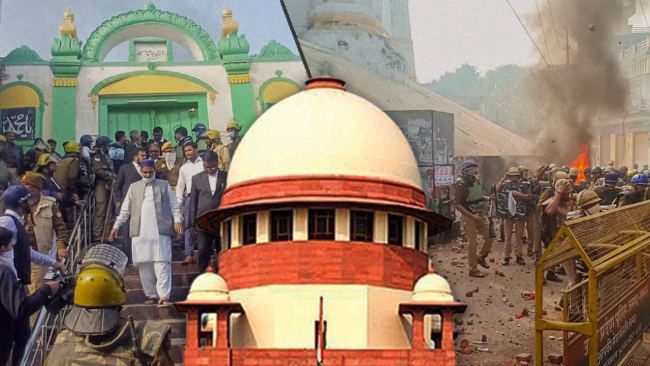
Towards the end of 2024, court-ordered surveys were conducted on certain mosques, such as the Shahi Jama Masjid in Sambhal, Uttar Pradesh, to verify historical claims. This led to local tension and unrest, resulting in a riot. The media has discussed who was responsible for this riot and related issues.
7. Muslim leaders in Kashmir who claim that collecting information on mosques, and not terrorism, creates divisions in society
Where terrorism has raged for decades, it inherently creates a Hindu-Muslim divide. Two examples will suffice.
A. In 1990, after announcements were made from mosques saying, ‘Hindus, convert your religion or leave Kashmir’, and slogans were raised by members of the Muslim community on the streets, lakhs of Hindus were displaced overnight to the rest of India.
B. Last year, when tourists were killed in Pahalgam, it was widely reported that the attackers specifically identified who was Hindu.
Despite all this, when the Police began collecting detailed information about mosques and madarasas, Muslim leaders claimed that this was creating divisions in society. PDP MLA Waheed Para said, ‘This inquiry will only widen the existing divide in society.’ Even when attempts have been made to bring any form of Government control over temples, Hindus have never made such claims. Devout followers of Hindu Dharma should draw the appropriate lesson from this and study the mindset of Muslim leaders in Kashmir.
8. Objections to the UP Government’s efforts to gather information on unrecognised madarasas
Between 2022 & 2025, the Uttar Pradesh Government conducted surveys of unregistered madarasas across the State. These surveys mainly focused on infrastructure, student enrolment, and curriculum. – Dr Durgesh Samant
Conditions were imposed to disclose sources of income and affiliations with non-Governmental organisations. Organisations such as the All India Muslim Personal Law Board and Jamiat Ulema-e-Hind strongly opposed this. AIMIM chief and MP Asaduddin Owaisi also criticised the move.
9. Comparison of the relative mindset of Muslims and Hindus regarding places of worship
Hindus initially did not raise their voices against the Government takeover of temples. They trusted that the Government would manage them better. For many years, the Government continued to exercise control over temples. In recent years, as multiple cases of theft, corruption, and encroachment on temple land in Government-controlled temples have come to light, some small temples and devout followers of Dharma have begun to protest. To what extent have Hindu leaders across Political Parties raised their voices against Government control ? Did they ever describe it as an attempt to create a rift between communities, a violation of the Constitution, or an attack on religious freedom ? This itself highlights the difference between the two communities.
– Dr Durgesh Samant, MD (Medicine) (Sanatan Ashram, Ramnathi, Goa, 24.1.2026)
It is worth noting how, whenever Police take steps to curb terrorism, an outcry is raised about violation of fundamental rights !
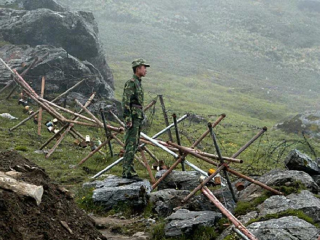 China has illegally occupied parts of Jammu & Kashmir and Ladakh belonging to India !
 Hindus brutally assaulted by Muslims over a trivial dispute
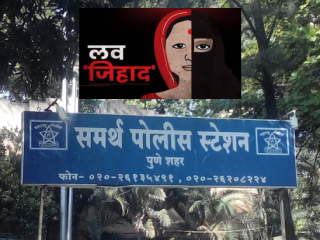 Mental harassment by Sufiyan Khan while attempting to lure a Hindu girl into a love trap !
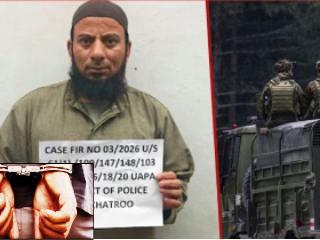 Mohammad Rafiq Naik, who aided Pakistani terrorists, arrested in Kashmir !
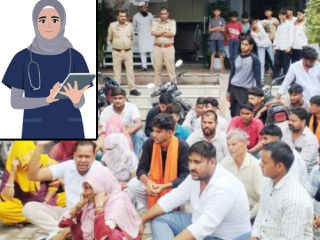 Hindu nurse converted in Amroha by Muslim hospital owner using fake identity
 Leaders who drove me out of Bengal are now also portraying me as a supporter of BJP and RSS !