
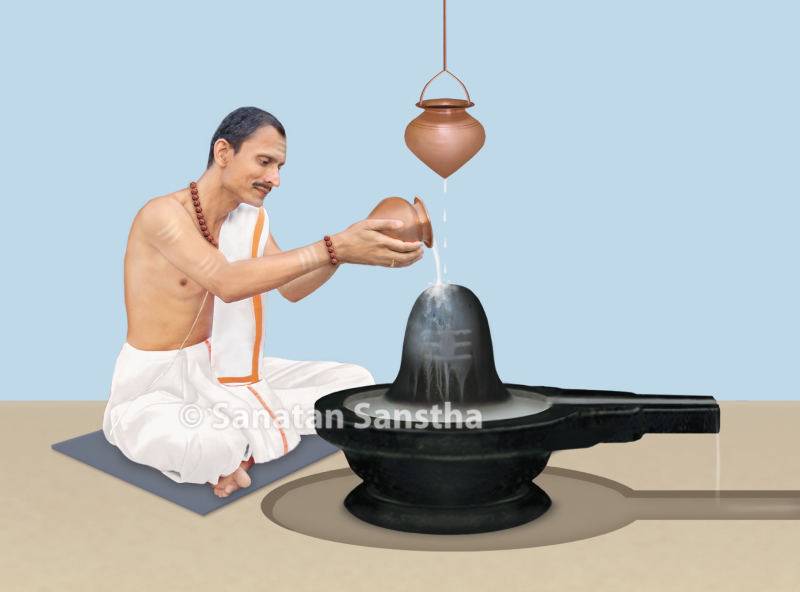
On this occasion, devotees of Deity Shiva perform Abhishek (Consecration by ritualistic bathing with water, milk, etc.) on the Shivapindi, because milk has a greater ability to attract Deity Shiva’s Principle. Through Abhishek with milk, Deity Shiva’s Principle is awakened faster. Thereafter, when this milk is consumed as Tirtha (Sacred liquid), one obtains a greater benefit of the Shiva Principle.
The science underlying Chaitanya in the Shivalinga
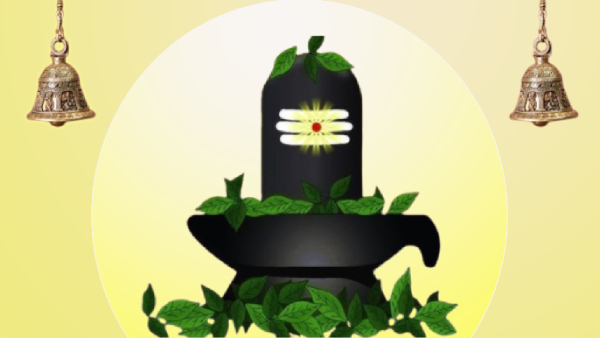
In Sacred Texts such as the Shiva Puran, Mahashiva Puran, there are references to the Shivalinga (Deity Shiva’s sacred symbol) and the Shaligram (Stone emblem of Shri Vishnu). The Shiva Puran describes 164 types of Shivalingas, Shaligrams, and Banalingas (A naturally oval, smooth stone found in the Narmada River and revered as a swayambhu [Self-manifested] linga).
The Shivalinga is a yantra. If different colours are to be manifested in it, specific mantras must be chanted. A mantra is a form of Shakti (Divine Energy). Every word, every syllable, its pronunciation, and the number of repetitions have the power to generate Shakti. It has been established that when mantras are chanted methodically, specific Shaktis and vibrations are generated, and the expected effects are observed. Such is the greatness of the Shivalinga.
Even today, there are such Shivalingas at 142 places. At Konark, the Shivalinga in the Mahadev Temple changes colour every three months. Some Shivalingas not only change colour but also emit substances such as milk, water, honey, gold, silver, and mercury. (Spiritual experiences are according to the Principle – ‘Where there is bhav, there is God’. It is not that everyone will have similar experiences.)
(Courtesy : ‘Purusharth’; February 2007)
Offer white flowers to Deity Shiva
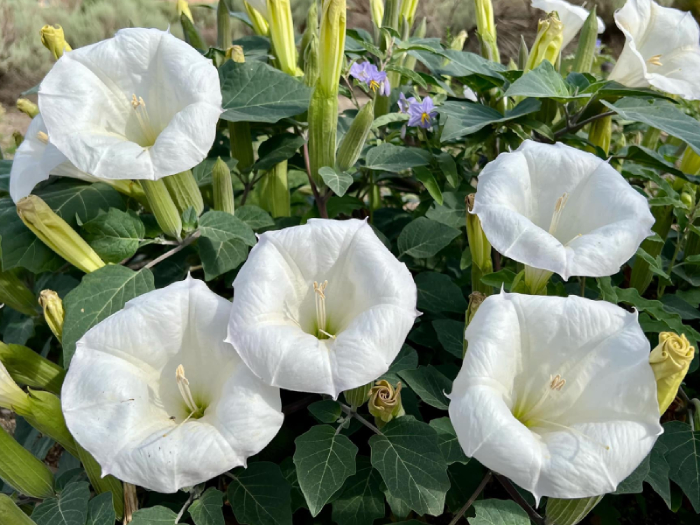
Specific flowers have higher ability to attract the Principle of specific Deities, when compared with that of other flowers. Deity Shiva should be offered dhatura (Mexican poppy – photo above), shweta kamal (White lotus), shweta kanher (White oleander), chameli (Jasmine), mandar (Coral), nagachampa (Mesua ferrea), punnaga (Calopbyllum inophyllum), nagakeshar (Mesua ferrea), nishigandha (Tuberose), jai (Common jasmine), jui (Eared jasmine), mogra (Daisy) and other white flowers. (Kevada [Screwpine flower] is prohibited for Shiva; hence, it should not be offered, except on the day of Mahashivaratra.) The fragrance of these flowers attracts the Shiva Principle to the Shivapindi to a higher extent and consequently, we benefit more.
Incense sticks to attract Deity Shiva’s tarak and marak Principles
While worshipping Deity Shiva, to attract His tarak (Saviour) Principle to a higher extent, incense-sticks that have the fragrance of kewada or jasmine should be used. To attract Deity Shiva’s marak (Destroyer) Principle to a higher extent, light incense-sticks of heena (Henna) or darbar (A complex blend of herbs) fragrance.
Offering bel leaves to Deity Shiva

Certain objects have higher ability to attract the pavitraks (Subtlemost particles containing Divine consciousness) of specific Deities. If such objects are offered to a Deity, the Principle of the Deity is attracted to the Idol and we benefit from the Principle faster. Hence, offer bel leaves to Deity Shiva.
Importance of Shrungadarshan
|
|
|

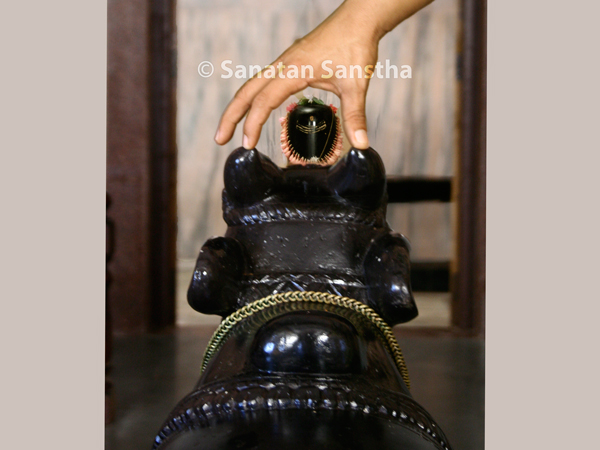
As per the Holy Text Shri Gurucharitra, we should sit or stand on the right side of Nandi and place our left hand on His testicles. This denotes learning how to control our sexual urge. Place the forefinger and thumb of the right hand on His horns. The horns symbolize ego, masculinity and anger; touching them denotes that we should control these traits. Due to this mudra, the devotee gets greater benefit at the spiritual level since the flow of Shakti (Divine Energy) emanating from the Shivapindi gets activated to a higher extent and it spreads throughout the body.
Spiritual science underlying circumambulation of the shivapindi
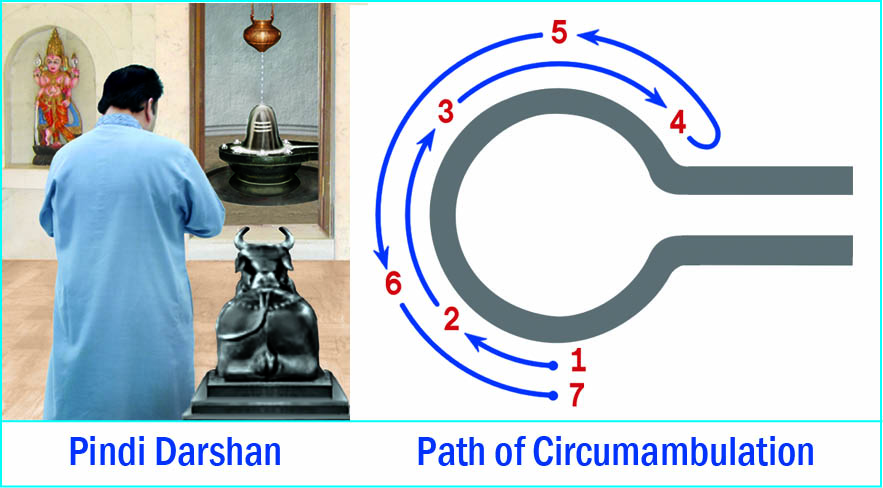
Circumambulation of the Shivapindi is like the crescent, meaning, somasutri. The channel which runs northwards towards the som (Moon) from the shalunka till the boundary of a Shiva temple is known as the somasutra. We should begin circumambulating from the left side and continue till the channel of the shalunka from where the water offered during the Abhishek flows. Without crossing it, we should complete a circumambulation, by moving in the reverse direction up to the other side of the channel (also known as the strota). This rule applies only if the Shivapindi has been installed or created by man; it does not apply to a swayambhu or a chalalinga (Placed in the house). The flow of a shalunka is not crossed, since it is the flow of Shakti. When we cross it, the legs are spread. As a result, formation of semen and the five vayus (Internal vital energies) are adversely affected. Flow of Devdatta and Dhananjaya vital energies is obstructed too. However, it does not have any effect if while crossing it the body is contracted, that is, the nadis (Channels) are contracted.
(Reference : Sanatan’s Text – ‘Science underlying the worship of Deity Shiva’)
The glory of the Shivalinga
There is only one God in this world who has truly continued to reside on the Earth, because the Earth itself is the abode of Mother Durga. Out of love for His consort (Deity Durga), Deity Shiva resides on the Earth. Mahadev (Deity Shiva) is worshipped on Earth in the form of the Shivalinga because He was once cursed to take this form. The consequence of that curse is Mahadev’s Shivalinga, also known as the Pindi. The Shivalinga symbolises Mahadev’s (Deity Shiva’s) linga (Sacred symbol) and the yoni (Birth passage). From this Shivalinga, Creation continuously emerges. To worship the Shivalinga is to worship Nature as well as the Divine. Through this, human welfare is attained.
(Courtesy : Swami Sanket)
Shiva – A Deity worshipped by Deities and demons
Subordinate Deities, Inferior Deities, some Deities of the celestial realms, and even Shri Vishnu Himself worship Deity Shiva. (Likewise, Deity Shiva worships Shri Vishnu.) Not only Deities but demons too worship Deity Shiva and this is a unique aspect of Deity Shiva. Demons such as Banasur and Ravan did not perform penance to appease Shri Vishnu, nor did Shri Vishnu grant boons to any demon; however, they worshipped Deity Shiva, who granted them boons. As a result, He Himself and other Deities were often troubled by them. Each time, Shri Vishnu found a way to resolve the situation.
Worship of Deity Shiva’s tarak and marak forms

Celebrate the festival of Mahashivratra blissfully. Regularly worship Deity Shiva. Offer milk on the Shivapindi (Deity Shiva’s sacred symbol) and donate to Goshalas (Protective shelters for cows). Protect and nurture cows. Firmly refute people who object to these religious acts. Such resistance by itself is the worship of Deity Shiva’s marak (Destroyer) form in the present times. Along with the tarak (Saviour) worship of the blessing-bestowing Deity Shiva, let us also perform His marak worship and strive to please Him.
– Sadguru Nilesh Singbal (Dharmapracharak, Hindu Janajagruti Samiti)
Radiant Hindu kings who were ardent devotees of Deity Shiva
The 200-year-long Gupta Empire, which was the golden age of Sanatan Hindu culture; Chandragupta, whose empire stretched from Gandhar to the ocean; the invincible Samudragupta, whose dominion extended to the four seas; Vikramaditya, who was able enough to have the ‘Navaratnas’ in his court; Pushyamitra, who performed the Ashwamedha Yajna; and Satyashraya Pulakeshi – all these mighty rulers were ardent devotees of Shiva in the form of the unmanifest Rudra embodied as the Shivalinga. – Gurudev (Dr) Kateswamiji
With the tarak worship of the blessing-bestowing Deity Shiva, let us also perform His marak worship and strive to please Him !
 Radiant Thoughts of Sachchidananda Parabrahman (Dr) Jayant Athavale
 We pay our obeisance a million times on the Birthday (as per Tithi) of
 Major win for Hindu unity : Maharashtra Government suspends the controversial ‘Devasthan Inam Abolition Draft Act’
 Mumbai-based advocate Siddhavidya, who is trying to stop trafficking through surrogacy (artificial pregnancy) and animals, and animal killing
 Construction of Sanatan Dharma Complex halted due to threats in Bangladesh
 Cuba 2026 : Why Havana Suddenly Matters Again