
|
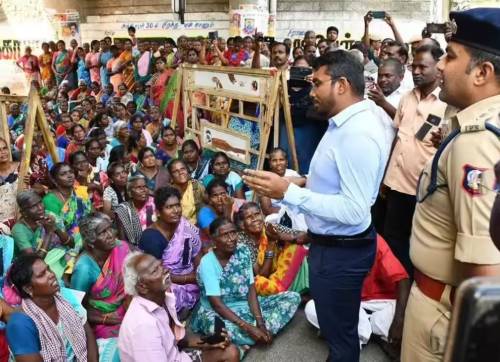
Dindigul (TN) – In Panchampatti village of Dindigul, Hindus had organised a food donation event (annadanam) on government land to mark a temple’s kumbhabhishekam (consecration ceremony). However, local Christians protested against it, leading to tensions. Following this, Hindus approached the Madras High Court, which later granted permission to conduct the event on that land.
About 500 Christians staged a road blockade protest against the food donation on 2nd November. From morning onwards, Christian men and women gathered near the District Collector’s office, shouting slogans and announcing that they would return their Aadhaar and voter ID cards. They blocked the main road, prompting the deployment of over 100 Police personnel due to the tense situation. District Collector S. Saravanan and Superintendent of Police A. Pradeep held talks with the protesters, after which the crowd dispersed and withdrew the protest.
Denying a community access to government land based on religion violates the Constitution: Madras High Court
Justice G.R. Swaminathan of the Madurai Bench of the Madras High Court first asked, ‘Who owns this land ?’ When told that it was government land, the judge issued a clear directive, ‘If the land belongs to the government, then it must be accessible to people of all religions. Public land should either belong to everyone or to no one. Denying a community access to such land based on religion violates Article 15 of the Indian Constitution. Moreover, under Article 25, citizens have the right to practice and perform their religious activities.
Protecting people’s rights is the duty of the Police
The Court rejected the Police’s argument that ‘law and order may be disturbed’, asserting that the Police’s duty is to protect citizens’ rights, not restrict them. Justice Swaminathan noted that the village has approximately 2,500 Christians and 400 Hindu families, and that claiming law and order would be endangered merely because one community opposes another’s event is deeply regrettable.
Christians’ argument
Christian representatives told the Court that they had been celebrating Easter on that ground for over 100 years and that a stage had been built there for the festival, making the site traditionally theirs. They cited a 2017 peace committee meeting, which reportedly decided that no new events would be allowed on the ground. They also demanded that the ground be officially named ‘Pascha Ground’ (Easter Ground).
However, Justice Swaminathan rejected this argument, stating, ‘If the ground can be used by Christians during Easter, then Hindus cannot be prevented from using it for food donation on other days. However, on Easter Day itself, the ground shall be reserved for the Christian community.
Background of the dispute
In Panchampatti, Hindus had planned to hold a community meal (annadanam) on government land located between a temple and a nearby church after the temple’s consecration.
When they sought permission, local authorities and the Police denied it, citing potential law and order issues.
One villager challenged this as unjust, taking the matter to Court. The case eventually reached the Madurai Bench of the Madras High Court, where the Police argued that the denial was to ‘avoid possible tension’.
Editorial Perspectives
|
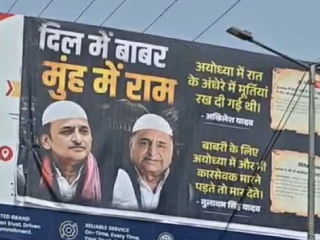 Statement by Samajwadi Party leaders expressing anger over a poster displayed in Mathura (UP) reading, “Babar in the heart, Ram on the lips”
 Mountains of garbage pile up on Mumbai’s Juhu Beach !
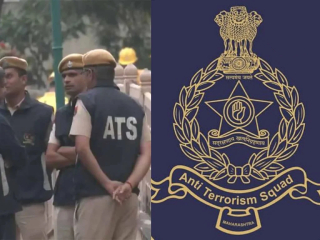 Anti-Terrorism Squad conducts raids at more than 23 locations in Pune and Pimpri-Chinchwad !
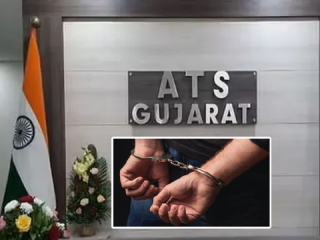 Five terrorists arrested in Gujarat ahead of Bhagwan Jagannath’s Rath Yatra
 A Jharkhand gram panchayat fines Rs 1 lakh and releases accused who sexually assaulted a 3-year-old
 One arrested in the Badrinath Dham theft case