
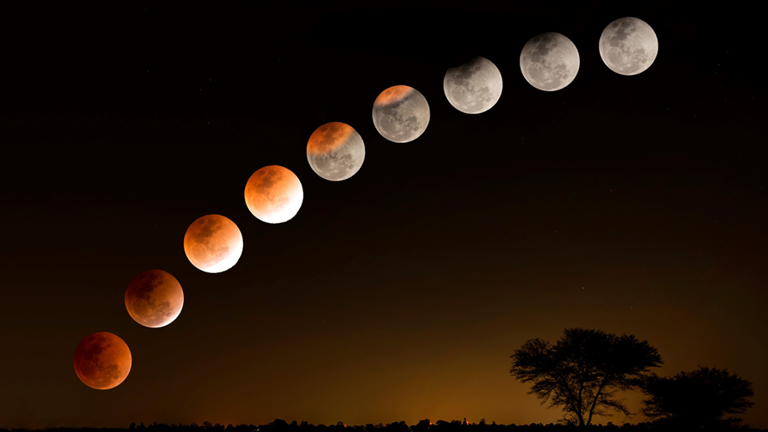
On Sunday, 7.9.2025 (Bhadrapad Purnima), there will be a total lunar eclipse, which will be visible throughout India. A total lunar eclipse takes place when the Earth, Moon, and Sun align in a perfect straight line, causing the Earth’s shadow to completely cover the Moon. As a result, the Moon appears fully darkened. The lunar eclipses always occur on a Purnima (Full moon).
1. Regions where the eclipse will be visible
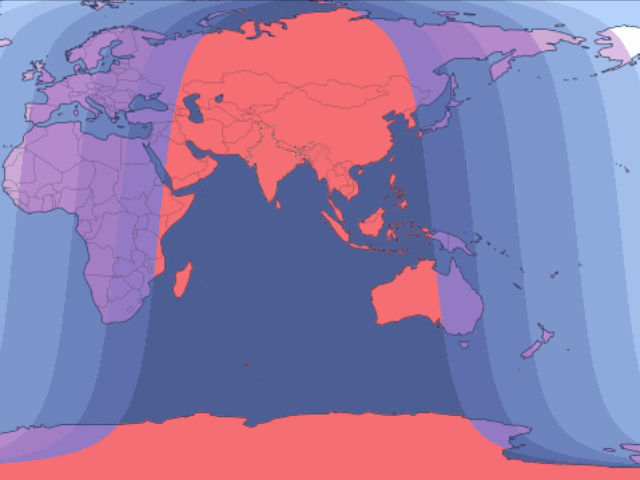
This lunar eclipse will be visible across India, as well as the continents of Asia and Africa, the whole of Europe including Norway, and in regions including Australia, New Zealand and Antarctica. In India, the eclipse will be visible from all locations.
2. Commencement of the Vedha of the eclipse
2A. Meaning : During the lead-up to a total lunar eclipse, the Moon gradually dims as it first enters the Earth’s outer shadow. This phenomenon is referred to as the commencement of the Vedha of the eclipse.
2B. Vedhakal (Period of the Vedha) : Since this eclipse will occur during the second quarter of the night, the Vedhakal should be observed three quarters earlier, starting from 12:37 p.m. and continuing until the Moksha (The conclusion of the eclipse). During this period, activities such as bathing, worship, daily rituals, chanting of mantras, and performing Shraddha (ancestral rites) are permitted.
However, consumption of food is prohibited during the Vedhakal. Essential actions such as drinking water, attending to nature’s calls, and sleeping are allowed during the initial Vedhakal.
Children, the elderly, people who are ill or physically weak, and pregnant women are advised to begin observing the Vedhakal from 5:15 p.m. on Sunday.
During the Parvakal (Duration of the eclipse) – from 9:57 p.m. to 1:27 a.m. – activities such as drinking water, sleeping, and attending to nature’s calls should be avoided.

3. Phases of the lunar eclipse (as per Indian Standard Time)
3A. Sparsha (First contact) : 9:57 p.m.
3B. Sammilan (Conjunction) : 11:00 p.m.
3C.Madhya (Mid-eclipse) : 11:42 p.m.
3D.Unmilan (Opposition) : 12:23 a.m.
3E.Moksha (The end or the last contact) : 1:27 a.m. (early hours of Sunday, 7.9.2025)
3F. Grahan Parva (Duration of the eclipse) : 3 hours 30 minutes
Note 1 – Parva means an auspicious time. The time from the start to the end of the eclipse is auspicious. The Scriptures say that spiritual benefits are accrued if one remains in communion with God during this auspicious period.
4. General guidelines to be followed during the eclipse
4A. One should bathe at the Sparsha (onset of the eclipse).
4B. One should perform the following activities during the Parvakal : Worship of Deities, Tarpana (Offering water, oblations), Shraddha (Ancestral rites), chanting of mantras, Homa (Yajna or ritual of sacrificial fires), and Daan (Donation).
4C. If the recitation of a mantra had been interrupted earlier for someone for some reason, he can resume(known as Mantra Purashcharana) it during this period since it is believed to yield manifold spiritual benefits.
4D. One should bathe immediately after the Moksha (The end of the eclipse).
4E. During the Parvakal, one should avoid activities such as sleeping, attending to nature’s calls, Abhyanga (Applying oil to the whole body), consuming food, and indulging in sensual pleasures.
4F. If an individual is facing impurity (Sutak, etc.), he remains pure in this context with acts associated with the eclipse, such as bathing and donating during the period of the eclipse
5. Fruit of the lunar eclipse according to the Zodiac signs
5A. Auspicious fruit : Mesh (Aries), Vrushabha (Taurus), Kanya (Virgo), and Dhanu (Sagittarius)
5B. Inauspicious fruit : Karka (Cancer), Vrushchik (Scorpio), Kumbha (Aquarius), and Meen (Pisces)
5C. Mixed fruit : Mithun (Gemini), Simha (Leo),Tula (Libra), and Makar (Capricorn)
People who are in the inauspicious Zodiac signs, and pregnant women should not view this solar??? eclipse. (Reference : Datey Almanac)
6. Prohibited activities during the eclipse
6A. Consumption of food is strictly prohibited during the eclipse period. Cooked food prepared before the onset of the eclipse should not be consumed afterwards, since it is believed that harmful radiation emitted during the eclipse might have been absorbed by the food.
6B. The eclipse period is considered highly conducive for spiritual practice. Instead of sleeping that increases the Tama component, one should engage in spiritual activities to make the most of this auspicious time.
6C. The time should not be wasted in entertainment or indulgence, since this period is precious for seekers in their spiritual practice. Performing spiritual practices such as chanting, meditating, and praying during this period is believed to bring enormous spiritual benefits. Hence, one should wholeheartedly remember his/ her Upasyadevata (Deity of worship) or the Guru (Spiritual master), and engage in chanting during this sacred and auspicious period.
 Iran attacks oil tankers in the Strait of Hormuz; Indian national killed
 If you want to do politics, take off your uniforms and participate in the elections : Maulana Fazlur Rehman
 Temple premises sold to Muslims in an auction in Britain
 The Kashmir issue should be resolved in accordance with the UN resolutions !
 Nepal’s youth take to the streets again: Anger over unemployment !
 “Statues of Chhatrapati Shivaji Maharaj are being installed to target Muslims !” : France 24