

One of the most tragic aspects of modern life is that “science gathers knowledge faster than society gathers wisdom.” This quote by 20th-century American author Prof. Isaac Asimov holds uncannily true today. Artificial Intelligence (AI) has, in a way, made humans dependent to the point of irrationality. It can provide whatever one seeks, instantly. So much so that by the end of 2022, some individuals used ChatGPT to write entire books, which later became bestsellers. During the same period, ChatGPT managed to pass the USMLE (United States Medical Licensing Examination) with 60% marks — an exam mandatory for practicing medicine in the US. That was just two and a half years ago. Since then, AI has progressed tremendously.
Recently, Justice Rajesh Bindal of the Supreme Court noted that young advocates are using AI tools like ChatGPT to search past court verdicts and present them as legal references. He clarified that “many times, that information is incorrect.” A year ago, AI tools like ChatGPT weren’t particularly good at translating content from English to Indian languages. But today, platforms like Gemini and ChatGPT can generate spontaneous translations with 85–90% accuracy. Hence, it’s fair to suggest that soon even AI-assisted legal work will also become much accurate. The irony, however, is that these very jobs — like translation — will be among the first to be impacted heavily by AI.
Microsoft has already warned about 40 job categories that are at high risk due to AI, and translators top the list. Alongside them are historians, political scientists, mathematicians, writers across disciplines, editors, journalists, media critics, data scientists, web developers, and teachers in business and economic fields. These roles are being taken over by AI tools with increasing ease.
The Limits of AI Today
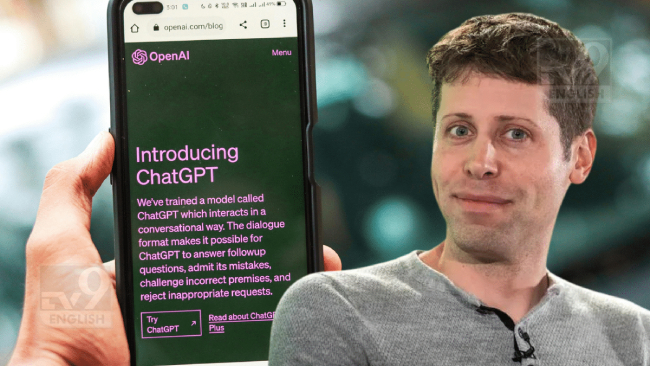
Sam Altman, CEO of OpenAI — the creator of ChatGPT — has warned users not to overly rely on ChatGPT, as it “can also provide inaccurate or misleading information.” His statement reflects the current limitations of AI’s capabilities. However, generative AI is evolving at lightning speed. Today, it can effortlessly produce articles, editorials, books, translations, videos, and images. Though it still has limitations in creating high-quality accurate video and image content, its trajectory suggests that those boundaries may soon be crossed as well.
The World Will Be Disrupted

Just as Microsoft highlighted 40 professions at risk, it also released a list of 40 relatively “safe” jobs — mainly in sectors like construction, domestic labor, truck driving, firefighting, road repair, and maintenance work. This raises the question: will we now see salaries for white-collar (first-class) jobs plummet while blue-collar (fourth-class) workers command sky-high salaries? That may seem far-fetched for now. But Jez Corden, executive editor of Windows Central, believes that humanoid robots performing physical labor cannot be ruled out.
 In short, the coming decade may bring unprecedented changes to daily life. In March 2025, Microsoft founder Bill Gates also expressed concern that society may shift from a five-day workweek to just three days. Elon Musk, founder of Tesla, has expressed fears that AI will dominate to the extent that human labor will become merely a hobby — making people emotionally dissatisfied. As we stand on this brink, it is apt to recall the Second Industrial Revolution of the 19th century in Europe and America. Beginning in 1870, it reshaped job structures, rendered many roles obsolete — but ultimately led to immense material progress for humanity.
Today, we are at the cusp of the Fourth Industrial Revolution — one far more distinctive than the previous three. It will profoundly impact global governance, economies, and industries. We can only hope, as in previous revolutions, that “good emerges from the bad.”
A Critical Dimension We Mustn’t Overlook
While AI is all the rage across the globe, we must not ignore that the infrastructure it draws information from is largely controlled by communists. This is especially relevant for Sanatan Prabhat and other pro-Hindu voices. The data AI tools feed on is sourced primarily from the internet — much of which has been written following the narratives of communist ideologues.
Take Wikipedia, for instance. It perpetuates:
- The glorification of the Aryan Invasion Theory,
- The deliberate downgrading of the Vedas to around 1500 BCE,
- The shifting of Adi Shankaracharya’s timeline from 500 BCE to 800 CE,
- The attempt to separate the Harappa–Mohenjo-daro civilization from Hindu roots,
- The misleading conflation of the Sarasvati River with the Indus, or its denial altogether by referring to as merely an Aryan deity,
- The mythologization of the Ramayana and Mahabharata,
- And the suppression of the Out-of-India theory, among others.
For nearly two centuries, communist literature has distorted Indian history, Hindu Dharma, and its philosophy. Naturally, AI, relying on such sources, reflects the same prejudices.
For the communists and the literature they authored, neutral Western scholars like John Playfair and Arthur Macdonell were considered unscientific, whereas fanatical scholars like John Bentley were deemed the true authorities.
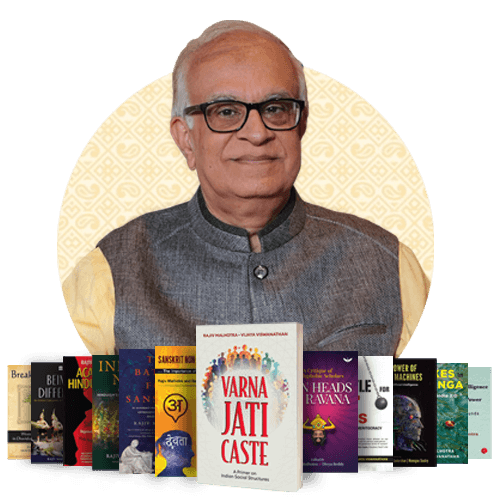
For these reasons, renowned American-based think tank Infinity Foundation — led by Rajiv Malhotra — is developing a chatbot called “Ask Rajiv” to provide accurate, dharmic information about Sanatan Dharma. The tool aims to counter misinformation propagated by mainstream media. Similarly, staunch Hindutva thinker Sanjeev Newar recently challenged Grok (X’s AI tool) so thoroughly with logic and knowledge that it was forced to acknowledge the supremacy of the Vedas. Famous historian Neeraj Atri has uncovered the sinister agenda perpetrated by the leftists to colonize the Indian minds and to spread false propaganda about Hindu Dharma outside India.
Today, as institutions and media networks begin to fear AI making their websites obsolete, such initiatives may provide Hindus with a much-needed sanctuary. Otherwise, today it’s the communists and Islamists, and tomorrow, it could be AI itself that erases us.
The Final Warning
In the midst of all this chaos, one is reminded of a statement made by General Omar N. Bradley, commander of the U.S. Army during World War II:
“If we continue to develop our technology without wisdom or prudence, our servant may prove to be our executioner.”
Now, more than ever, this warning rings true. And it is Hindus who bear the greatest responsibility to ensure that AI does not become that harbinger of doom.
THE BOTTOMLINE : AI has brought humanity to a precipice — without wisdom and discernment, destruction is inevitable.
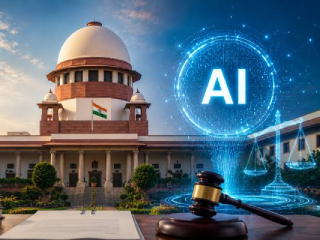 AI must be used in legal matters only under human supervision !
 Indian and Chinese armies hold more than 1,100 ground-level interactions every year !
 Apple’s Siri does not respond to ‘Jai Shri Ram’, but responds to ‘Salaam Alaikum’
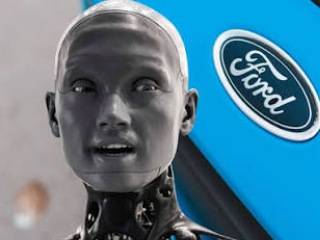 Realising the limitations of AI, Ford rehires hundreds of engineers
 Build a museum of invaders like Babur, Akbar, Humayun etc. to showcase their cruelty : Sangeet Som, Former BJP MLA
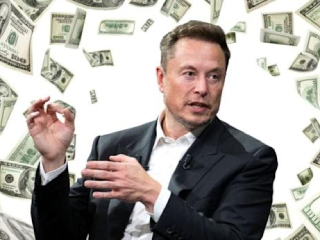 Elon Musk Becomes the First Trillionaire in the World!