

Tithi of Janmashtami
According to the Hindu lunar calendar, Shrikrushna was born on Shravan Krushna Ashtami (Eighth day of the dark fortnight in the month of Shravan) at midnight, when the moon was in Vrushabha formation with the lunar asterism, Rohini. Five thousand years ago, He incarnated at the end of the third cosmic era ‘Dwaparyug’ and the beginning of the present era, ‘Kaliyug’.
Importance of Janmashtami
Janmashtami is especially significant from the perspective of establishing Dharma (Righteousness), and surrendering unto Shrikrushna. Since we are imprisoned in Maya (Great Illusion), Shrikrushna incarnates in this prison with us, establishes Dharma and rescues us from Maya. We can overcome and go beyond Maya only if we surrender unto Shrikrushna, as Arjun did during the battle of Mahabharat.
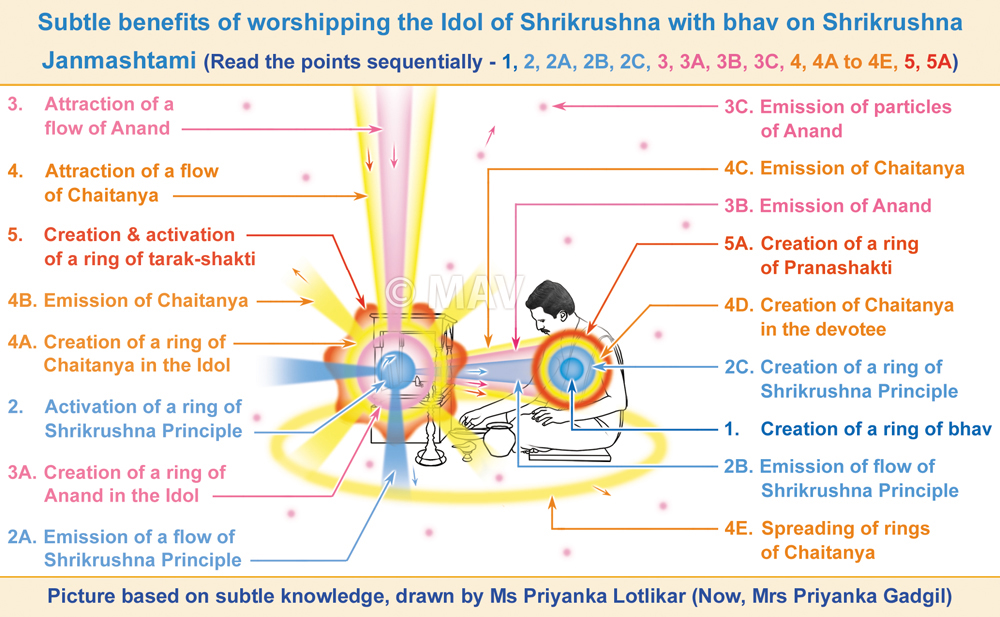
On Janmashtami, Shrikrushna’s Principle is thousand times more active when compared with other days. Chanting ll Om Namo Bhagawate Vasudevaya ll and worshipping Shrikrushna with bhav (Spiritual emotion) helps obtain maximum benefit of His Principle. Chanting His Name invokes His presence within oneself, since God and His Name are one. All the qualities in Shrikrushna are there in His Name. Thus, repeating His Name will surely herald His presence and blessings in life.
Janmashtami Celebration
At midnight, the ritual of waving lit lamps is performed. Janmashtami is especially significant from the viewpoint of establishing Dharma (Righteousness), and surrendering unto Shrikrushna.
Fasting the whole day through, the birth of infant Krushna is celebrated at midnight on Janmashtami. At midnight, Arati (Ritual of waving lit lamps) is performed.
His Idol is placed on a swing with devotion, and it is offered many sumptuous dishes. The Vrat is also ended by partaking this Prasad (Holy sacrament) at midnight or by partaking dahikala (A preparation from curds) the next morning of Janmashtami.
Temples are decorated for the occasion. Kirtans are sung, bells are rung, conches are blown, and Sanskrit verses are recited in praise of Shrikrushna. At Mathura, special spiritual gatherings are organised. Pilgrims from all over India attend these spiritual gatherings.
Dahikala
Kala is a mixture of various eatables, curds, milk and butter. When grazing cattle with the cowherds in Vraj, Shrikrushna mixed the food brought by His companions with His own to make a kala, and ate it with them. In keeping with this event, later it became customary to prepare kala and break a hanging pot of curds on the day after Janmashtami.
Shrikrushna and Dharma are synonymous
Where there is Shrikrushna, there is Dharma; where there is Dharma, there is victory. Since Duryodhan did not observe Dharma, he did not have Shrikrushna with him. No Shrikrushna, no victory. – Sage Ved Vyas
(Ref.: Sanatan’s Text – ‘Spiritual benefits of Religious festivals and Vowed observances’)
| We can overcome and go beyond Maya only if we surrender unto Shrikrushna, as Arjun did during the battle of Mahabharat ! |
| Note : ‘Subtle’ is that which is beyond the comprehension of the five sense organs, mind and intellect. People who have progressed spiritually can perceive the subtle vibrations. Various Scriptures contain reference to subtle knowledge. |
 Radiant Thoughts of Sachchidananda Parabrahman (Dr) Jayant Athavale
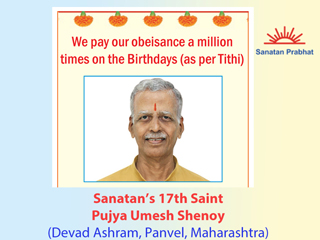 We pay our obeisance a million times on the Birthday (as per Tithi) of
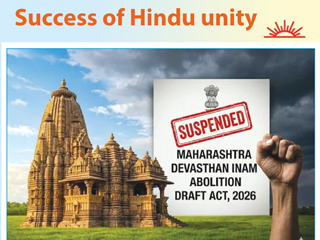 Major win for Hindu unity : Maharashtra Government suspends the controversial ‘Devasthan Inam Abolition Draft Act’
 Mumbai-based advocate Siddhavidya, who is trying to stop trafficking through surrogacy (artificial pregnancy) and animals, and animal killing
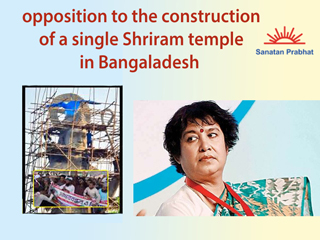 Construction of Sanatan Dharma Complex halted due to threats in Bangladesh
 Cuba 2026 : Why Havana Suddenly Matters Again