


The sacrifice of the soldiers and generals for the Hindavi Swarajya as envisaged by Chhatrapati Shivaji Maharaj is supreme. Similarly, in the present times, many devout Hindus and patriotic citizens of this country have been striving to protect the Nation & Dharma. The ‘Warriors of Hindutva’ is a series of articles that sheds light on their life and their struggle to protect Hindu Dharma. We hope that it serves as a catalyst for the mission of establishing the ‘Hindu Rashtra’ and inspires many others. – Editor
Dr Anand Ranganathan was born into a family of accomplished scientists, which set the stage for his lifelong pursuit of knowledge and truth. He earned his B.Sc. (Hons) in Chemistry from St. Stephen’s College, Delhi, and then secured the prestigious Nehru Centenary Scholarship to the University of Cambridge in the UK. At Cambridge’s Pembroke College, he obtained a BA (Tripos) in Natural Sciences followed by an MA and a PhD, and postdoc in Biochemistry. This stellar academic background laid a firm foundation for both his scientific career and his later role as a public intellectual.
1. Scientific Career and Achievements
With a freshly minted doctorate, Dr Ranganathan began his career as a post-doctoral fellow at the Department of Biochemistry, Cambridge (1998-1999). Instead of settling abroad, he chose to return to India to contribute to its scientific progress. In 1999, he joined the International Centre for Genetic Engineering and Biotechnology (ICGEB) in New Delhi as a Staff Research Scientist, running his own laboratory for the next 16 years. In 2015, Dr Ranganathan transitioned to academia as an Associate Professor at the Special Centre for Molecular Medicine, Jawaharlal Nehru University (JNU) in New Delhi. By 2019, he became a full Professor at JNU, continuing to mentor students and advance research in infectious disease and biology. Honors such as the Indian National Science Academy’s Young Scientist Medal (2007) and the World Economic Forum’s Young Scientist award (2012) adorn his career.
2. Author and Public Intellectual
Parallel to his scientific journey, Dr Ranganathan nurtured a rich career as an author and columnist, emerging as a bold public intellectual. He has penned five books to date : The Land of the Wilted Rose (2012); For Love and Honour (2015); The Rat Eater (2019, co-authored with journalist Chitra Subramaniam); Soufflé (2023); and Hindus in Hindu Rashtra (2023). As a columnist, his writings began appearing in outlets like Newslaundry, DNA, Firstpost, The News Minute, and later regularly in Swarajya magazine, where he serves as a Consulting Editor. His columns often blend incisive analysis with satire, reflecting what he once described as affiliation to the ‘anti-hypocrisy wing’ of commentators.
Not content with print alone, he also became a familiar face on Indian television. By the late 2010s, he was frequently seen on primetime debate panels across major news channels, where his sharp wit and command of facts set him apart. A profile in Swarajya noted that with his pithy one-liners and sharp interventions, he has become one of the most followed social-media commentators – a testament to how effectively his message resonates in the age of Twitter and TV soundbites. Indeed, his Twitter handle @ARanganathan72, where he unabashedly tweets his mind, has hundreds of thousands of followers and is a source of both information and fiery debate.
3. Fearless Critic of Islamic Extremism
One of the pillars of Dr Ranganathan’s public identity is his fearless critique of Islamic extremism and religious fundamentalism. In an era when many intellectuals shy away from blunt talk on this topic, he has boldly gone where others demur. He has repeatedly argued that so-called Islamic ‘extremists’ are often simply adhering to literal interpretations of fundamentalist doctrine, and he urges society to confront this reality rather than hide behind euphemisms. On TV debates, he does not hesitate to quote chapter and verse – for example, citing Quranic passages used by radicals – to challenge Islamist apologists. His outspokenness has made him a target of ire from fundamentalist quarters, but he remains undeterred.
4. Championing Hindu Rights and Justice
Dr Ranganathan has emerged as one of the most vocal champions of Hindu rights in modern India, earning him the moniker of a ‘Hindutva warrior’ in the eyes of many. What makes this especially striking is that he is an avowed atheist. He does not approach the issue from a standpoint of personal religiosity, but from a deeper commitment to civilizational justice and equality. As one observer noted with some astonishment, the plight of Hindus in India is ‘so abhorrent that even an atheist finds it disturbing’, underscoring that Ranganathan’s fight ‘is not just about religion, but about civilization as a whole’. In other words, for him the question of Hindu rights is fundamentally one of human rights and fairness in a secular republic. His 2023 book Hindus in Hindu Rashtra : Eighth-Class Citizens and Victims of State-Sanctioned Apartheid encapsulates this crusade. In this hard-hitting commentary, Ranganathan lays out how Hindus – despite being the majority – have been systematically denied equal rights and dignity in independent India. “There is no pretence, no political correctness, only unvarnished truth – that the Hindus are living under State-sanctioned Apartheid,” he writes, pulling no punches.
Fierce opinion about atrocities against Hindus in the name of secularism : Through columns, public talks, and fiery TV debates, he has also fought the selective application of laws and norms that, in his view, always demand reform from Hindus but never from minorities. He often gives the example of how progressive courts and activists target Hindu practices (whether it be temple entry rules as in Sabarimala or firecracker bans on Diwali) in the name of reform, yet stay conspicuously quiet about regressive or discriminatory practices in other religions. This, he contends, breeds a justifiable resentment. His mission is not to argue that Hindus should get special treatment, but that they should not be the only community denied basic rights or subjected to constant derision. Despite his intense focus on Hindu issues, Ranganathan’s moral compass is resolutely against bigotry of all kinds. He has repeatedly said that his vision of India is one of true equality – a Nation where secularism is not a code for Hindu suppression. He also frequently reminds people of India’s pluralist ethos and how freedom of belief and expression must extend to all.
In his view, history and contemporary data tell a very different story – one of a majority that has been remarkably tolerant, and minorities that have often enjoyed extra constitutional protections. His clarion call is for Hindus to stand up confidently for their rights, shed any colonial-era guilt, and reject the apartheid of lowered expectations.
5. Media Presence and Bold Oratory
Part of what has made Dr Ranganathan such a folk hero for many is the sheer boldness and clarity of his oratory. Whether it is a university lecture, a book launch, or a shouting match on live TV, he speaks in measured, well-enunciated English, often with a touch of dry humor, and a habit of dropping historical facts or statistics to stump his opponents. In an age of equivocation, his direct style has been described as a ‘breath of fresh air’. On televised panels, one can often see him sitting firm and unflustered while political heavyweights hurl accusations; when his turn comes, he responds with a surgeon’s precision, dissecting arguments and exposing hypocrisy. For instance, in one viral debate clip, Ranganathan responds to criticism of Hindu festival chants by saying : “Let us not guilt-trip Hindus anymore. We are tired of it.” This simple statement, delivered in his calm baritone, struck a chord with viewers who feel Hindus are unfairly maligned in public discourse.
Ranganathan’s media engagements are not limited to defensive debates. He also uses them to articulate an inspirational vision of what India and Hindu civilization stand for. Frequently quoting Swami Vivekananda or Mahatma Gandhi’s more unheralded thoughts, he reminds audiences of the truly secular, inclusive nature of Sanatan Dharma – a faith that, in his words, ‘wears atheism on its sleeve’ and is confident enough to accommodate dissent.
Unsurprisingly, Dr Ranganathan has become a fixture in intellectual circuits that celebrate Indic thought and free speech. He is often on stage at literary festivals, think-tank conferences, and webinars alongside other outspoken intellectuals like J Sai Deepak (the Supreme Court lawyer) and historian Vikram Sampath. In these forums, he deftly bridges topics from molecular biology to medieval history to contemporary politics, embodying a rare interdisciplinary intellect. His scientific training is evident in his emphasis on evidence and data, even when discussing emotive topics like religious riots or court judgments.
This unique combination of traits – a scientist’s mind, a writer’s flair, and a warrior’s spirit – is perhaps what most justifies calling him a ‘modern Hindutva warrior’. Unlike street fighters, his weapons are reason, research, and rhetoric, and he wields them with equal parts of ferocity and finesse.
6. Inspiring Clarity, Courage, and Change
Dr Ranganathan’s journey from the halls of Cambridge and JNU to the noisy newsrooms and TV studios is an inspiring testament to clarity and courage. Count-less young people, who once felt confused or silenced by the dominant narratives, say they found their voice after listening to Ranganathan or reading his works.
By elevating public discourse with a mix of logical argumentation and moral urgency, he has shown that one can be erudite yet accessible, fiery yet principled. It is important to note that Dr Ranganathan’s impact goes beyond any political label. While he is often associated with the ‘Hindutva’ side of debates, he does not spare the failings of any political party or leader. He has criticized the current ruling party when he felt they were not doing enough to uphold the rights of Hindus or were being hypocritical.
Such positions show that his north star is not any party’s agenda but a deeper quest for truth and justice. Over the years, he has earned many epithets – scientist, professor, author, columnist, provocateur, dissenter, patriot. But perhaps the title that suits him best is what this Series calls him : A Hindutva Warrior. Not a warrior who wields weapons or spreads hate, but one who wields words and spreads awareness.
(Ref.: SanatanPrabhat.org/english/)
| A scientist’s mind, a writer’s flair, and a warrior’s spirit – is what justifies calling Dr Ranganathan a ‘modern Hindutva warrior’ ! |
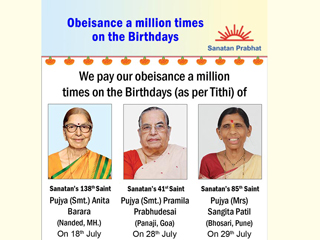 We pay our obeisance a million times on the Birthdays (as per Tithi) of
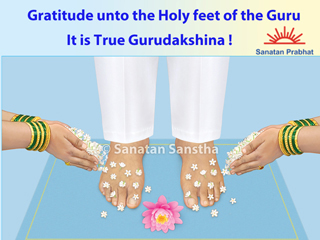 Offering gratitude unto the Holy feet of the Guru is true Gurudakshina !
 Messages of the Gurus on the occasion of Guru Purnima (29th July)
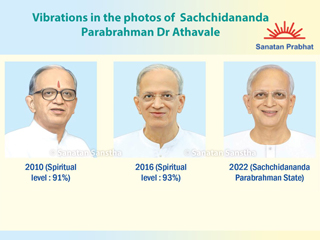 Sadguru (Dr) Mukul Gadgil’s analysis of the vibrations in the photos of Sachchidananda Parabrahman (Dr) Athavale, corresponding to His spiritual level at different times
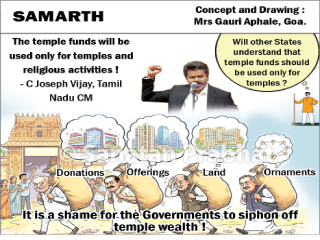 Projects of funding commercial complexes worth Rs 246 crore using temple funds cancelled by Tamil Nadu Government
 Salutations unto the Guru !