
Spiritual changes perceived in the temple after the resolve of the Shriram Temple at Ayodhya was fulfilled
I perceive that the smile on the face of Param Pujya Bhaktaraj Maharaj (Baba) in the temple in my room has increased. His face gives Anand. Param Pujya Ramanand Maharaj’s lips appear to move, and it feels as though He is softly chanting God’s Name. Shriram’s picture placed next to Baba’s also gives great Anand, and I feel that His smile has increased.
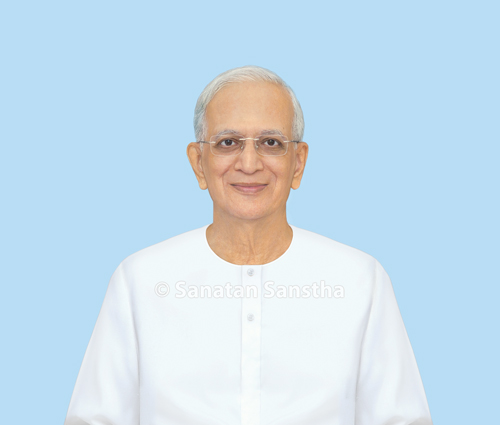
This change is perceived because the resolve of the Shriram Mandir at Ayodhya has been fulfilled. The next goal now is to establish Ram Rajya, and for this I too am praying to Shriram.
– Sachchidananda Parabrahman (Dr) Athavale (27.11.2025)
Shriram’s picture placed in the temple in Sachchidananda Parabrahman (Dr) Athavale’s room (March 2026)
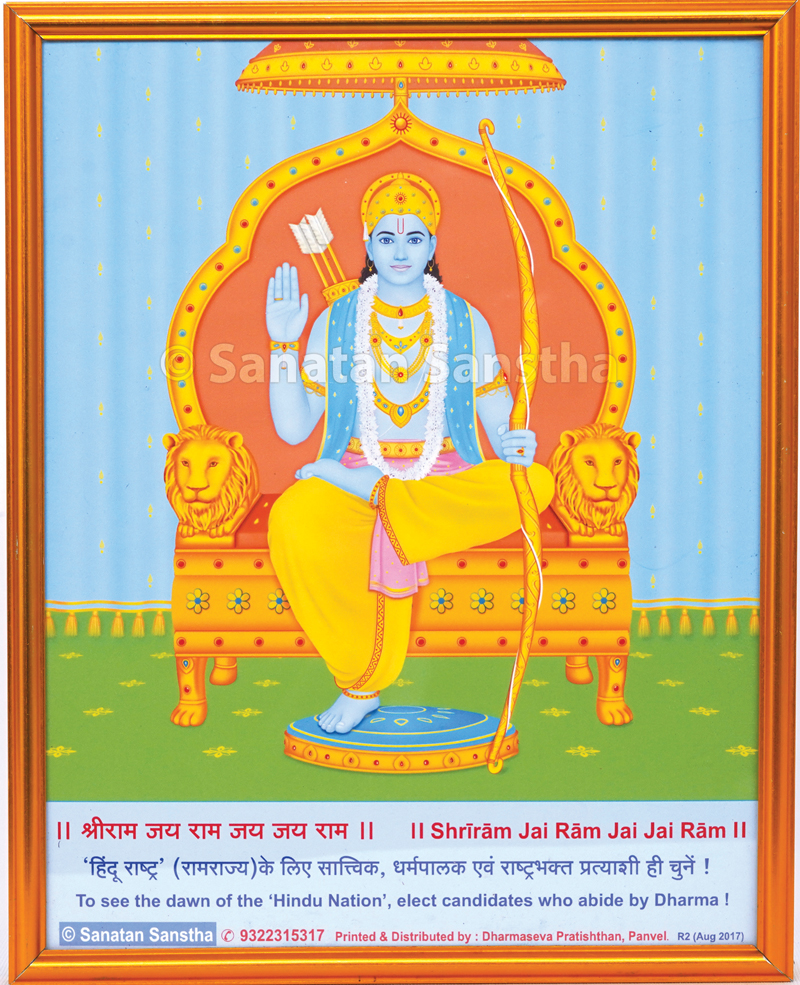
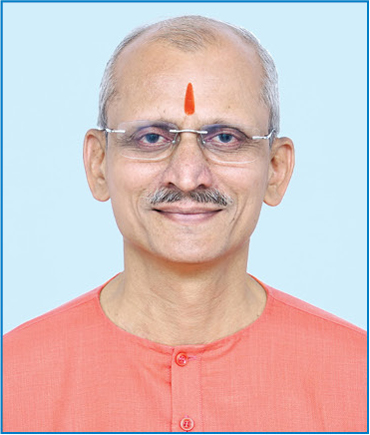
Sachchidananda Parabrahman (Dr) Athavale (Gurudev) is carrying out the great mission of establishing the ‘Hindu Rashtra’ (Ram Rajya). The temple in Gurudev’s room has sattvik (Spiritually pure) pictures of Deities made by Sanatan Sanstha. Every day, He prays with devotion to the Deities in this temple. In the great samashti mission of establishing the ‘Hindu Rashtra’, the Deities assist Gurudev. Owing to Gurudev’s devotion, subtle changes are taking place in their pictures. Changes are also taking place in the proportion of the spiritual experience-related vibrations, sagun (Materialised) / nirgun (Non-materialised) Principle, and tarak (Saviour) / marak (Destroyer) Principle in these pictures.
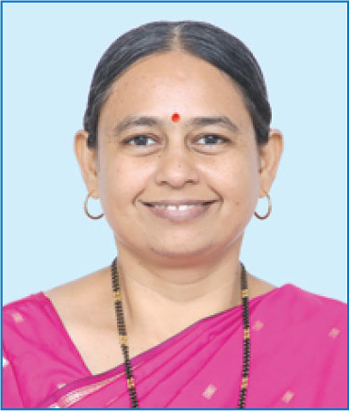
Distinctive changes took place in Shriram’s picture in this temple in March 2026. To study these changes, a pendulum test (Note 1) was conducted on Shriram’s picture that was there in March 2026 and, for comparison, on an earlier picture (placed there in November 2025). The aforesaid spiritual experience-related vibrations, etc. in these pictures were studied by Sadguru (Dr) Mukul Gadgil. His observations and spiritual analysis are given here.
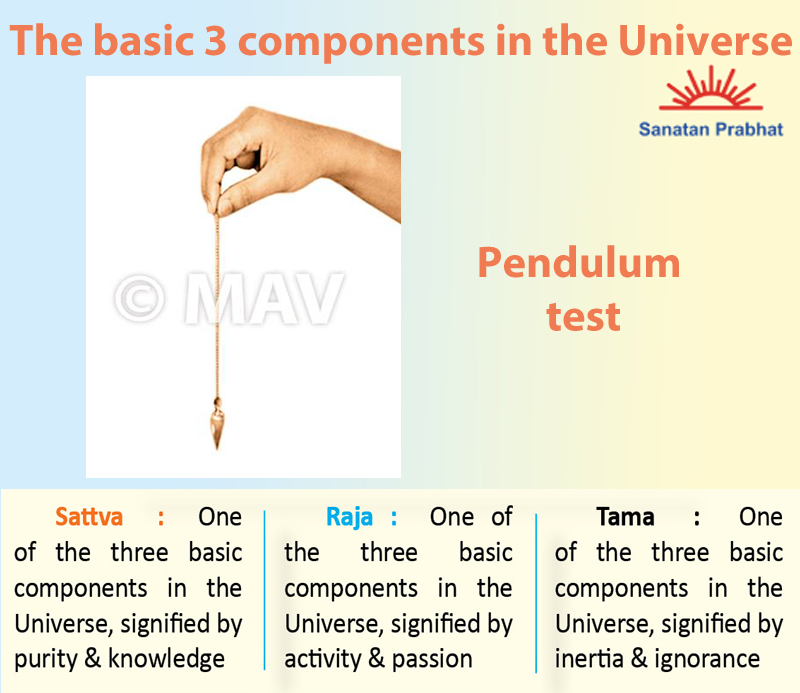
Note 1 – Pendulum test : Through this test, the negative and positive energy in any object, place, or person can be measured. To conduct this test, the object (or its photo), a pendulum, and certain charts are required. The individual conducting the test first prays to the Family Deity or Benevolent Deity thus – ‘May a protective sheath be created around me and around the pendulum’. Thereafter, He asks the pendulum the following questions :
1. Can I conduct a pendulum test ?
2. Is the selected place and time appropriate for conducting the pendulum test ? : Once the pendulum gives an affirmative response to these questions, the individual begins the tests. Holding the pendulum in front of the object or its photo, He asks further questions. Different types of charts are used to obtain their answers, such as charts for ‘Yes’ and ‘No’; charts for ‘metres’ and ‘kilometres’; number charts such as 1 to 10; charts with multiples such as 5, 10, 50, 100, etc. Using these charts, the aura of negative and/or positive energy in any object can be measured. After completing the tests, the individual expresses gratitude to the Benevolent Deity.
Pendulum tests can also provide information on other aspects, such as the proportion of the three basic components (Sattva, Raja, and Tama)*, the type of vibrations (sagun, sagun-nirgun, nirgun-sagun, and nirgun), the proportion of the five Cosmic Principles – (Earth, Water, Fire, Air, and Ether), and the proportion of spiritual experience-related vibrations (Shakti [Divine Energy], bhav [Spiritual emotion], Chaitanya [Divine consciousness], Anand [Bliss], and Shanti [Peace]), etc.
1. Observations regarding Shriram’s picture in the temple in Gurudev’s room & its spiritual analysis
To immediately notice any change in the vibrations of Shriram’s picture, it has been underlined.
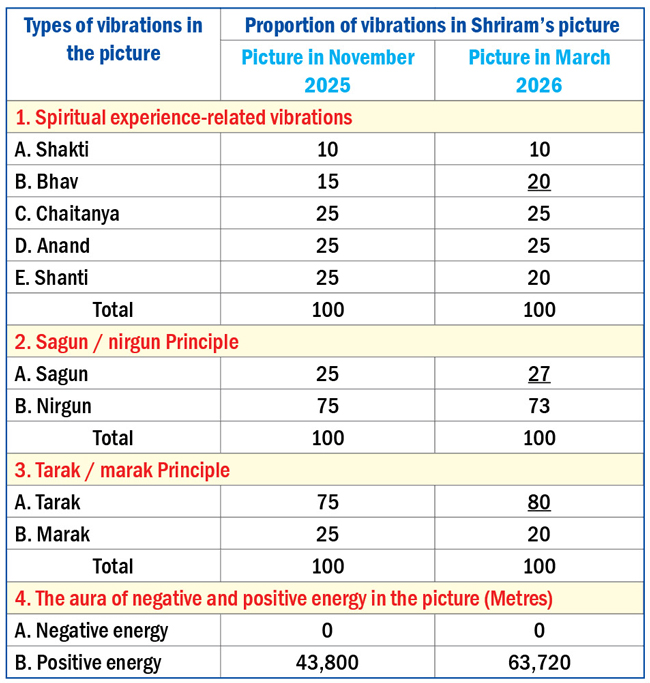
Based on a comparative study, the following changes were observed in March 2026 in Shriram’s picture when compared with that placed in Gurudev’s room in November 2025.
1A. Increase in the vibrations of bhav : In the picture placed there in November 2025, the proportion of bhav vibrations was 15%. In March 2026, this proportion increased to 20%.
1B. Slight increase in the proportion of the sagun Principle : In the picture placed there in November 2025, the sagun Principle was 25%. In March 2026, it is 27%, indicating a slight increase in the sagun Principle.
1C. Increase in the proportion of the tarak Principle : In the picture placed there in November 2025, the tarak Principle was 75%. In March 2026, it increased to 80%. The tarak form of a Deity provides blessings, whereas the marak form functions for protection.
1D. Significant increase in the positive energy : In the picture placed there in November 2025, the aura of positive energy measured 43,800 metres. In March 2026, the aura of positive energy measured 63,720 metres, showing an increase of 19,920 metres.
2. Conclusion
A comparative study of the observations regarding the spiritual experience-related vibrations of spiritual bhav, the sagun / nirgun Principle, and the tarak / marak Principle in Shriram’s picture reveals that the proportion of bhav vibrations, the sagun Principle, and the tarak Principle has increased. As a result, the aura of positive energy in the picture has also increased considerably.
The present period is the time to become active in the mission of establishing the Ram Rajya. Therefore, the sagun vibrations in Shriram’s picture have increased slightly. Furthermore, establishing the Ram Rajya is not possible without the Divine support (of God). This calls for supplementing the efforts with bhav. To enhance bhav in the minds of seekers, Shriram has increased the vibrations of bhav in His picture. His objective is that the seeker’s bhav should awaken on seeing His picture. Shriram has also increased the tarak Principle in His picture to bestow blessings on seekers engaged in the mission of establishing the Ram Rajya.
These distinctive changes in Shriram’s picture indicate that Shriram’s Principle is becoming increasingly active for establishing the Ram Rajya.
– Sadguru (Dr) Mukul Gadgil (Ph.D. in Chemistry, University of Mumbai) and Mrs Madhura Dhananjay Karve, Maharshi Adhyatma Vishwavidyalay, Goa. (21.3.2026)
 I threw ink at urban Naxal Abhijeet Dipke for insulting Shriram
 Denigration of Hindu Deities and Hate Speech at Delhi’s Jantar Mantar
 If Prabhu Shriram married only once, the same can be expected of Rahim !
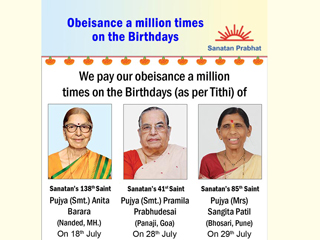 We pay our obeisance a million times on the Birthdays (as per Tithi) of
 Offering gratitude unto the Holy feet of the Guru is true Gurudakshina !
 Messages of the Gurus on the occasion of Guru Purnima (29th July)