
Ms Fatima Thahliya, the first woman MLA of the Indian Union Muslim League in Kerala, lit a traditional oil lamp (Nilavilakku) during an inauguration programme at Perambra. This has created a major controversy there. Her party and other Islamic fundamentalists have criticised her, with some even speaking of excommunicating her from the religion. The Sunni scholars’ organisation, ‘Samastha Kerala Jamiatul Ulema’, has also raised strong objections. Similar controversies have arisen in Kerala in the past. Former Education Minister Abdu Rabb had refused to light a lamp at a Government function. At that time, the well-known actor Mammootty had publicly stated, ‘The lamp is a symbol of knowledge. Therefore, Muslims should not make an issue out of such matters’.
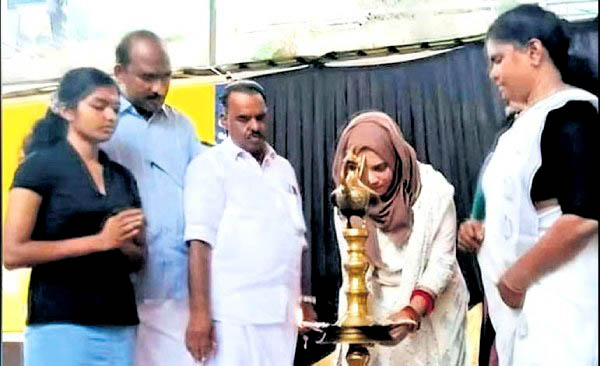
1. The ‘Religion First’ stand of opponents of lamp-lighting
Commencing a programme after lighting a lamp is a part of Indian culture. Salafis, Wahhabis and similar groups strongly oppose the participation of Muslims in this practice. According to them, if there is a belief that lighting a lamp brings good fortune or averts adversity, then it is contrary to Islam. Islam strictly prohibits the imitation of the religious practices of other religions.
The Maulvis and religious leaders who support the Indian Union Muslim League are of the opinion that a religious individual’s religious identity and religious rules are more important than a political office. They also argue that if party leaders openly violate fatwas, the party’s traditional Muslim vote bank may be displeased.
2. The stand of Muslims who say that lamp-lighting should be performed
Some leaders of the Indian Union of Muslim League, who hold modern views are of the opinion that, in a Democracy, it is important to maintain social harmony while representing people of all religions. Lighting a lamp is merely a symbol of knowledge and a cultural ceremony; it does not involve any religious worship. Ms Fatima had once led these young people.
Apart from them, reformist Muslim thinkers such as MN Karassery and secular political and social leaders in Kerala have also supported Ms Fatima. It is noteworthy that three former Presidents of India – Dr APJ Abdul Kalam, Dr Zakir Husain and Fakhruddin Ali Ahmed used to participate in such lamp-lighting.
Dr APJ Abdul Kalam was a student of the Quran as well as the Upanishads. In his view, ‘The flame of the lamp was merely a symbol of knowledge, scientific progress and the destruction of ignorance’.
Dr Zakir Husain believed in India’s ‘Ganga-Jamuni Tehzeeb’ (Composite culture). He held that respecting the diversity of the country does not endanger one’s own religion. Dr Fakhruddin Ali Ahmed regarded this act not as a religious ritual, but as a civic duty in His capacity as the Head of the State.
3. Is a woman, who is a public representative not entitled to freedom of expression ?
Overall, it appears that for organisations such as Samastha, the guiding principle is ‘Islam First’. They are not even prepared to grant the woman in question the freedom of expression. This also makes it clear that Muslims who do not wish to equate their cultural identity solely with their religious identity must themselves preserve their personal freedom.
If Muslims who refrain from lamp-lighting are prioritising religious identity in the name of preserving their personal freedom, then why should young reformist Muslims not use the same freedom to assert their own views firmly ?
– Dr Durgesh Samant
(To read complete Article, please visit : Sanatan.org/English)
 ‘I am a Muslim, but I will not implement Sharia law in the country !’ : President of Burkina Faso
 Tamil Nadu:Devout Hindus condemn Muslim organisations for supporting cow slaughter
 Serious allegations by Aamir Khan’s ex-sister-in-law against his stepbrother !
 Actor Aamir Khan receives death threat from Lawrence Bishnoi gang over ‘Love Jihad’
 I had never met Mr Sonam Wangchuk before 3 Idiots ! – Aamir Khan
 Hindi and Urdu are indigenous Indian languages, while Sanskrut is a foreign language : Cong. MP Mohammad Javed