
Case regarding women’s entry into the Sabarimala temple
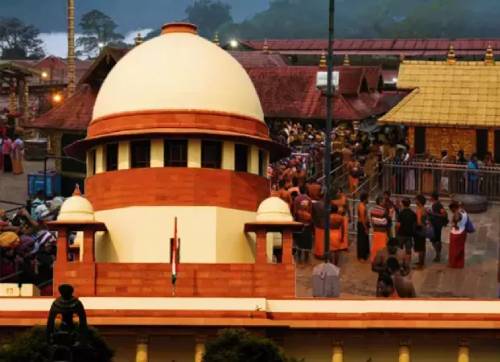
New Delhi – The Supreme Court of India observed that Hindu society must come together in unity rather than dividing itself along sectarian lines. “You cannot say, ‘We belong to one sect and they to another.’ If Hindu sects do not open their doors to others, they will ultimately suffer,” the Court remarked during the hearing of the Sabarimala temple entry case. The Court noted that Article 25(2)(b) of the Constitution was added in the 1950s to address social evils such as exclusion and discrimination. This provision empowers the State to enact laws for social welfare and reform.
The Court further stated that, within Hinduism, discrimination in temple worship practices based on sect should not exist. The idea that “we belong to one sect and they belong to another, therefore they cannot enter our temple, or we cannot enter theirs” is not consistent with the fundamental concept of Hindu society. If a Hindu sect refuses to open its temples to others, it may ultimately harm itself. Hence, broader unity and mutual acceptance are essential.
Difficult for courts to decide religious traditions
The Supreme Court also remarked that it is extremely difficult for judicial bodies to determine whether any religious tradition is “essential” or “non-essential.” Setting such criteria is nearly impossible. Not all practices followed within a Hindu sect can be considered essential—especially when they impact morality, public order, or health. The Court added that it is difficult to lay down universal guidelines on when the State can intervene in religious traditions in the name of social reform. Such decisions must depend on the specific facts of each case.
Appearing for one of the parties, senior advocate Rakesh Dwivedi stated that religious freedom also includes the right of believers to decide for themselves how and when to worship. These matters, he argued, should be determined by the devotees themselves.
 Villagers march to Kagal (Kolhapur district) Police Station in the ‘Love Jihad’ case and demand that the Hindu young woman be handed over to her parents !
 The Temple has fixed deposits worth ₹472 crore and gold and silver worth ₹300 crore !
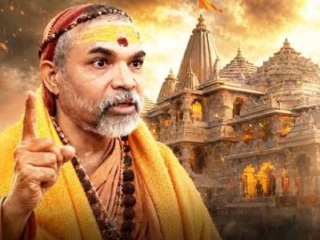 The Shri Ram Temple is an office of the BJP and the RSS; I will go for darshan when it truly becomes a Shri Ram Temple ! : Jyotish Peeth Shankaracharya Swami Avimukteshwaranand Saraswati
 Actor Aamir Khan is the ‘brand ambassador’ of ‘Love Jihad’; Boycott his films ! : Minister Nitesh Rane
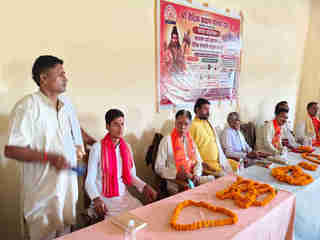 Jaunpur Hosts Seminar on Sanatan Dharma Awakening and Preservation of Vedic Culture
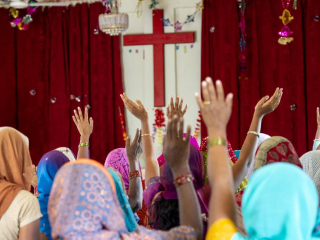 Case registered against husband and wife for propagating Christianity at Sassoon General Hospital, Pune