
Issue of a lesson referring to corruption in the judiciary(NCERT – National Council of Educational Research and Training) |
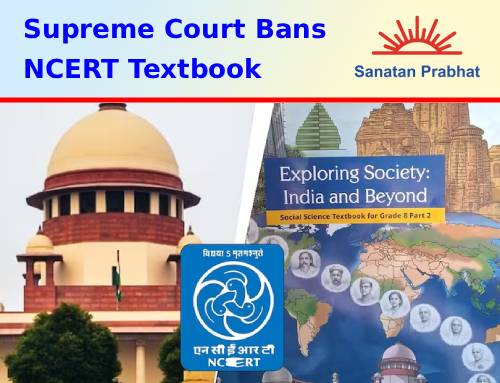
New Delhi – Taking suo motu cognisance of the inclusion of a lesson referring to corruption in the judiciary in the new Class 8 Social Science textbook, the Supreme Court of India has issued notice to the School Education Department, the Secretary, Ministry of Education, and the Director of the National Council of Educational Research and Training (NCERT), calling upon them to explain why proceedings for contempt of court and other action in accordance with law should not be initiated.
The Bench headed by Justice Surya Kant has directed that there shall be a stay on further publication, re-printing and digital circulation of the concerned textbook until further orders. The Court observed that any attempt to distribute the book, in print or digital form, would be viewed seriously and treated as a wilful disobedience of its order.
The Court recorded that if, prima facie, the publication is found to have been made with the intent to scandalise or lower the authority of the judiciary, such conduct may amount to criminal contempt. The matter is listed for further hearing on 11 March 2026.
Supreme Court Bans NCERT Class 8 Book
The Court has imposed a complete ban on further publication, printing, or digital circulation of the NCERT Class 8 book containing a section on “corruption in the judiciary.”
The bench said a deeper probe into the matter is needed.
PC:… https://t.co/UQJ4IP3Q3R pic.twitter.com/bPVQAsA585
— Sanatan Prabhat (@SanatanPrabhat) February 26, 2026
NCERT tenders apology
NCERT has expressed regret before the Court and stated that it has decided to revise the concerned portions of the textbook and keep its distribution in abeyance. A senior official submitted that the Supreme Court is the guardian of the Constitution and protector of fundamental rights.
The Bench observed that it would examine whether the public apology tendered by NCERT is bona fide or merely an attempt to evade possible criminal liability.
Directions to withdraw and secure all copies
The Court has directed that all printed copies of the textbook be withdrawn. NCERT has been instructed, in coordination with the Union Government and the States, to ensure that all copies — whether lying with schools, booksellers or available in digital form — are taken out of circulation forthwith.
The Director of NCERT has been directed to ensure compliance and submit a report. The Court has also directed that no teaching shall be imparted to students based on the impugned chapter.
Principal Secretaries of the Education Departments of all States have been directed to file compliance reports within two weeks. NCERT has further been directed to place on record the names and qualifications of the persons involved in drafting the chapter, as well as the original minutes of the meeting in which the chapter was discussed and finalised.
Serious observations by the Court
The Court observed that the manner in which the number of complaints received against judges was referred to in the chapter created an impression as if no action had been taken on such complaints. It further noted that certain remarks attributed to former Chief Justice Bhushan Gavai were cited out of context, thereby giving an impression that the existence of corruption in the judiciary had been acknowledged in that manner.
The Bench also expressed displeasure over a communication addressed by the NCERT Director to the Secretary General of the Supreme Court seeking to justify the contents of the textbook, observing that the tenor of the letter was inappropriate.
Attempt to undermine institutional authority
Justice Surya Kant observed that the material, on a prima facie reading, appeared to be a calculated attempt to undermine the institutional authority and dignity of the judiciary. The Court cautioned that if such content is permitted to circulate unchecked, it may erode public confidence in the justice delivery system, particularly among impressionable young students.
Not intended to stifle legitimate criticism
At the same time, the Supreme Court clarified that its suo motu action is not intended to stifle fair or legitimate criticism. The Court observed that the chapter did not refer to the judiciary’s historic and commendable interventions in upholding constitutional values and strengthening democratic governance. It reiterated that courts have, on several occasions, taken stringent action against corruption and misuse of public office.
The Court clarified that the present proceedings are confined to examining whether the contents of the textbook cross the line into contempt and are not meant to prevent reasoned academic discussion or lawful criticism of public institutions.
 A Jharkhand gram panchayat fines Rs 1 lakh and releases accused who sexually assaulted a 3-year-old
 One arrested in the Badrinath Dham theft case
 Separate plans for internet data and voice calls to become mandatory
 Bus conductor asks Karnataka minister to get off the bus for not paying exact change
 Muslim couple arrested for holding Hindu woman hostage and converting her at gunpoint
 Christian father of a Police Sub-Inspector who was converting Hindus arrested !